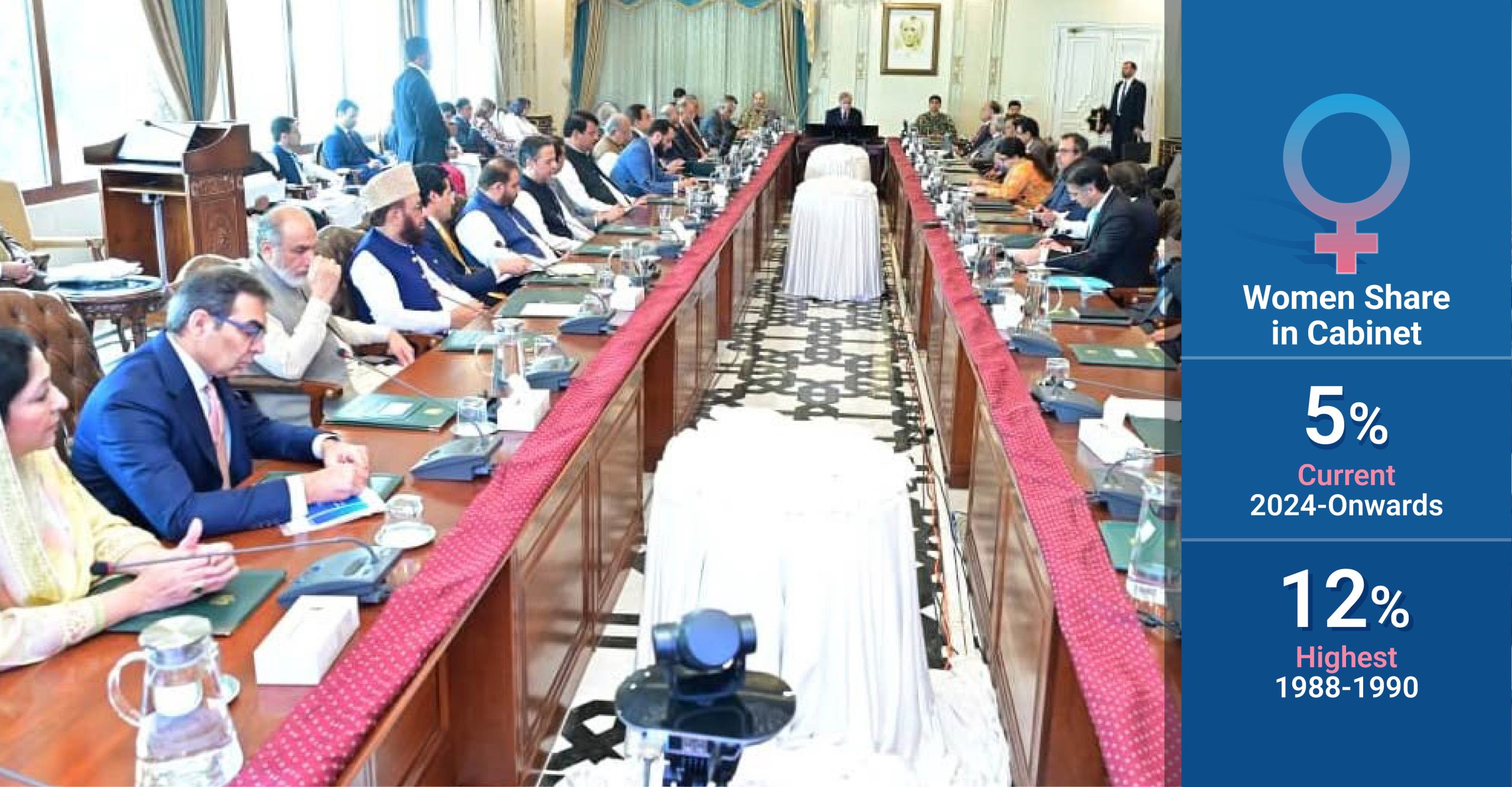
Despite making up 49 percent of Pakistan’s population and holding 18 percent of seats in Parliament, women occupy only a sliver of space in the federal cabinet. The incumbent 55-member cabinet has only three (five percent) women, as per the notification available on the Cabinet Division website.
Historically, women were absent from Pakistan’s federal cabinets until 1978, when Chief Martial Law Administrator General Zia-ul-Haq appointed the first female minister in his second cabinet. Although women’s parliamentary representation improved significantly after 2002, when 17 percent of seats in the national and provincial legislatures were reserved for women, their presence in governments has never exceeded 12 percent—except under caretaker Prime Minister Nasirul Mulk in 2018, whose cabinet included 22 percent women.
Among elected prime ministers, the first cabinet of Benazir Bhutto (1988–1990) had the highest proportion of women i.e. 12 percent. She included six women, including herself, in a 50-member cabinet. In absolute terms, the largest number of women—nine—served in the cabinets of Shaukat Aziz (2004-2007), Yousaf Raza Gillani (2008-2011), and the coalition government led by Shehbaz Sharif (2022-2023).
Women’s representation in government is also one of the indicators measured in the Global Gender Gap Index, where Pakistan ranks lowest (148th) in the 2025 edition.
The following overview shows how women’s presence in the federal cabinets has evolved across different political tenures.
Women representation in PPP cabinets
| Head of Government | Tenure | Women Representation in Cabinet |
|---|---|---|
| Zulfikar Ali Bhutto | 1971–1977 | No woman in cabinet |
| Benazir Bhutto | 1988–1990 | 12 percent |
| Benazir Bhutto | 1993–1996 | Three percent |
| Yousaf Raza Gillani | 2008–2012 | 10 percent |
| Raja Pervez Ashraf | 2012–2013 | Eight percent |
Women representation in PML-N cabinets
| Head of Government | Tenure | Women Representation in Cabinet |
|---|---|---|
| Nawaz Sharif | 1990-1993 | No woman in cabinet |
| Nawaz Sharif | 1997-1999 | Eight percent |
| Nawaz Sharif | 2013-2017 | Five percent |
| Shahid Khaqan Abbasi | 2017-2018 | Nine percent |
| Shehbaz Sharif | 2022–2023 | 10 percent |
| Shehbaz Sharif | 2024-to date | Five percent |
Women representation in PTI cabinet
| Head of Government | Tenure | Women Representation in Cabinet |
|---|---|---|
| Imran Khan | 2018-20222 | Nine percent |
Women representation in caretaker cabinets
| Head of Government | Tenure | Women Representation in Cabinet |
|---|---|---|
| Ghulam Mustafa Jatoi | 1990 | Five percent |
| Balkh Sher Mazari | 1993 | Two percent |
| Moeen Qureshi | 1993 | No woman in cabinet |
| Malik Meraj Khalid | 1996-1997 | Four percent |
| Mian Muhammad Soomro | 2007-2008 | Three Percent |
| Mir Hazar Khan Khoso | 2013 | Six percent |
| Nasirul Mulk | 2018 | 22 percent |
| Anwarul Haq Kakar | 2023-2024 | 10 percent |
Women representation in cabinets under Military & Quasi-Military rule
| Head of Government | Tenure | Women Representation in Cabinet |
|---|---|---|
| General Ziaul Haq – 1st Cabinet | 1978 | No woman in cabinet |
| General Ziaul Haq – 2nd Cabinet | 1978 | Four percent |
| General Ziaul Haq – 3rd Cabinet | 1978-1979 | No woman in cabinet |
| General Ziaul Haq – 4th Cabinet | 1979-1981 | No woman in cabinet |
| General Ziaul Haq – 5th Cabinet | 1981-1985 | Three percent |
| Muhammad Khan Junejo | 1985-1986 | Three percent |
| Muhammad Khan Junejo | 1986 | Three percent |
| Muhammad Khan JuneJo | 1986-1988 | Eight percent |
| General Pervez Musharraf | 1999-2002 | Seven percent |
| Mir Zafarullah Khan Jamali | 2002-2004 | Four percent |
| Ch. Shujaat Hussain | 2004 | Six percent |
| Shaukat Aziz | 2004-2007 | 12 percent |
Despite gradual gains in legislative representation, women’s participation in executive decision-making remains minimal. The data highlights the need for consistent policy measures and political will to ensure women’s equal presence in governance structures. – Written by Anum Naz, FAFEN staff member.