
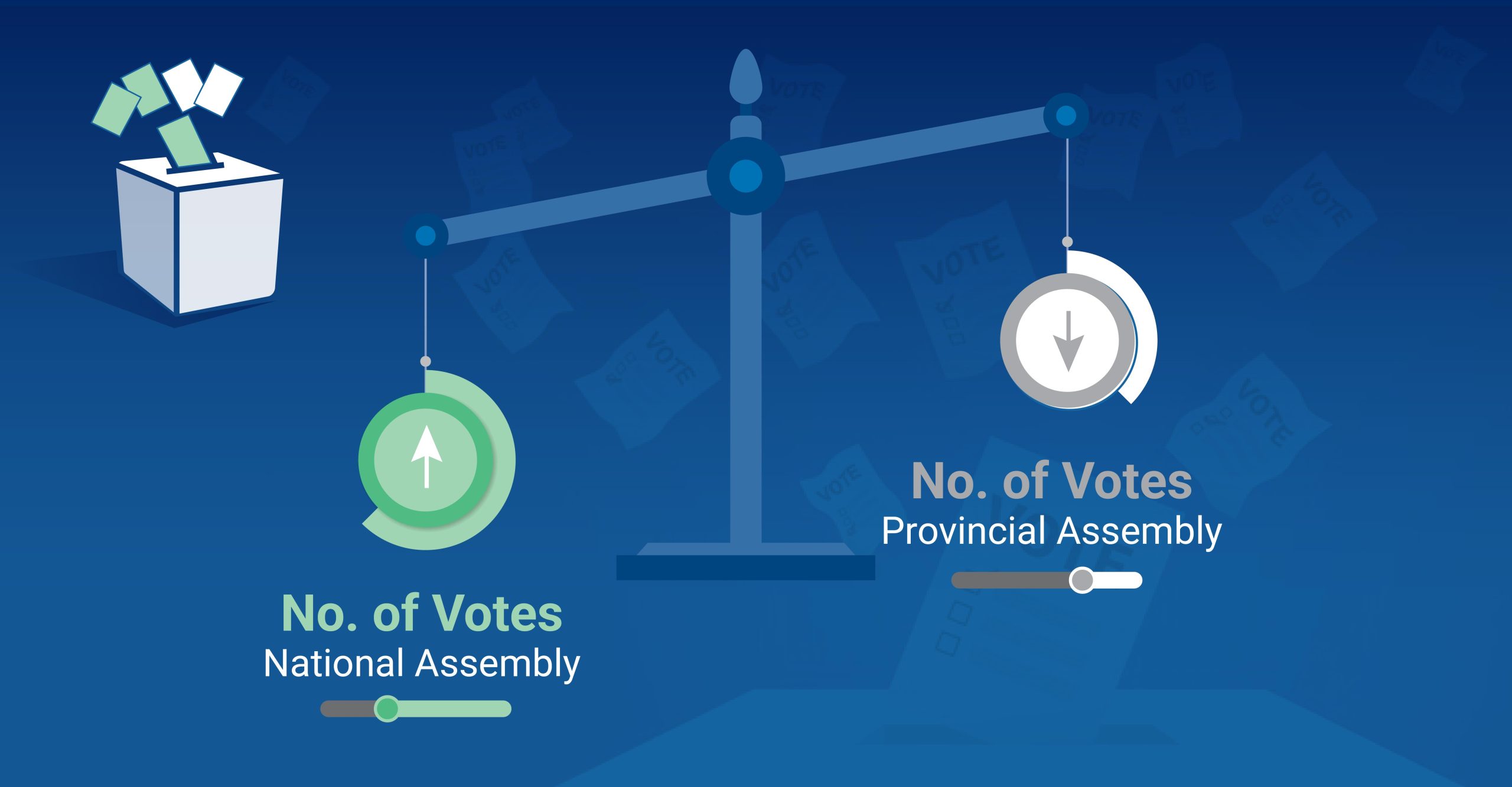
Except for voters in Islamabad, every Pakistani voter on February 8, 2024, was issued two ballot papers, a green ballot for the National Assembly and a white ballot for the Provincial Assembly. After verification of their identity, each voter had to mark the two ballots and drop them into their respective ballot boxes.
However, despite this consistent process, the number of ballots cast for the National and Provincial seats differed at many polling stations in the General Elections 2024 (GE-2024) across the country.
Where did the differences occur?
In Balochistan and Khyber Pakhtunkhwa (KP), the Provincial Assembly ballot boxes contained more votes than the National Assembly boxes. In contrast, in Punjab and Sindh, the National Assembly ballot boxes had more votes than the Provincial ones.
Punjab recorded the largest discrepancy, with around 450,000 more ballots cast for the National Assembly than for the Provincial Assembly, which is equivalent to over one percent of all votes cast in the province.
In Sindh, there were about 67,000 more votes for the National Assembly.
In Khyber Pakhtunkhwa, 35,751 more votes were cast for the Provincial Assembly.
In Balochistan, the Provincial Assembly received 32,149 more votes than the National Assembly.
What could explain the discrepancy?
Such discrepancies can occur if a voter refuses to take one of the ballot papers. For example, if voter A comes to Polling Station 123 and asks to vote only for the National Assembly seat and refuses to receive a ballot paper for the Provincial seat. However, it is unusual for this to happen, especially on a noticeable scale.
Another plausible explanation is where the election for one of the seats, either National or Provincial, was postponed. This happened in Rahim Yar Khan, where the election in PP-266 (Rahim Yar Khan XII) was postponed due to the death of a contesting candidate, but the elections took place in NA-174 (Rahim Yar Khan-VI) constituency, which includes the entire PP-266 as well. Similarly, elections were postponed in NA-8 Bajaur, PK-22 Bajaur-IV, and PK-91 Kohat-II due to the death of contesting candidates. These postponements might have partly contributed to differences in ballot counts for National and Provincial constituencies in the Punjab and Khyber Pakhtunkhwa provinces.
Apart from these specific situations, the number of ballots in both boxes should ordinarily match. Any significant difference raises questions about the oversight in ballot paper handling and the integrity of the electoral process. Such issues may include incidents of voters taking ballots with themselves instead of putting them in ballot box, or errors in counting of ballots.
How can voters catch such discrepancies?
Voters can cross-check Form-45 (Statement of the Count) and Form-46 (Ballot Paper Account) for both the National and Provincial Assembly constituencies to identify and report any significant discrepancies.
If you want to know more about these election result forms and where to access them, please stay tuned to the FAFEN website. We’ll be publishing explainers on these soon.