It is no surprise that Pakistan ranks the lowest among 148 countries in the Global Gender Gap Index 2025. Despite repeated constitutional and legal emphasis on women’s political participation, women remain largely absent from the leadership structures of political parties.
An analysis of certificates of intra-party elections available on the Election Commission of Pakistan (ECP) website shows that 138 political parties elected more than 3,100 office-bearers between 2018 and 2025, but only seven percent of them were women.
Where do these numbers come from?
Under Section 208(4) of the Elections Act, 2017 and relevant rules, all political parties enlisted with the Election Commission of Pakistan (ECP) are required to publish an updated list of their central office-bearers and executive committee members on their websites and to submit the same to the ECP on Form-65 (Certificate Regarding Intra-Party Elections).
FAFEN compiled the information of party office holders from the certificates published on the ECP’s website during eight years between 2018 and 2025. Out of 167 enlisted parties, certificates were available for 138. The remaining parties may not have submitted their certificates, or the ECP may not have uploaded them. Some party election cases may also still be pending before the Commission.
The available records show that two political parties held their intra-party elections four times during the past eight years, while eight parties held elections thrice, 43 parties twice, and 83 parties only once.
Where do parliamentary parties stand on women’s representation?
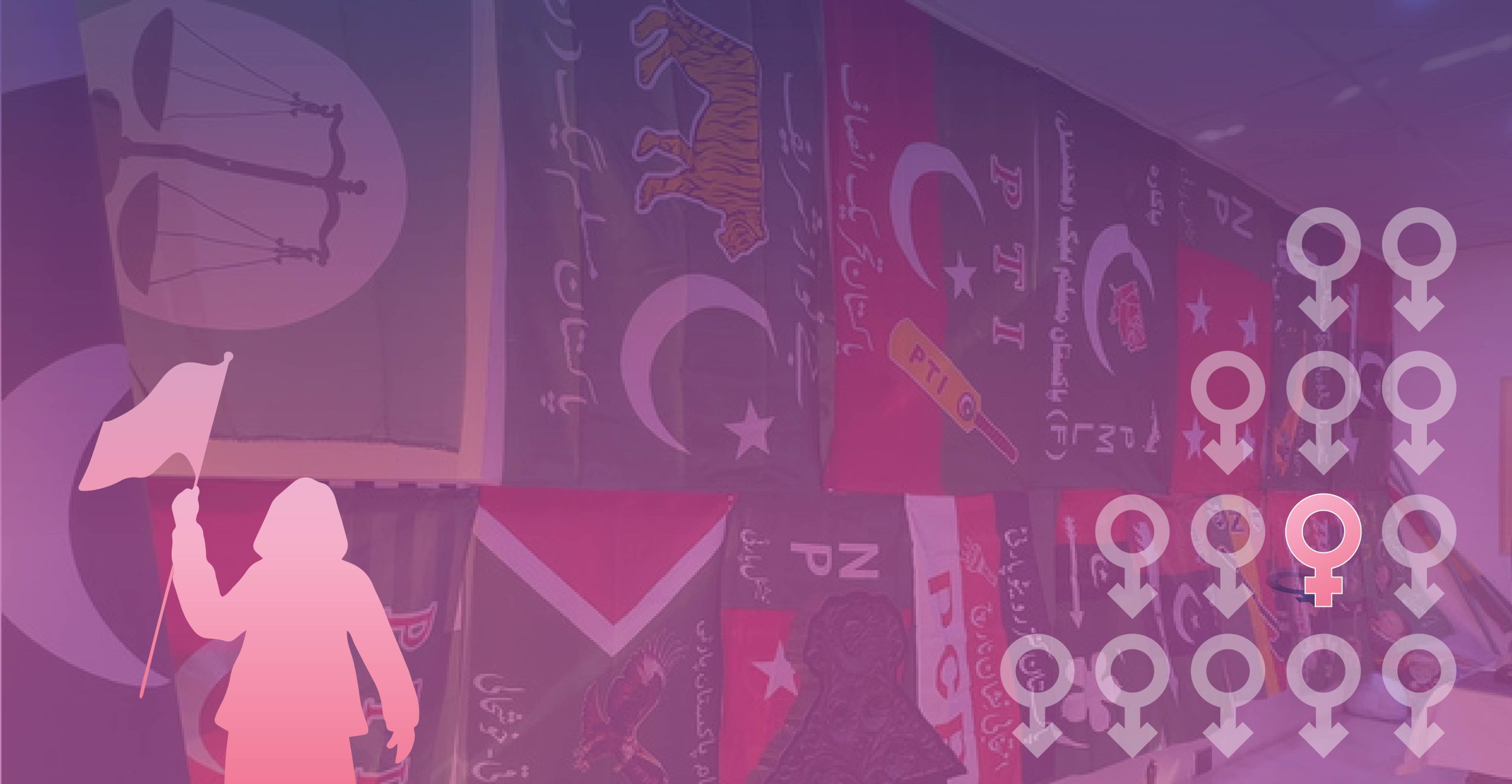
Currently, there are 15 political parties having representation in the Federal Parliament. Below is the status of women representation in key positions of these parliamentary parties:
| Party | Women Office-Bearers | Total Office-Bearers | % of Women | Year of Last Available Election Certificate |
|---|---|---|---|---|
| Awami National Party (ANP) | 10 | 38 | 26% | 2024 |
| Balochistan Awami Party (BAP) | 0 | 1 | 0 | 2023 |
| Balochistan National Party (BNP) | 1 | 15 | 7% | 2022 |
| Istehkam-e-Pakistan Party (IPP) | 0 | 5 | 0 | 2025 |
| Jamiat Ulma-e-Islam Pakistan (JUIP) | 0 | 14 | 0 | 2019 |
| Majlis Wahdatul Muslimeen (MWM) | 0 | 6 | 0 | 2022 |
| Muttahida Qaumi Movement Pakistan (MQMP) | 6 | 74 | 8% | 2022 |
| National Party (NP) | 2 | 15 | 13% | 2024 |
| Pakhtoonkhwa Milli Awami Party (PkMAP) | 0 | 137 | 0 | 2023 |
| Pakistan Muslim League (PML) | 0 | 10 | 0 | 2023 |
| Pakistan Muslim League-N (PML-N) | 2 | 6 | 33% | 2023 |
| Pakistan Muslim League Zia (PML-Z) | 0 | 15 | 0 | 2023 |
| Pakistan Peoples Party Parliamentarians (PPPP) | Election Certificate not available on ECP website | |||
| Pakistan Tehreek-e-Insaf (PTI) | Election Certificate not available on ECP website | |||
| Sunni Ittehad Council (SIC) | 0 | 66 | 0 | 2018 |
It is important to note that the Pakistan Peoples Party (PPP) and the Pakistan Peoples Party Parliamentarians (PPPP) are enlisted as separate parties with the ECP. Bilawal Bhutto Zardari leads the PPP, which contests elections on the symbol of Sword, while Asif Ali Zardari heads the PPPP, which uses the Arrow symbol. Only the PPP’s election certificate is available on the ECP website, showing one woman among its four central office-bearers, which translates to 25 percent representation.
What is the overall state of women representation in party structures?
Overall, 27 parties have up to 10 percent women representation in their ranks, 19 parties have between 11 and 20 percent, 16 parties have between 21 and 30 percent, and three parties have over 30 percent. As many as 73 parties have no woman office-bearer.
The highest share of women among central office-bearers of all enlisted political parties is 33 percent. Three parties, including Pakistan Muslim League (N), Pakistan Muslim League Organization, and Awami Falahi Party, have women occupying one-third of their elected positions.
What do the Constitution and the law say about women’s political representation?
The framers of the Pakistani Constitution initially reserved 10 seats for women in the federal legislature for a period of 10 years, hoping that women would be politically mainstreamed within this period and would no longer need any affirmative measures thereafter. However, progress on gender inclusion remained far slower than expected, and once those seats expired, women’s representation in the legislatures nearly vanished.
Then again, in 2002, the Legal Framework Order reintroduced 60 reserved seats for women in the National Assembly, a provision that continues even today. Yet, more than two decades later, women elected to general seats still can be counted on fingers.
The Elections Act, 2017 also introduced measures to strengthen women’s political participation, including emphasis on encouraging women’s membership in political parties, mandatory five percent nomination of women as candidates for elected offices, and measures to ensure women registration and participation as voters. – Written by Azhar Ali and Salman Khawaja, FAFEN Staff Members