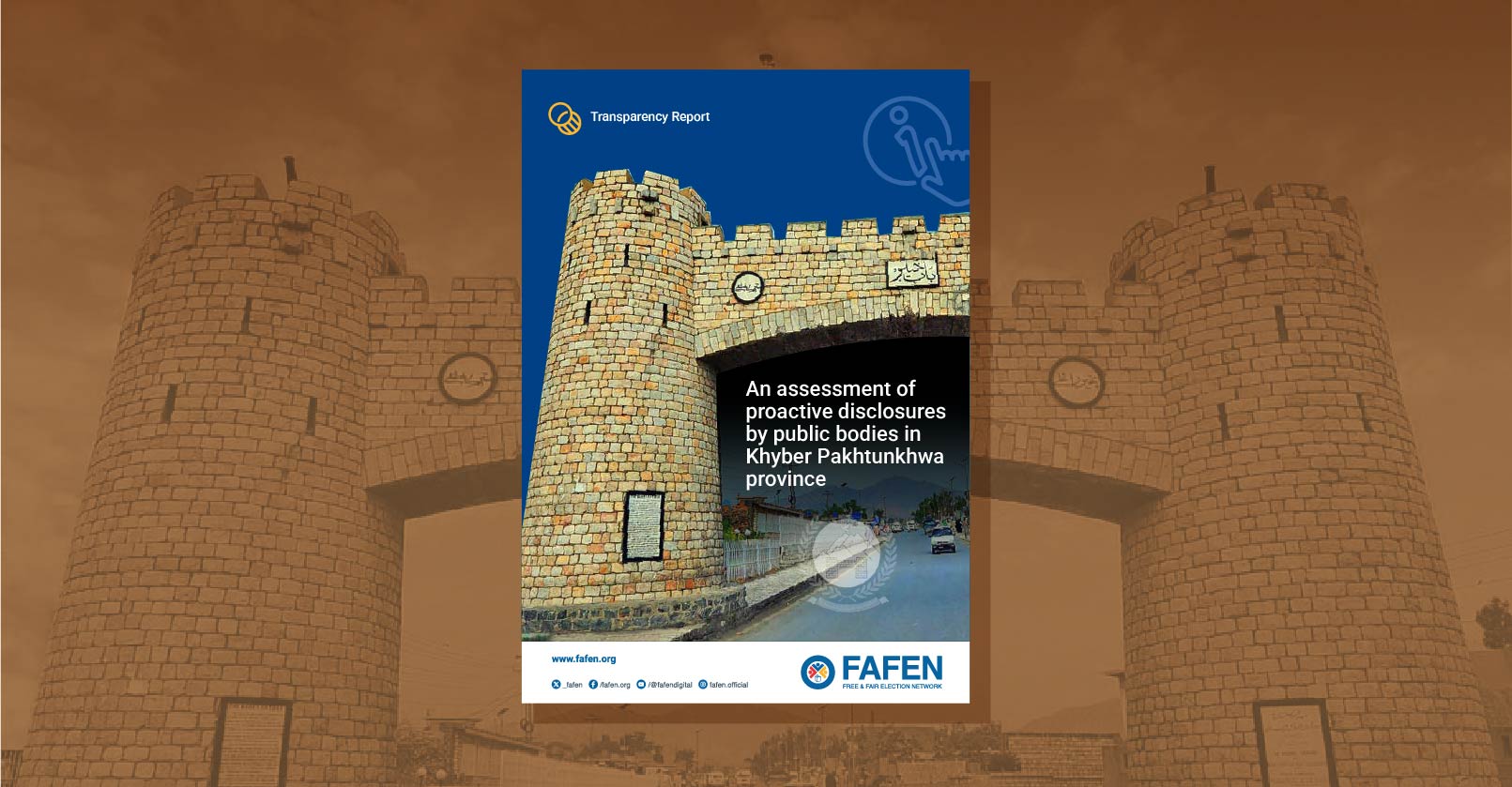
ISLAMABAD, December 6, 2025: Public bodies in Khyber Pakhtunkhwa province proactively disclose an average of 57 percent of the legally-required information on their official websites, says the latest transparency assessment report by the Free and Fair Election Network (FAFEN).
The assessment, conducted as part of FAFEN’s Countering Disinformation through Information campaign, emphasizes upon the role of proactive disclosures in strengthening institutional transparency and curbing misinformation. The lack of official and authentic information fuels speculation, rumors, assumptions, and conjectures, all of which become major drivers of disinformation that undermines institutional credibility, dents public trust, and contributes to instability.
The assessment reviewed 190 public bodies, including 36 secretariat departments, 98 attached departments, and 56 autonomous bodies, against the proactive disclosure requirements of Section 5 of the Khyber Pakhtunkhwa Right to Information (KPRTI) Act, 2013. The KPRTI explicitly mandates proactive disclosures of 12 distinct categories of information by the public bodies, and emphasizes upon the publishing up-to-date information in accessible manners including over the internet.
Overall, autonomous bodies and secretariat departments of the provincial government showed the highest compliance at 64 percent, while attached departments lagged behind at 50 percent.
Among the secretariat departments, the Auqaf, Hajj, Religious and Minority Affairs Department and the Minerals Development Department emerged as top performers, each disclosing 92 percent of the required information. The Institute of Management Sciences (IMSciences), Central Prison Peshawar, and Peshawar Development Authority (PDA) led among attached departments with 83 percent compliance. Among autonomous bodies, the University of Agriculture, Peshawar, also achieved 92 percent compliance.
However, the assessment found that nearly half of the public bodies trail below the 50 percent mark. Twenty-seven Secretariat Departments, seventy-three Attached Departments, and thirty Autonomous Bodies disclosed only 33–67 percent of the required information. In addition, fourteen Attached Departments, two Autonomous Bodies, and one Secretariat Department disclosed merely 17–25 percent.
The organizational information, including a public body’s functions, duties, and structure, is most widely available category of information on official websites, with 89 percent of public bodies sharing these details. The legal frameworks governing the functions of public bodies were available on 84 percent of the assessed websites. The personnel information and the public services offered by the public bodies were provided on 76 percent websites.
However, major gaps persist in disclosures related to public decision-making and financial transparency. Only 15 percent of public bodies shared information about their decision-making processes or opportunities for public consultation. Budget transparency was notably weak, with only 27 percent public bodies publishing proposed and actual expenditures on their websites. Transparency in subsidies, concessions, permits, and authorizations also remains limited. Only 23 percent disclosed any information related to subsidies or benefit programs, and just four percent provided details of recipients of concessions, permits, or licenses.
While 94 percent of public bodies disclosed the categories of information they hold, only 29 percent provided guidance on submitting information requests or the contact details of Public Information Officers (PIOs).
FAFEN stresses that while the KPRTI Act provides a strong legal framework for access to information, inconsistent implementation continues to limit citizen oversight. With millions of internet users in Khyber Pakhtunkhwa, FAFEN urges public institutions to leverage digital platforms to proactively share authentic, updated information and strengthen public trust in democratic and governance processes through openness.
Click here to download complete Khyber Pakhtunkhwa Transparency Assessment Report
You may also read the Punjab Transparency Assessment Report here and the Federal Transparency Assessment Report here.
Stay tuned to our website to read Balochistan and Sindh transparency assessment reports, due to be published in coming weeks.