Islamabad is home to more than 2.4 million people, of whom around half are registered as voters. The remaining residents may be eligible but unregistered, registered in other districts, or under the voting age. The voting population is almost double what it was at the time of local government elections in 2015.
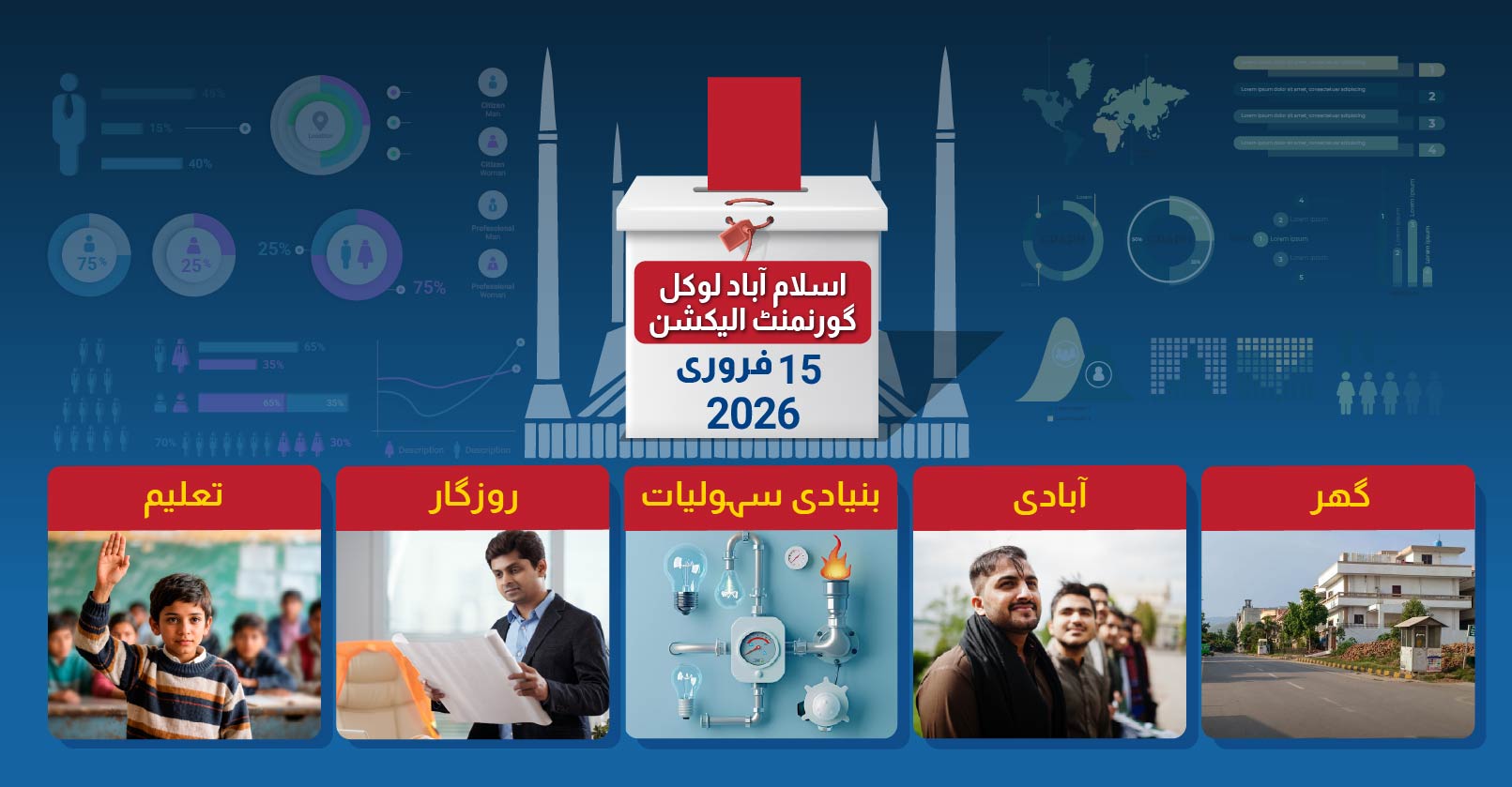
With the possibility of fresh local government elections in February 2026, it is timely to review the state of governance in the federal capital.
What is the governance structure in the capital?
The Islamabad Capital Territory (ICT) administration operates under a presidential order. Under this arrangement, the ICT Administration is headed by a Chief Commissioner who functions with powers similar to a provincial government and is overseen by the Federal Minister for Interior. Previously, it fell under the Capital Administration and Development Division (CADD).
The federal capital has three National Assembly constituencies and four Senate seats. However, the city does not have any elected provincial tier. Historically, it has remained under an unelected local governance framework, with elections held only twice, first in 1979, limited to rural areas, and then in 2015.
Read about the election process for local governments in Islamabad
What are the city’s demographics?
According to the 7th Population and Housing Census 2023, Islamabad’s population is more than 2.36 million and growing at an annual rate of 2.8 percent. This reflects an increase of 18 percent since 2017, when the population was around two million. The projected population for 2025 is over 2.42 million.
Men constitute around 53 percent of the population, and women 47 percent. Roughly 27 percent of residents fall in the age bracket of 15 to 29 years. Around 46 percent of the population lives in urban localities and 53 percent in areas categorized as rural. The city has more than 411,000 households.
What ethnicities dominate the city?
Punjabi is the most commonly reported mother tongue, spoken by around 50.6 percent of residents. This is followed by Pushto (18.2 percent), Urdu (15.7 percent), Hindko (6.2 percent), and Seraiki and Kashmiri at around two percent each. Sindhi speakers constitute one percent, and the remaining languages – including Mewati, Balochi, Kohistani, Shina, Brahvi, and Balti –account for about four percent. Almost five percent of the population comprises foreign nationals.
What are the city’s educational and employment challenges?
Islamabad is often considered one of the country’s better-educated cities, yet the data highlights several gaps. More than 89,000 school-age children remain out of school. Only 29 percent of the population has education above the matric level, while 55 percent is under-matric and 16 percent has never attended school.
Over 450,000 young people are out of both education and employment. Around seven percent of people aged 10 years and above reported themselves unemployed.
According to the Pakistan Institute of Education (PIE), Islamabad has the lowest availability of schools per 1,000 children in the country, with only 0.73 schools for every 1,000 children. However, it ranks among the better-performing regions in basic school infrastructure, with 72 percent of schools having essential facilities. Annual budget allocations for education in Islamabad amount to three to four percent of the federal budget.
What is the state of basic facilities?
Electricity is available to more than 97 percent of households in Islamabad. Access to gas and drinking water, however, is lower at around 61 percent and 59 percent, respectively. Among the three percent of households without electricity, two percent are in urban areas, and one percent are in rural areas. Of the 41 percent of households without access to drinking water, 23 percent are rural and 19 percent urban. Gas access is also uneven, with 23 percent of rural households and around 16 percent of urban households without gas.
About 97 percent of homes are cemented pacca structures, with the remaining being semi-structured or temporary dwellings. Roughly four percent of households lack kitchen and bathroom facilities. More than 70 percent of households are connected to a sewerage system, while the rest rely on alternative arrangements. Over 60 percent of homes are older than  10 years, while the remaining 40 percent are newer.