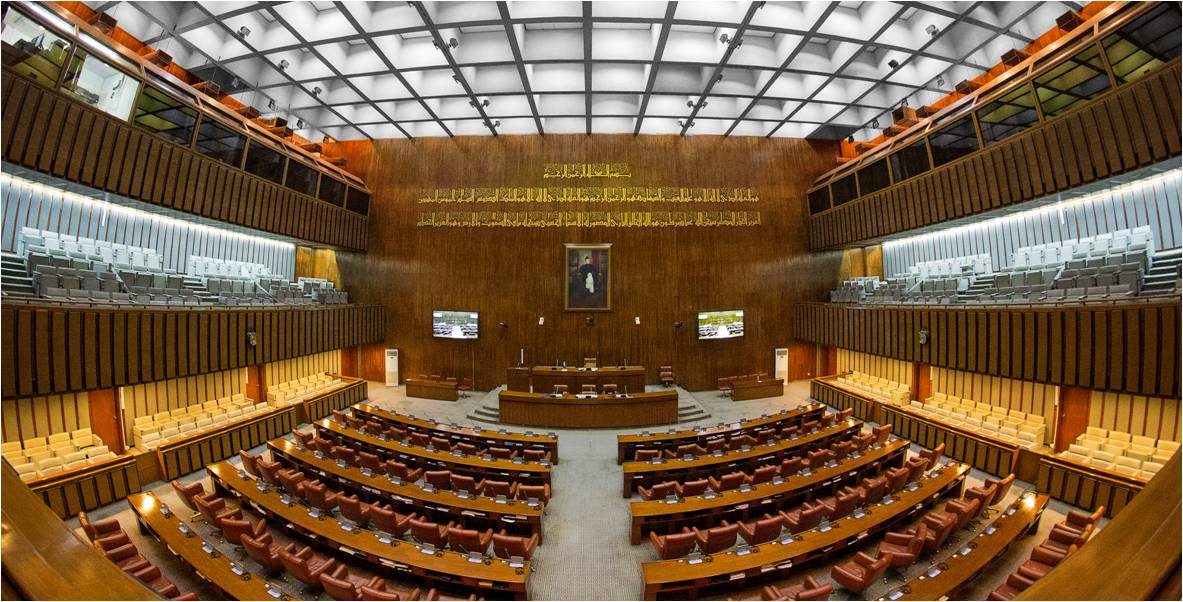
The Senate of Pakistan has recently amended its rules of procedure to prevent judicial interference in the committee hearings on public petitions. The Upper House passed an amendment to Rule 166(5) of its Rules of Procedure and Conduct of Business in the Senate, 2012 on Friday February 6, 2026.
Why was the amendment introduced?
Previously, Rule 166(5) allowed public petitions on matters connected to House business or general public interest, provided they did not fall within the jurisdiction of a court or tribunal. This wording limited the Senate’s ability to examine public grievances that overlapped with judicial processes, notwithstanding the fact that judicial cognizance was taken before admission of public petitions or after it.
On December 5, 2025 (Friday), Senator Saleem Mandviwala of PPPP moved a proposal to amend this rule on behalf of 10 other Senators including: Mohammad Abdul Qadir (independent), Anusha Rahman Ahmad Khan (PML-N), Palwasha Mohammed Zai Khan (PPPP), Fesal Vawda (independent), Syed Masroor Ahsan (PPPP), Amir Waliuddin Chishti (MQM), Sardar Al Haj Muhammad Umer Gorgaij (PPPP), Dr. Afnan Ullah Khan (PML-N), Syed Waqar Mehdi (PPPP), and Shahadat Awan (PPPP). The House referred the proposal to the Senate Standing Committee on Rules of Procedure and Privileges for further consideration and recommendations.
What does the amendment say?
The amendment sought revision in Rule 166(5) to remove the qualification for public petition that it does not fall within cognizance of a court or tribunal or pertains to matters pending before judicial or quasi-judicial forums. It also sought to broaden and specify the scope of public petition allowing not just individuals but also group of citizens to present public petitions on any matter of public importance, including grievances arising out of disputes where the circumstances disclose an element of public interest, systematic concern, regulatory oversight and/or protection of rights.
It also provided that a standing committee, to which a public petition is forwarded, may issue observations or recommendations for systemic or regulatory improvements, and facilitative guidance for resolution of the grievance placed before it to take necessary steps for disposal of the matter in accordance with the relevant law.
Additionally, it allowed the Chairman Senate, at his sole discretion, to review, admit, pend, dispense with, or decline to proceed with any petition, if in his opinion such action is necessary in the interest of proprietary, parliamentary discipline, or to prevent frivolous, vexatious or otherwise inappropriate proceedings.
How did the proceedings unfold when the amendment was passed?
During House proceedings on February 6, 2026, Senator Abdul Qadir Khan, one of the sponsors of the amendment, moved the House to consider and pass the proposal. After the motion for consideration was adopted, Senator Rana Sana Ullah, Advisor to the Prime Minister for Political and Public Affairs, requested a deferment to seek the further legal opinion on it. Senator Mandviwala, one of the sponsors of the amendment, was presiding the House at the time in absence of the Chairman and Deputy Chairman.
He pushed for its instant consideration and passage, emphasizing that it pertained to the Senate’s work and not the government’s. Despite further requests for delay, the House approved the amendment.