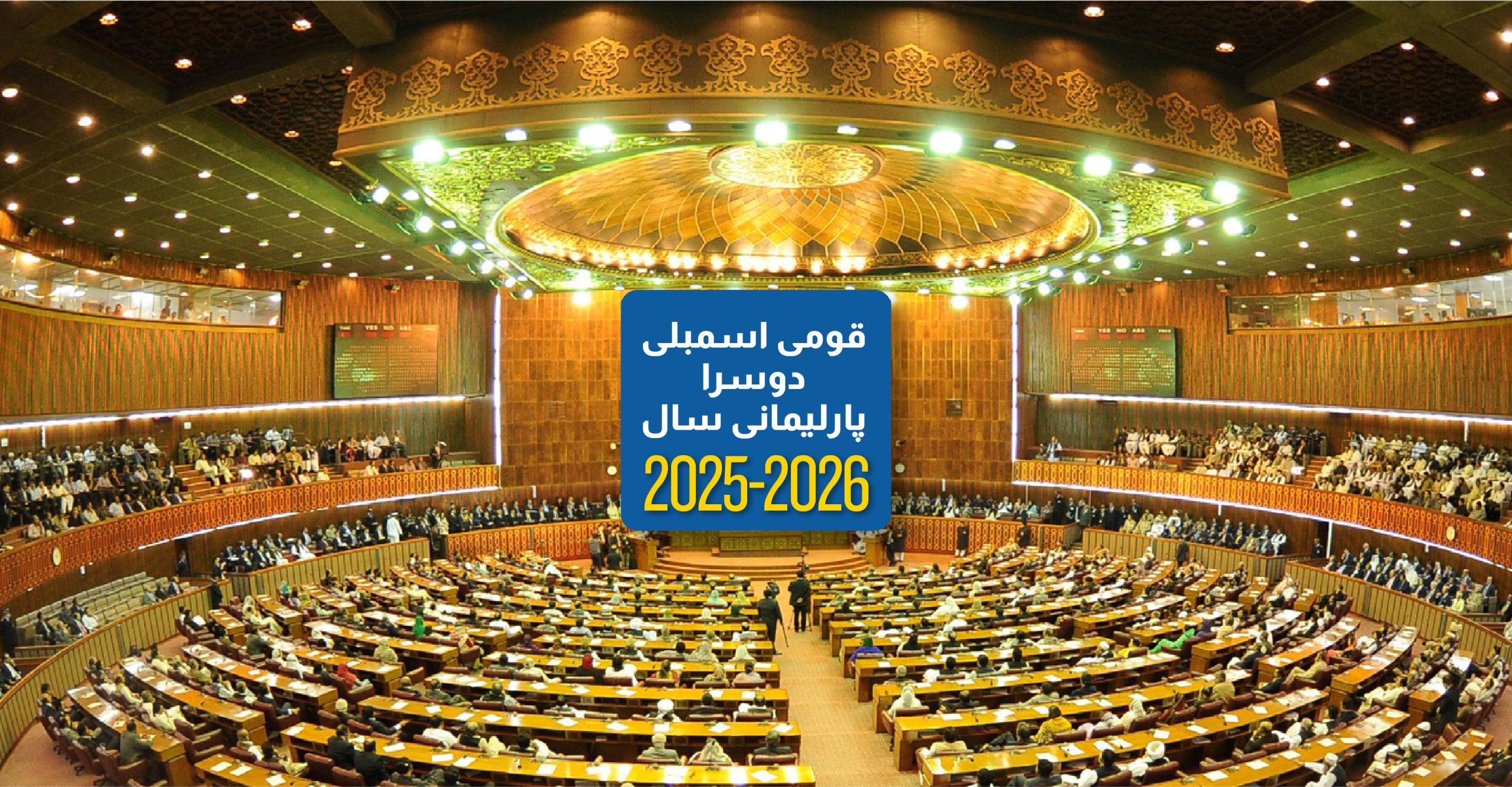
As many as 26 instances of pointing out quorum were recorded during the second parliamentary year of the National Assembly, reveals FAFEN’s review of the Lower House proceedings.
On 10 occasions, the House was found in order upon the count conducted after the quorum was pointed out. However, on 16 occasions the quorum requirement was not met, resulting in the suspension of proceedings for a cumulative duration of eight hours and five minutes.
In seven out of the 16 instances where the House was found lacking quorum, the required attendance was achieved upon reassembly after temporary suspension. However, in the remaining nine instances, the House had to be adjourned for another day, causing the regular business to suffer.
What is the quorum requirement?
The constitutional quorum requirement for the National Assembly is one-fourth of the total membership of the House. In a House of 336 members, at least 84 members must be present.
Article 55(2) of the Constitution provides that if the Chair’s attention is drawn to the lack of quorum, he shall either adjourn the Assembly or suspend the sitting until quorum is present.
Rule 5 of the Rules of Procedure and Conduct of Business in the National Assembly operationalizes this provision. It states that when quorum is pointed out, the Chair shall either suspend proceedings or cause the bells to be rung for five minutes to summon members to the House. If quorum is still not met after the bells are rung, the Chair shall adjourn the sitting to the next working day.
Who pointed out the lack of quorum?
The 26 quorum instances were pointed out by 10 lawmakers. Of these, seven were independent lawmakers affiliated with Pakistan Tehreek-e-Insaf, two were from the Pakistan People’s Party Parliamentarians (PPPP), and one with the Jamiat Ulema-e-Islam Pakistan (JUI-P).
Which sittings were adjourned due to lack of quorum?
The following nine sittings were adjourned after quorum could not be completed:
- Third sitting of the 15th session – None of the agenda items were taken up.
- Fourth sitting of the 15th session – None of the agenda items were taken up.
- Ninth sitting of the 16th session – One Calling Attention Notice was taken up. Two government bills were deferred due to absence of the relevant minister, while the remaining agenda was not considered.
- Fourth sitting of the 20th session – None of the agenda items were taken up.
- Second sitting of the 22nd session – None of the agenda items were taken up.
- Fifth sitting of the 22nd session – None of the agenda items were taken up.
- Seventh sitting of the 22nd session – Proceedings continued until Question Hour; the remaining agenda was not taken up.
- First sitting of the 23rd session – None of the agenda items were taken up.
- Third sitting of the 24th session – Some government business was considered; however, the Motion of Thanks and two Calling Attention Notices were left unaddressed.
These repeated disruptions indicate that insufficient attendance led to delayed legislative business and underutilization of parliamentary time.