
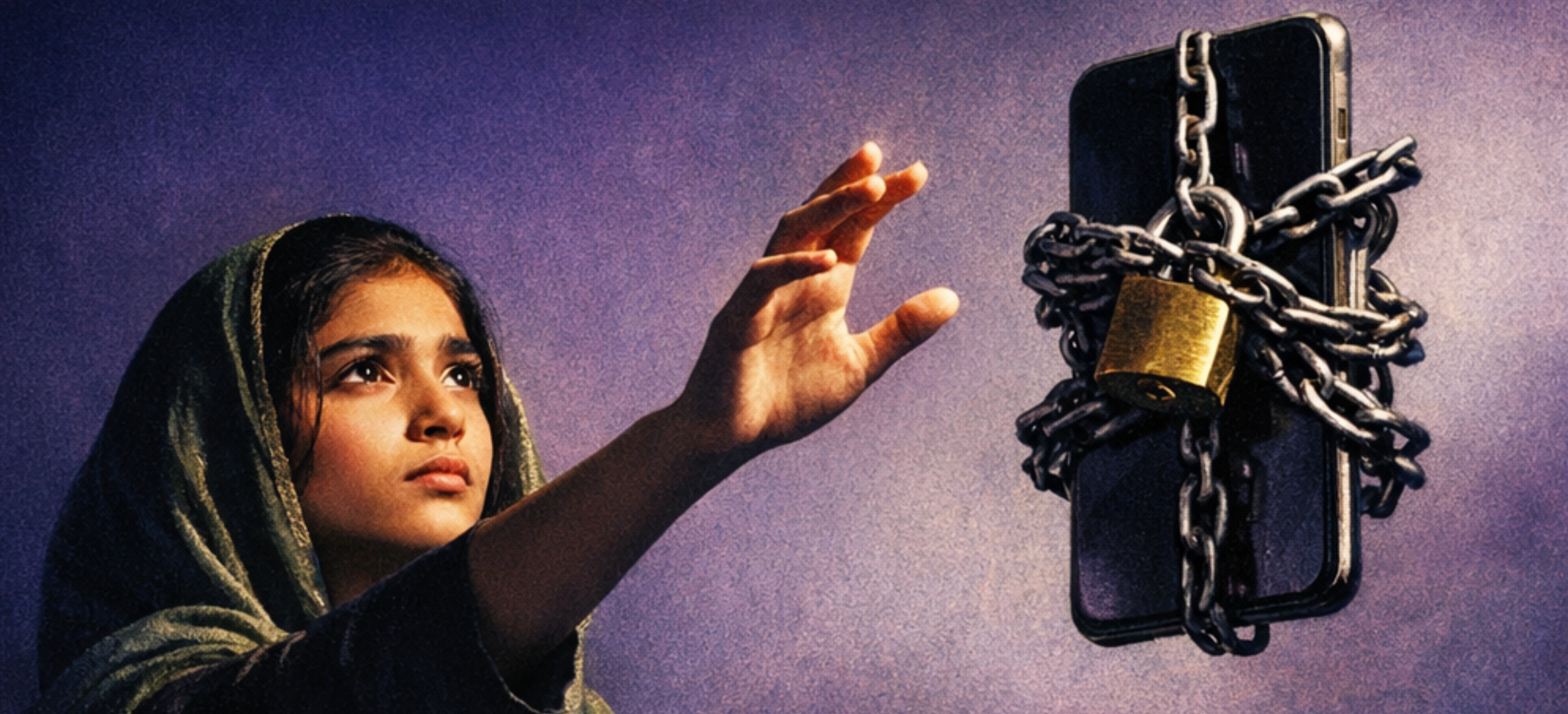
Islamabad: Can Pakistan’s parliament legally restrict children’s access to social media? The question is not hypothetical. A bill introduced by Senator Syed Masroor Ahsan in the Senate in June 2025 sought to ban social media use for children under 16 — but it did not advance and was withdrawn in August 2025. A calling attention notice collectively introduced by Senators Falak Naz, Fawzia Arshad, Aimal Wali Khan, Saadia Abbasi, and Dilawar Khan in the Senate’s 357th session, held on 16 January 2026, raised the issue again, proposing a ban for children under 18. The Minister for Parliamentary Affairs called for a collective effort by the Ministry of Education, the Ministry of IT, the government, and opposition members, noting that the issue concerns everyone, not just one individual. The Minister further suggested forming a committee comprising representatives of various ministries and the opposition to probe and discuss the issue.
Meanwhile, a petition filed by a 12-year-old through his father and lawyer reached the Islamabad High Court, which on 11 February 2026 directed the Pakistan Telecommunication Authority (PTA) and the Pakistan Electronic Media Regulatory Authority (PEMRA) to submit a report on measures to regulate minors’ access to social media by 3 March 2026. According to the Islamabad High Court website Case No. W.P No. 583[1] of 2026, no representation was present so the hearing for the said case has been rescheduled to April 20, 2026. No nationwide legislation is in force in Pakistan. The debate, however, is no longer confined to this country.
Across the world, the question of whether children should be allowed on social media platforms has moved from policy discussion to enacted law. By early 2026, approximately 40 countries had initiated steps — at varying stages of the legislative process — to restrict or ban social media use for minors. The trigger in most cases is documented concern over adolescent mental health: studies have linked prolonged social media use in children to anxiety, depression, self-harm, and exposure to bullying. Policymakers in multiple jurisdictions have concluded that younger users are disproportionately vulnerable to these harms and that platforms have not acted with sufficient diligence to protect them.
Australia: The First to Enforce a Nationwide Ban
Australia was the first country to enforce a nationwide ban. The Online Safety Amendment (Social Media Minimum Age) Bill 2024, passed by the Australian Parliament in November 2024, came into force on 10 December 2024. The law requires major social media platforms to block users under 16 or face financial penalties. According to UNICEF Australia, approximately five million accounts belonging to Australian teenagers under 16 have been deactivated since the ban took effect. Australia’s legislation set the template that other governments have since looked to — both for its scope and for the enforcement mechanisms it put in place.
Where Other Countries Stand
The Tech Policy Press Global Social Media Age Restriction Tracker categorises countries into five groups based on the status of their legislative action. Three countries — Australia, China, and Vietnam — have implemented laws currently in force. Brazil, France, Indonesia, Malaysia, and the United Arab Emirates have passed legislation that is not yet in effect. A further 12 countries, including the United Kingdom, the United States, South Korea, Turkey, and Norway, have active legislative processes underway. Seven countries — including Austria, Greece, Spain, and the European Union — have announced legislative intent without formal bills. A final group of 15 countries, including Pakistan, India, Germany, Canada, and Nigeria, are at the stage of public or official debate without formal legislative action.
The age threshold applied across these measures is generally consistent: the upper limit for restriction is 16 years and the lower threshold is 13 years. Platforms most frequently targeted include Facebook, Instagram, TikTok, and X.
| Implemented | Passed | In Consideration | Proposed | Under Discussion |
| Australia | Brazil | Denmark | Austria | Albania |
| China | France | Ireland | European Union | Belgium |
| Vietnam | Indonesia | Italy | Greece | Canada |
| Malaysia | New Zealand | Spain | Czech Republic | |
| United Arab Emirates | Norway | Egypt | ||
| Philippines | Finland | |||
| Portugal | Germany | |||
| Slovenia | India | |||
| South Korea | Japan | |||
| Thailand | Netherlands | |||
| Turkey | Nigeria | |||
| United Kingdom | Pakistan | |||
| United States | South Africa | |||
| Sweden | ||||
| Switzerland |
Source: Tech Policy Press — Global Social Media Age Restriction Tracker
Pakistan’s Legislative Status
Pakistan currently falls in the ‘under discussion’ category. Three separate actions have brought the issue into formal institutional channels since mid-2025, though none has produced binding legislation.
In June 2025, a Senate member introduced a bill to restrict social media access for children under 16. The bill did not progress through committee and was withdrawn in August 2025. On 16 January 2026, during the 357th Senate session, a separate calling attention notice was submitted, raising concern about children’s rising social media use and proposing a ban for those under 18. The notice did not result in a formal legislative referral.
The most procedurally significant development came through the judiciary. A petition filed by a 12-year-old child, through his father and legal counsel, sought a court-ordered ban on social media for children under 16. The Islamabad High Court, on 11 February 2026, directed the PTA and PEMRA to submit a comprehensive report by 3 March 2026 outlining what measures both regulators could take to limit minors’ access to social media platforms. The outcome of that report and any subsequent court directions have not been formally published at the time of writing.
The legislative gap in Pakistan is notable given that the country’s two primary digital regulators — the PTA and PEMRA — have existing mandates over content regulation and platform access. Whether those mandates extend to age-based restrictions on major international platforms without specific enabling legislation remains an open regulatory and legal question.
[1] https://mis.ihc.gov.pk/frmCseSrch (Accessed on March 12, 2026).