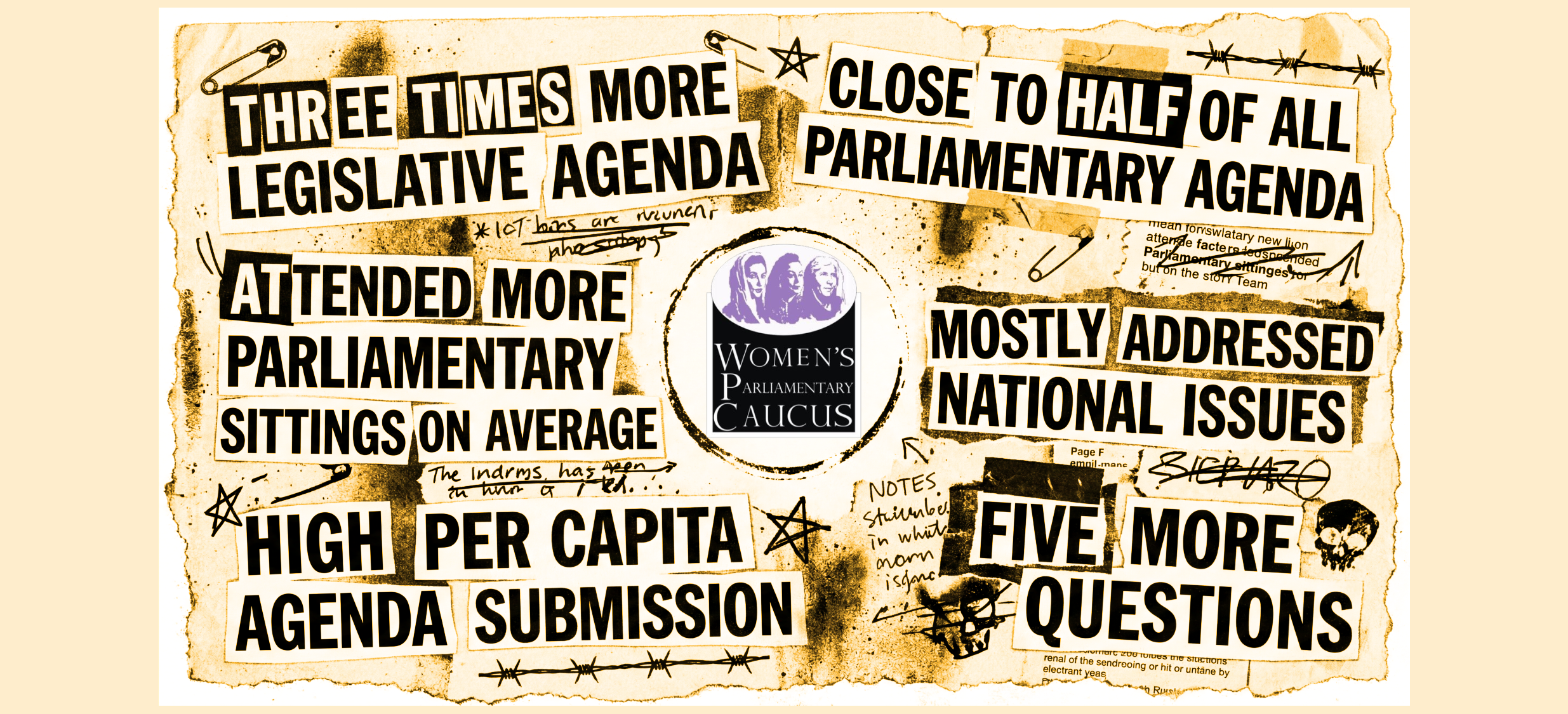
During the second parliamentary year of the 16th National Assembly, female Members of the National Assembly (MNAs) submitted an average of 16 agenda items each. Male MNAs submitted an average of five items each. The per-capita agenda submission rate for female MNAs was almost three times that of male MNAs — the widest gap FAFEN has recorded since systematic tracking began in 2013.
How this is measured: The Free and Fair Election Network (FAFEN) tracks every item placed on the National Assembly’s Order of the Day — including questions, private member bills, motions, resolutions, and calling attention notices. The total number of agenda items submitted by each MNA is divided by the number of female and male MNAs respectively to produce the per-capita rate. Data are drawn from Orders of the Day and daily bulletins published on the National Assembly’s official website for the period 1 March 2025 to 28 February 2026.
Why this matters in parliamentary terms: Per-capita agenda submission is a direct measure of legislative initiative. Placing an item on the Order of the Day requires a member to identify a policy issue, draft a formal submission, and table it through the House secretariat. It is the most fundamental act of individual legislative participation available to a backbench member. A per-capita rate three times higher than male MNAs’ — in a House where women hold only 21.7% of seats, predominantly through reserved quotas — indicates that female MNAs are not passive recipients of parliamentary membership. They are actively using the institutional tools of the House at a significantly higher rate than their male colleagues. This finding is a direct, evidence-based counter to the assumption that women in Pakistan’s parliament are decorative rather than functional.
Source: FAFEN Women Parliamentarians Performance Report 2025–2026, Section 02. Data period: 1 March 2025 – 28 February 2026.