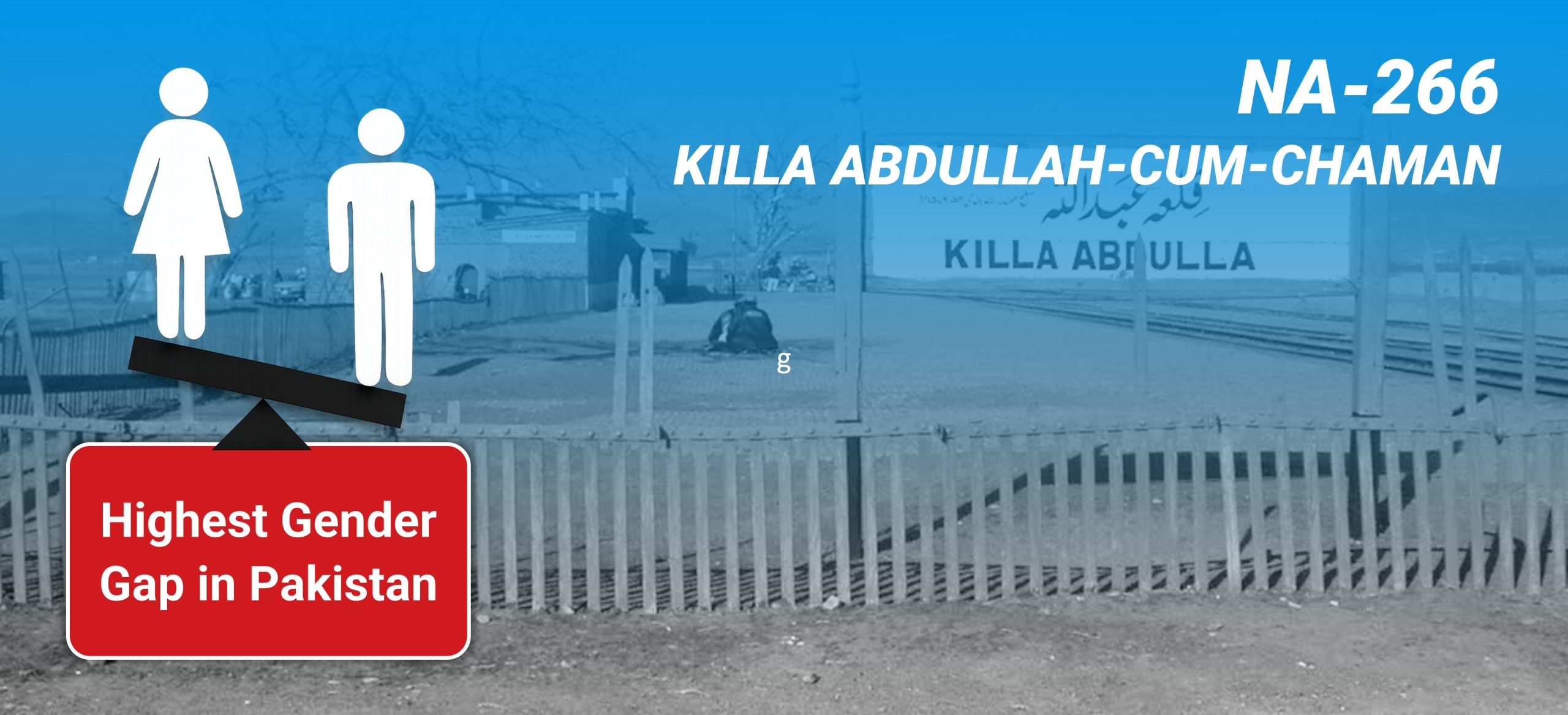
NA-266 Killa Abdullah-cum-Chaman in Balochistan recorded the highest voter registration gender gap of any National Assembly (NA) constituency in Pakistan — both in absolute numbers and as a percentage — according to the constituency-wise electoral rolls published by the Election Commission of Pakistan (ECP) on 3 February 2026.
As of the most recent ECP data, the constituency has 244,318 registered male voters against 140,615 registered female voters, out of a total of 384,933 registered voters. The absolute difference between registered male and female voters stands at 103,703 — the largest such gap recorded in any NA constituency nationwide. Female voters constitute only 36.5 percent of the constituency’s total registered voters, against a male share of 63.5 percent. The gender gap of 27 percent exceeds the legally permissible threshold of 10 percent by 17 percentage points.
A comparison with the electoral rolls at the time of the 2024 general elections reveals a contradictory picture. In percentage terms, the gender gap has narrowed marginally — from 29 percent in 2024 to 27 percent in 2026, an improvement of two percentage points. In absolute terms, however, the gap has widened. The number of registered male voters grew by 14,012 between 2024 and 2026, while the number of registered female voters grew by 13,087 — a difference of 925 voters. As a result, the absolute gender gap increased from 102,778 in 2024 to 103,703 in 2026. The marginal percentage improvement reflects the overall growth in total registered voters rather than a meaningful acceleration in female registration.
The data show that while both male and female registrations have increased, female voters continue to account for well under half of all new registrations in the constituency. Of the 27,099 new voters added to the rolls since 2024, 48.3 percent are female — insufficient to close a gap of this magnitude in any measurable timeframe at the current rate of enrolment.
NA-266 spans the Killa Abdullah and Chaman areas of Balochistan — a region where geographic remoteness, security conditions, and deeply entrenched sociocultural barriers have historically constrained women’s access to national identity documentation and voter registration. The constituency’s position at the top of both the absolute and percentage rankings for gender gap is a reflection of these compounding structural factors.
What the Elections Act requires
The continued presence of a gap of this nature underscores the need for sustained institutional action. Section 47(1) of the Elections Act, 2017 requires the ECP to annually publish disaggregated data of registered male and female voters in each constituency and to highlight the difference in their numbers. Under Section 47(2), the Commission must take special measures in any constituency where this difference exceeds 10 percent, including measures to reduce this variation. Section 47(3) further specifies that these measures shall include action by the National Database and Registration Authority (NADRA) to expedite National Identity Card (NIC) issuance for women in affected constituencies, and by the ECP to enrol them as voters in the relevant electoral area. This provision places a clear, joint institutional responsibility on both NADRA and the ECP to address the gender gap where it crosses the legal threshold.
These measures include targeted voter registration campaigns, NIC facilitation drives, and community-level outreach to address the barriers that continue to limit women’s registration. Consistent implementation of these provisions is critical to ensuring that the downward trend in the gender gap is sustained and accelerated in the electoral rolls ahead of the next general elections.