Pakistan’s election law sets a 2am deadline for provisional results on the night after polling. Any delay after that point requires a written explanation from the Returning Officer (RO).
During general elections in Pakistan, the late return of results from constituency after constituency has been a source of public anxiety, speculation, and accusations of manipulation. The Elections Act 2017 did not leave this situation ungoverned. It set a specific deadline and a specific accountability requirement.
What does the law say?
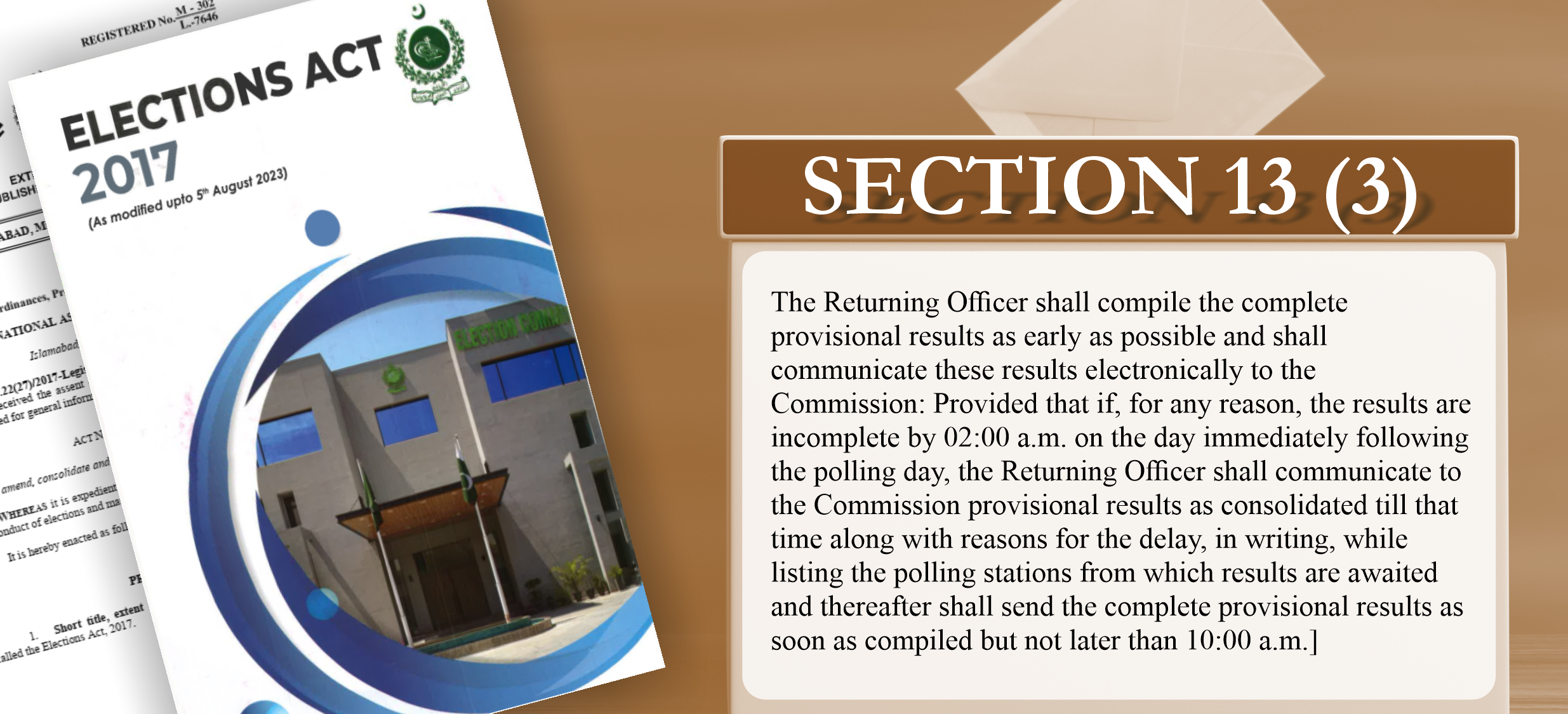
Section 13(3) of the Elections Act 2017, as substituted by the Elections (Second Amendment) Act 2023, requires the RO to compile complete provisional results as early as possible and communicate them electronically to the ECP. If for any reason results are incomplete by 2:00 am on the day immediately following polling day, the RO must communicate to the Commission the provisional results compiled up to that point, along with written reasons for the delay, listing by name the polling stations from which results are still awaited. Complete provisional results must then follow as soon as compiled, but no later than 10:00 am.
Section 13(2) additionally requires Presiding Officers to immediately photograph the result of the count (Form-45) at their polling station and transmit it electronically to the Commission and the Returning Officer as soon as connectivity allows.
Why does this matter?
The 2am proviso converts a common failure — delayed results — into a legally defined event with a mandatory accountability response. A Returning Officer who does not provide the Commission with written reasons for incomplete results after 2am is in breach of the Act.
For election observers and journalists covering results night, this provision is the legal baseline against which performance should be measured. When results are delayed, the question is not merely a logistical one. It is: did the Returning Officer comply with Section 13(3)? Did the written explanation reach the ECP? Were these reasons shared with the citizens?
 Source: Elections Act 2017, Section 13(2)&(3), as substituted by Elections (Second Amendment) Act 2023.
This post is part of FAFEN’s series on electoral literacy. Read more of this series here.