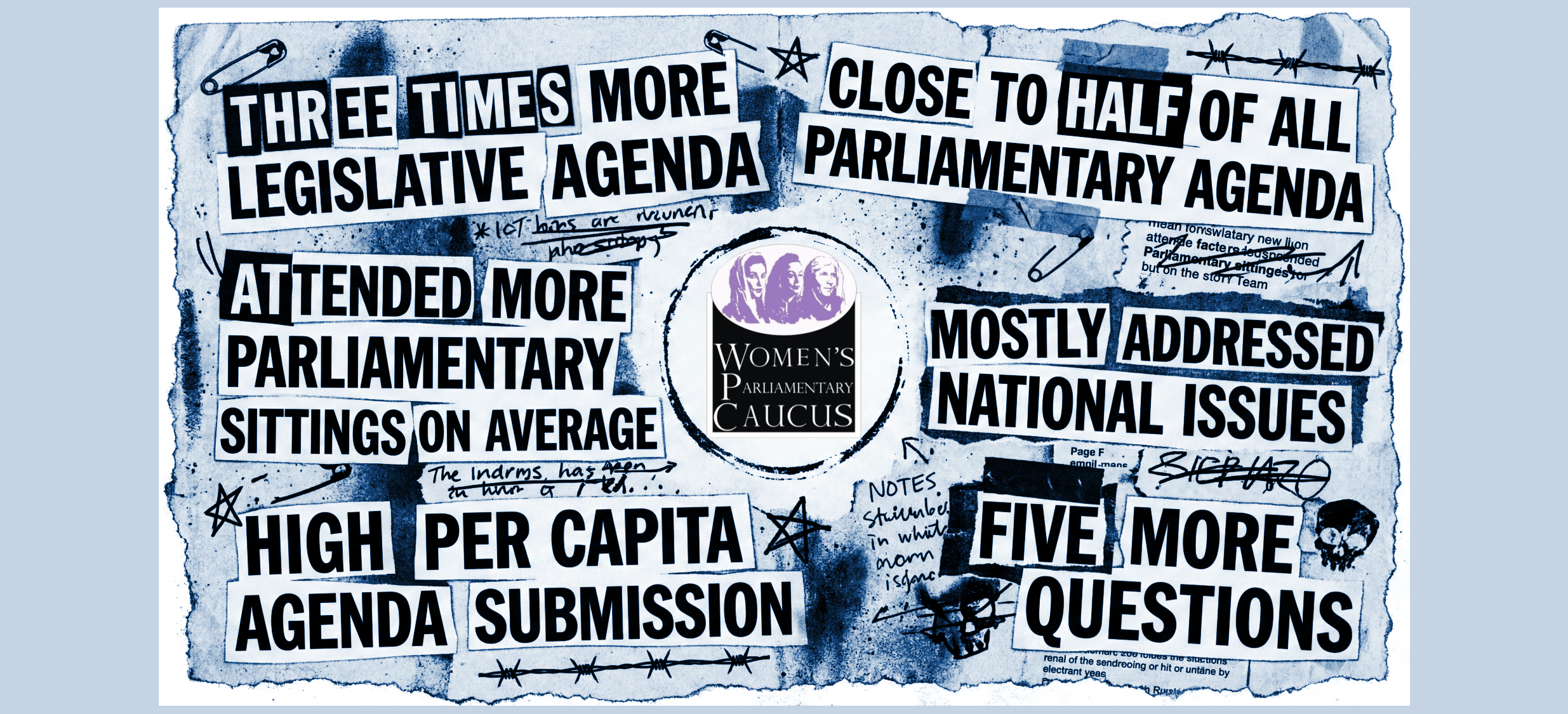
Female MNAs submitted 50 private member bills during the second parliamentary year of the 16th National Assembly; 32 were addressed. Male MNAs submitted 37 private member bills; 27 were addressed. The Gender Responsiveness Score for private member bills is 0.8, indicating that female MNAs’ bills were addressed at a lower rate than by male MNAs.
How this is measured
Private member bills are formal legislative proposals submitted by individual members, as distinct from government bills introduced by the executive. FAFEN tracks the submission and disposal of every private member’s bill placed on the National Assembly’s Order of the Day. A bill is classified as addressed when it is taken up for debate, read, referred to a committee, or otherwise formally processed during the reporting year. Bills that are listed but not reached, or that lapse without action, are classified as unaddressed. The GRS is female MNAs’ addressed rate (64%) divided by the male MNAs’ addressed rate (73%).
Why this matters in parliamentary terms
Private member bills are the principal legislative instrument available to members who do not hold ministerial office. They allow a member to propose new laws, amend existing legislation, or put a policy question before the House independent of the government’s agenda. A GRS of 0.8 means that a female MNA’s private member bill is less likely to receive parliamentary time than an equivalent bill submitted by a male MNA. Over time, a persistent gap in the processing rate for women’s legislative proposals affects their capacity to translate political presence into legal change. The gap also has a signalling effect: members whose bills are consistently deprioritised have less institutional incentive to invest effort in drafting and submitting legislation.
Source: FAFEN Women Parliamentarians Performance Report 2025–2026, Table 8. Data period: 1 March 2025 – 28 February 2026.