Pakistan’s current voter registration system is designed to be automatic. A new NIC should trigger registration as a voter without any additional application. The law says so explicitly.
Many people would never have applied to become a voter, but still be registered on the electoral rolls because they got themselves registered for National Identity Card (NIC). If someone holding a NIC is not on the electoral roll, it reflects a failure somewhere in a legal pipeline that should have enrolled them automatically.
What does the law say?
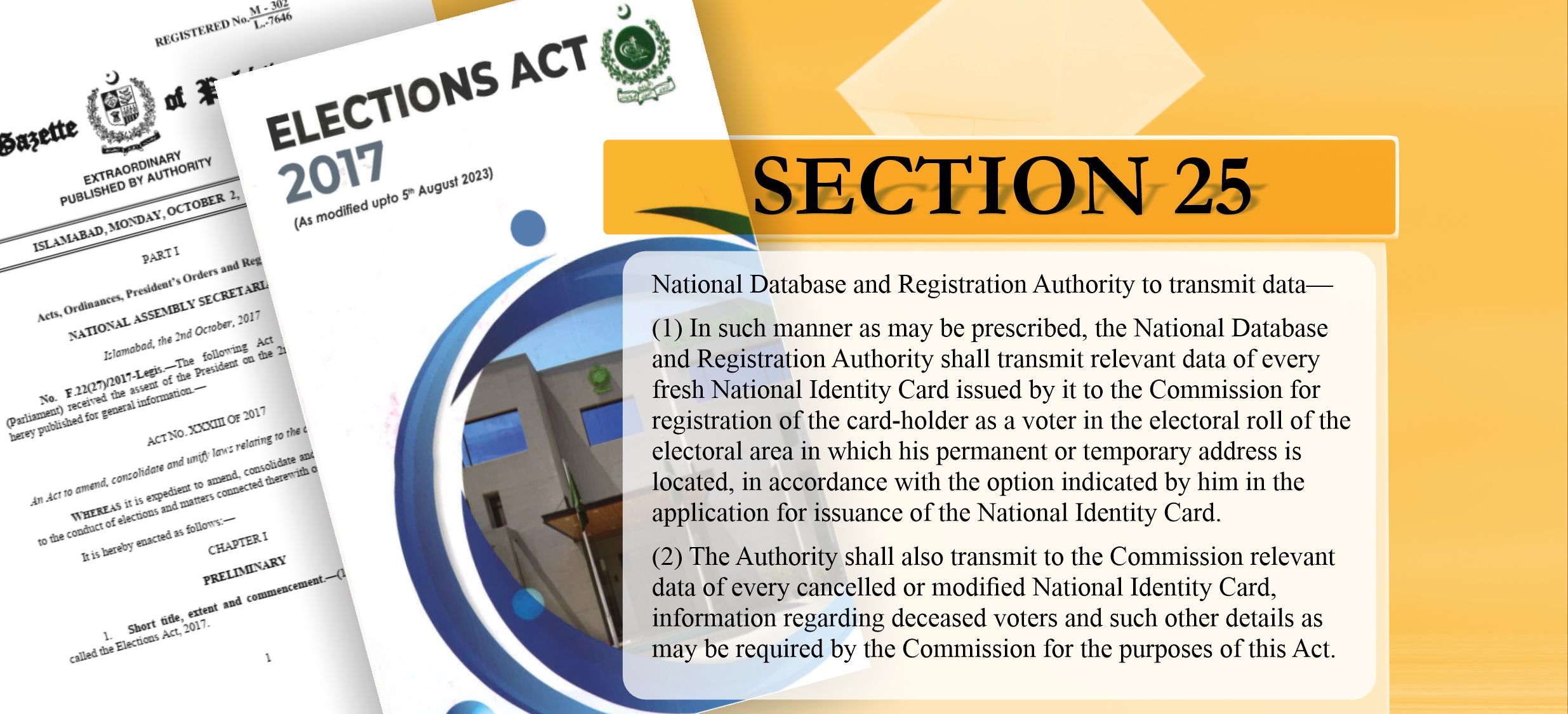
Section 25(1) of the Elections Act 2017 requires the National Database and Registration Authority (NADRA) to transmit the data of every fresh NIC it issues to the Election Commission of Pakistan (ECP). The ECP then forwards that data to the Registration Officer for the electoral area corresponding to the permanent or temporary address on the NIC application. The Registration Officer enrolls the person as a voter.
Section 25(2) extends this obligation of data transmission to cancelled or modified NICs as well. When a NIC is cancelled — including on the death of the holder — NADRA must transmit that information to the ECP as well, so the electoral roll can be corrected. The pipeline runs in both directions, adding new voters and removing those who are no longer eligible.
Why does this matter?
The automatic registration pipeline is designed to eliminate the registration barrier that prevents millions of eligible Pakistanis from voting. If NADRA transmits data correctly and Registration Officers act on it, every NIC-holder should appear on the roll.
When the pipeline breaks down — due to data transmission failures, address mismatches, or official inaction — the remedy is not the pipeline itself but the individual application process under Section 37(a). A voter whose name is missing can apply directly to the Registration Officer, produce their NIC, and request inclusion.
If you have a NIC and are not on the roll, verify your registration status at the ECP’s website or by texting your CNIC number to 8300. If you are not registered, file a written application with your district’s Registration Officer, who in most cases is the District Election Commissioner (DEC).
Source: Elections Act 2017, Sections 25(1)&(2) and 37(a).
This post is part of FAFEN’s series on electoral literacy. Read more of this series here.