A provision in the Elections Act places every election official under a specific oath of compliance — a commitment that overrides their ordinary chain of command for the duration of their election duties.
Pakistan’s election administration draws on civil servants, judicial officers, and government employees from across the public sector. These officials have regular employers such as ministries, departments, and provincial governments. However, during election duty, the Elections Act 2017 creates a different legal relationship.
What does the law say?
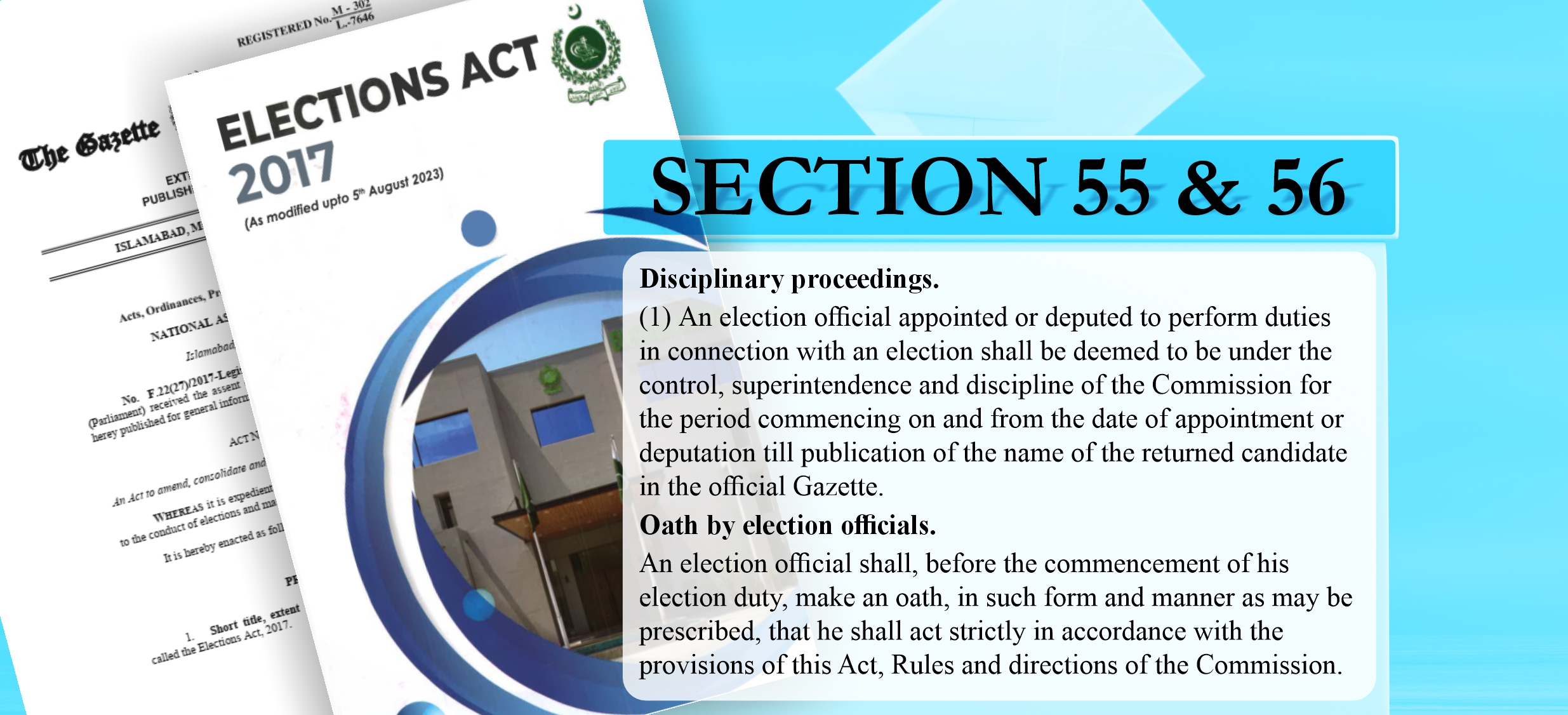
Section 56 of the Elections Act 2017 requires every election official to make an oath — in a form and manner prescribed by the Commission — before commencing their election duty. The oath commits the official to acting strictly in accordance with the provisions of the Act, the Rules, and the directions of the Election Commission of Pakistan (ECP). This oath is not to the appointing authority, not to the provincial government that seconded the official, and not to the federal government. It is to the Act and the ECP.
Section 55 further reinforces this provision as it requires that, from the date of appointment until the publication of the returned candidate’s name in the Gazette, every election official is deemed to be under the control, superintendence, and discipline of the Commission. The ECP may initiate disciplinary action against any election official for misconduct — independently of the official’s regular employer.
Why does this matter?
The oath in Section 56 creates an explicit legal commitment that is separate from an official’s regular professional obligations. When an election official is told by a superior in their regular ministry to act in a way that conflicts with ECP directions, the oath provides the basis — and the legal protection — for refusing.
Voters who observe election officials acting on instructions from political or administrative authorities rather than ECP directions can cite Section 56 as the standard that was not upheld. The oath is a public commitment, and non-compliance with it is a matter of electoral accountability.
 Source: Elections Act 2017, Sections 55 and 56.
This post is part of FAFEN’s series on electoral literacy. Read more of this series here.