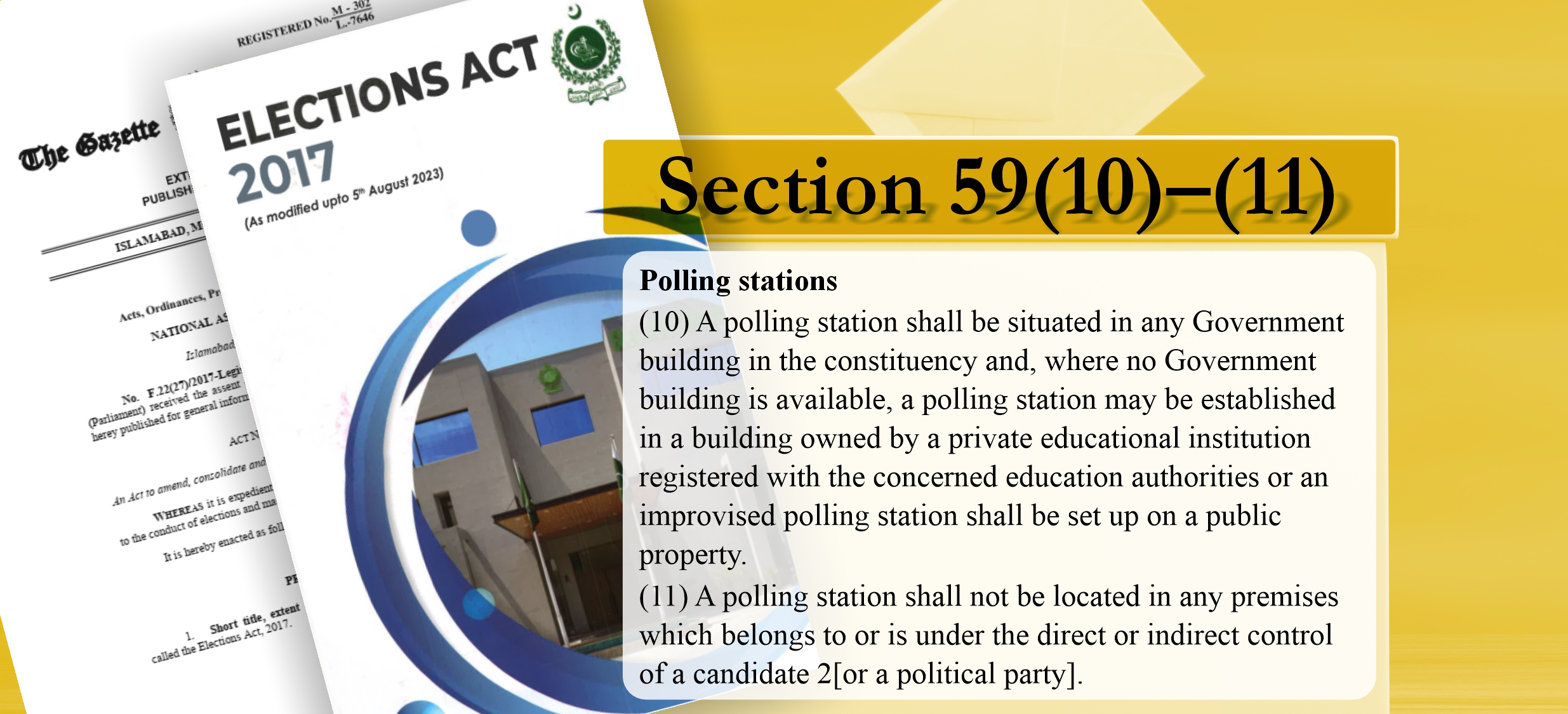
The Elections Act prohibits setting up a polling station in premises connected to any candidate or political party. The voters may object to the polling station buildings on these grounds.
The choice of polling station location affects not only voter convenience but also the fairness of the vote itself. A polling station situated in premises controlled by a candidate creates an inherent risk of intimidation and partisan conduct by staff associated with that candidate. The Elections Act 2017 addresses this risk directly.
What does the law say?
Section 59(10) of the Elections Act 2017 requires polling stations to be located in government buildings wherever available. Where no government building is available, a private educational institution registered with education authorities may be used. Where neither is available, an improvised polling station may be set up on public property. However, section 59(11) adds an absolute prohibition that no polling station shall be located in any premises belonging to, or under the direct or indirect control of, a candidate or a political party.
The reference to “direct or indirect control” is significant. A building owned by a company controlled by a candidate’s family, or rented by a candidate’s party, falls within the prohibition just as a directly owned premises would.
Why does this matter?
The objection mechanism under Section 59(4)–(5) allows candidates to raise concerns about any polling station in their constituency, and voters to raise concerns about the station to which they are assigned, within 21 days of the preliminary list’s publication.
If you are aware before polling day that your polling station is in a building connected to a candidate or political party, raise a formal objection with the District Returning Officer. After polling day, it is a valid election observation finding that should be reported to the ECP and documented for potential use in an election petition.
 Source: Elections Act 2017, Sections 59(10)–(11).
This post is part of FAFEN’s series on electoral literacy. Read more of this series here.