
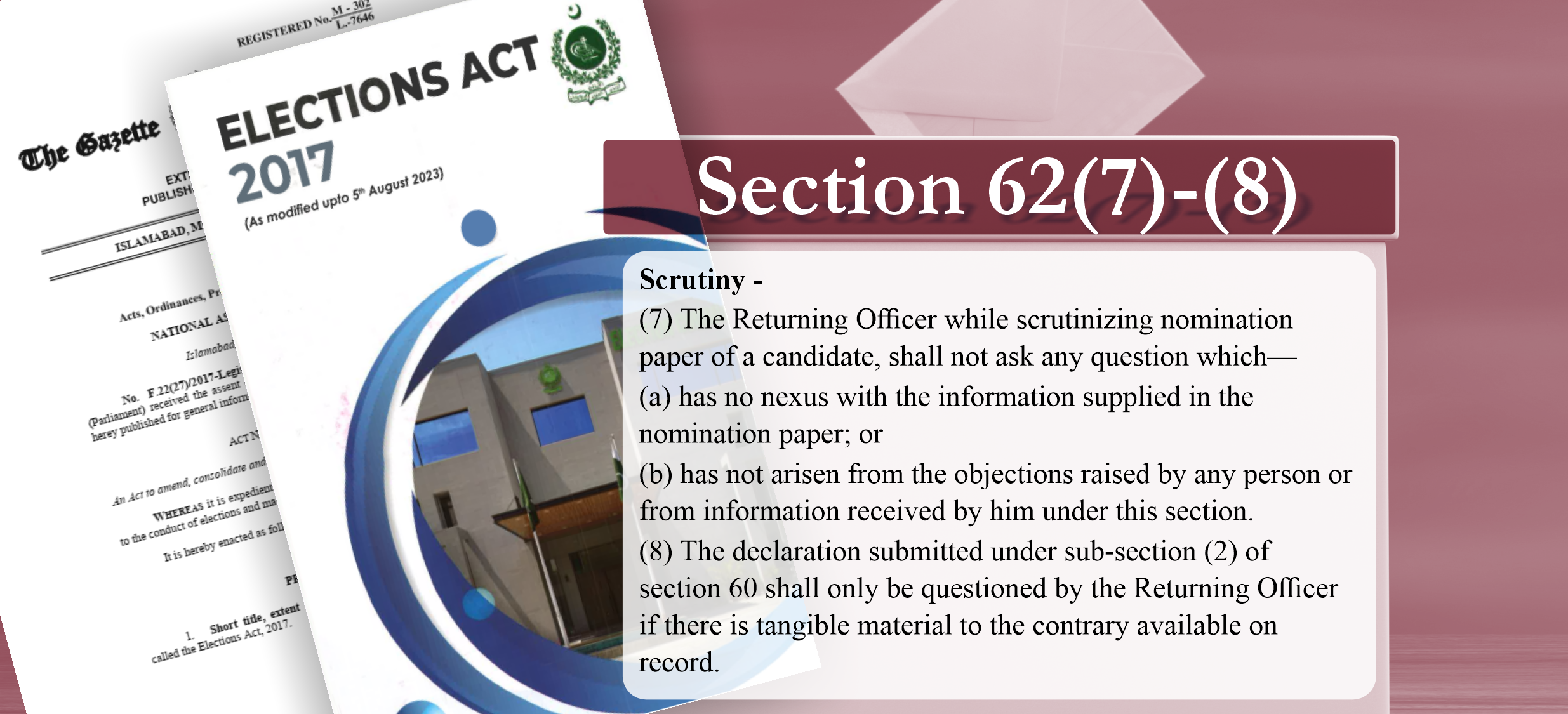
Nomination scrutiny – the stage at which a Returning Officer examines a candidate’s filed documents and decides whether to accept or reject the nomination – has generated political controversies during multiple general elections in Pakistan. The Elections Act 2017 contains explicit limits on what questions a Returning Officer may ask from candidates during the scrutiny.
What does the law say?
Section 62(7) of the Elections Act 2017 prohibits a Returning Officer from asking any question during scrutiny that has no nexus with the information supplied in the nomination paper, or that has not arisen from an objection raised by any person or from information received by the officer during the scrutiny process under Section 62(5). Section 62(8) adds that the declaration submitted by the candidate can only be questioned if there is tangible material to the contrary already on the record.
The scrutiny process is not a general character examination or a political vetting. The Returning Officer’s role is to examine the papers against the legal requirements — voter eligibility, proposer and seconder qualifications, documentation, compliance with Section 60 and 61 — and to decide objections that have been formally filed.
Why does this matter?
Section 62(7) is a protection for all candidates, not only those who have something to hide. It prevents scrutiny from becoming a process in which Returning Officers use their position to disadvantage candidates for political or personal reasons. Any question asked during scrutiny that falls outside the nominated paper’s content or filed objections exceeds the Returning Officer’s authority.
A candidate subjected to questions outside Section 62(7)’s permitted scope should formally object on the record during scrutiny. This objection preserves their right to raise the issue in any subsequent appeal under Section 63.
Source: Elections Act 2017, Sections 62(7)–(8).
This post is part of FAFEN’s series on electoral literacy. Read more of this series here.