
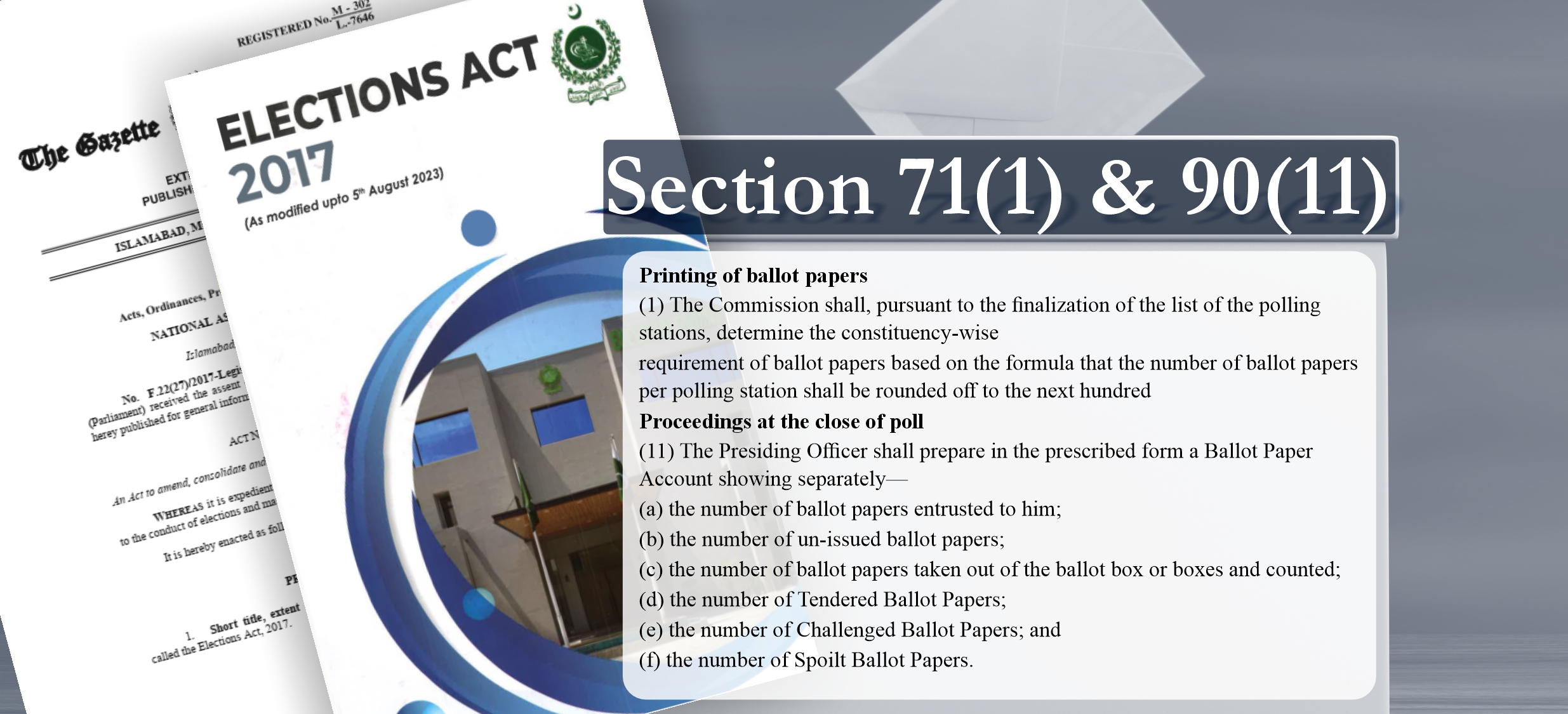
Printing 1,000 ballot papers for a polling station that has 901 voters is not a case of election fraud. Rather, it is a legal requirement under the Elections Act that provides a mathematical formula for determining the need of ballot papers for each constituency and polling station.
 What does the law say?
Section 71(1) of the Elections Act 2017 requires the Election Commission of Pakistan (ECP) to determine the constituency-wise requirement of ballot papers based on a specific formula. Under this formula, the number of ballot papers per polling station is rounded off to the next hundred. The Explanation to Section 71(1) provides an example for such “rounding off to the next hundred”. If voter strength at a polling station is 1,201 to 1,299, the requirement is printed as 1,300.
If a polling station has exactly 1,200 voters, 1,200 papers are printed. If it has 1,201 voters, 1,300 papers are printed. The surplus in this case is up to 99 papers, all of which must be accounted for in the Ballot Paper Account completed by the Presiding Officer under Section 90(11).
 Why does this matter?
The rounding formula is a statutory requirement. The surplus papers are not available for fraudulent use without detection as they appear in the official count of un-issued papers, which must balance against the total distributed. Any shortfall between printed, issued, and returned papers triggers questions in the formal accounting process.
When a social media post, party allegation, or media report claims that extra ballot papers are evidence of pre-planned fraud, Section 71(1) and the Ballot Paper Account under Section 90(11) are the factual and legal response.
 Source: Elections Act 2017, Section 71(1) Explanation and Section 90(11).
This post is part of FAFEN’s series on electoral literacy. Read more of this series here.