
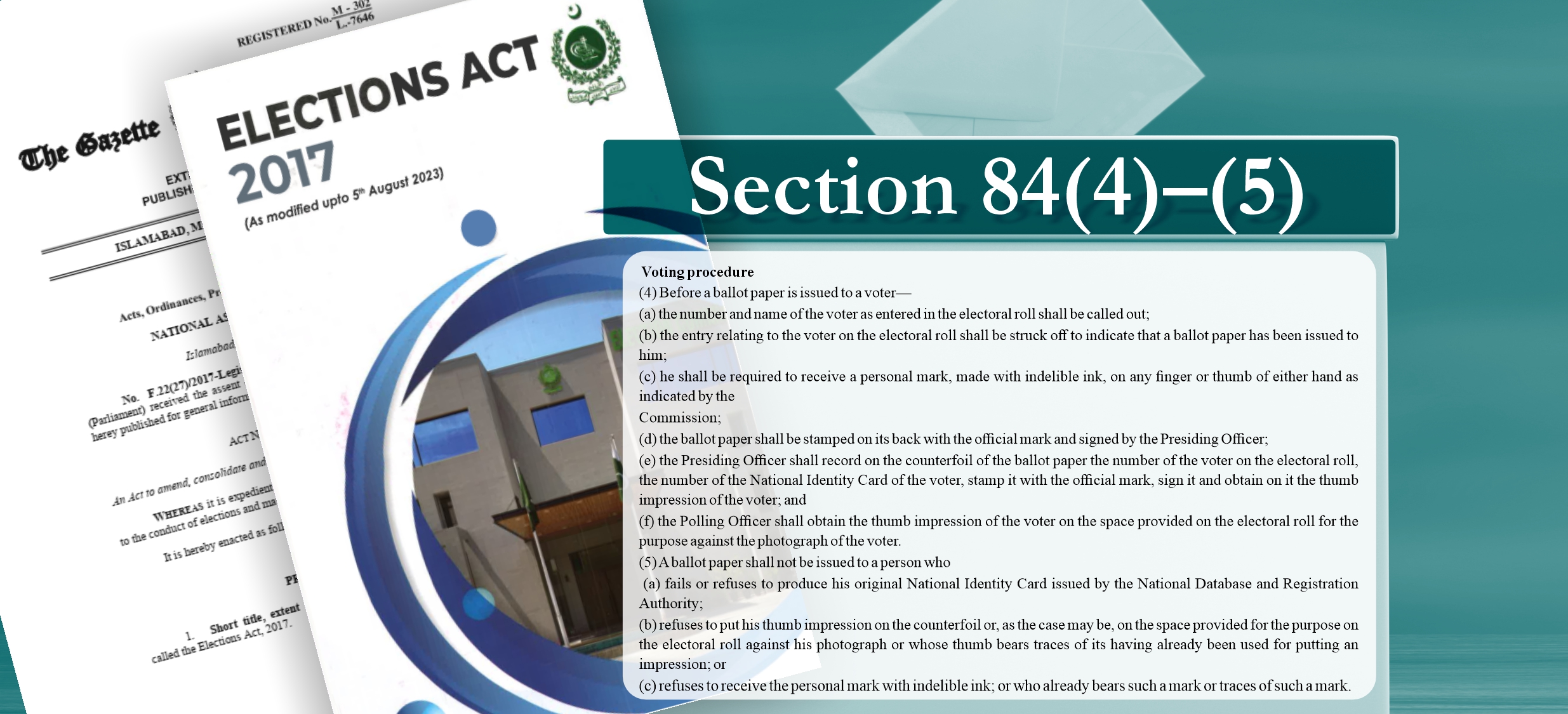
Section 84(5) of the Elections Act identifies three circumstances in which a polling official must decline to issue a ballot paper, regardless of whether the voter’s name appears in the electoral roll.
Voter entitlement to a ballot paper is not unconditional. The Elections Act 2017 links it to specific acts of cooperation from the voter. Failure to comply with any of three requirements results in lawful refusal to issue the paper — a distinction voters should understand before arriving at the polling station.
What does the law say?
Section 84(5) of the Elections Act 2017 prohibits the issuance of a ballot paper to any person who:
- fails or refuses to produce their original CNIC issued by NADRA — a copy or another form of identification is not sufficient;
- refuses to give their thumb impression on the counterfoil of the ballot paper, or whose thumb already bears traces of an ink impression indicating they have already voted; or
- refuses to receive the indelible ink mark on their finger or thumb, or who already has such a mark or traces of one.
The original NIC requirement is strict and a photocopy, a digital image on a phone, or another photo identification such as driving license does not satisfy subsection the requirement. However, an expired NIC is valid identity for receiving the ballot paper.
Why does this matter?
Understanding Section 84(5) prevents two kinds of problems. First, voters who arrive without their original NIC or who refuse the ink mark cannot claim they were unlawfully denied a ballot. Second, polling officials who use these grounds to deny ballots to voters who are in fact complying — or who apply additional grounds not in Section 84(5) — are exceeding their authority.
Source: Elections Act 2017, Section 84(4)–(5).
This post is part of FAFEN’s series on electoral literacy. Read more of this series here.