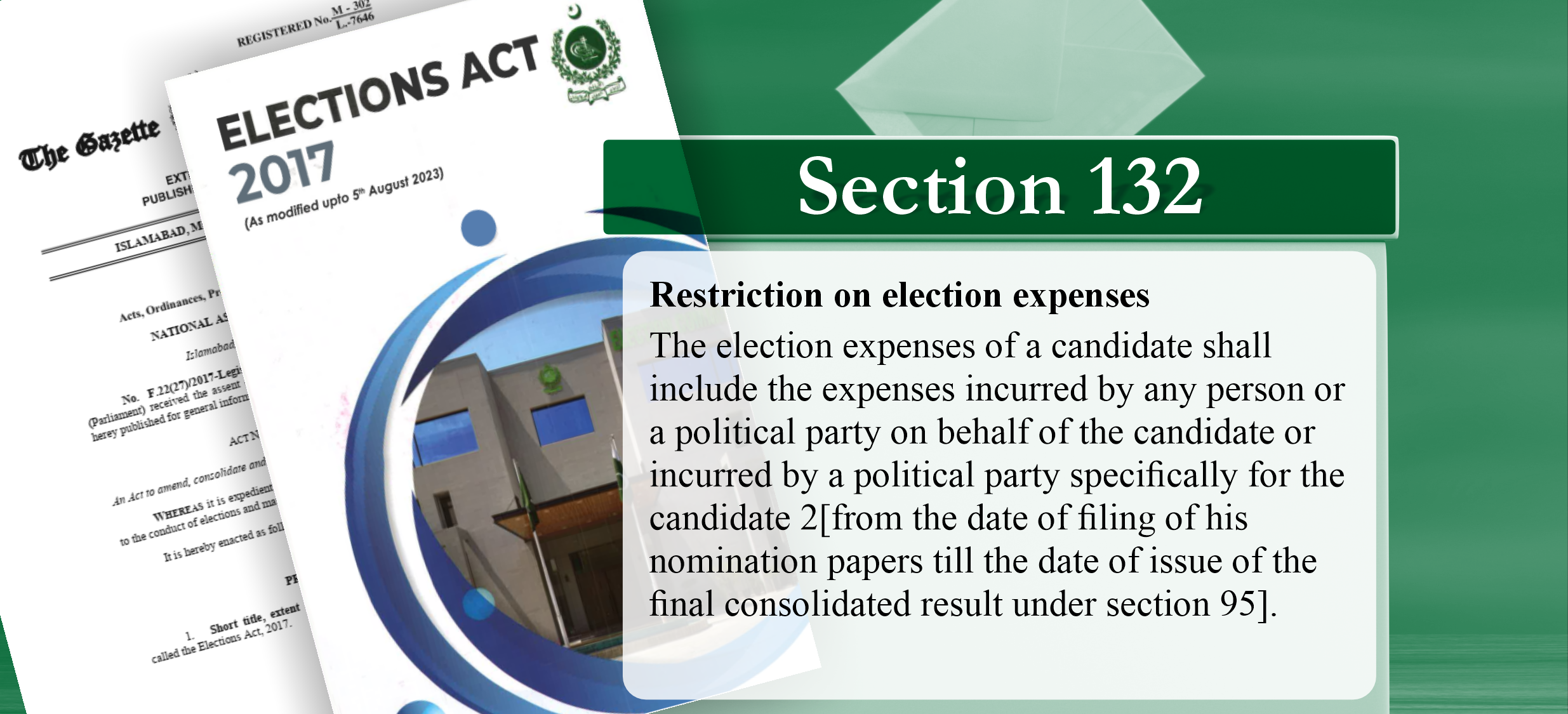
Election spending limits are a core electoral accountability mechanism. Pakistan’s election law sets a ceiling on how much a candidate can spend to contest in an election. Section 132 of the Elections Act 2017 defines what counts as election expenses, fixes the spending limits, and determines who is responsible for what.
 What does the law say?
Section 132(1) defines election expenses broadly. They include not just what the candidate spends directly, but all expenses incurred by any person or a political party on the candidate’s behalf. Importantly, the clock starts from the date of filing of nomination papers and runs until the date of issue of the final consolidated result under Section 95.
Section 132(2) reinforces this by providing that any expenses incurred on behalf of the candidate, whether for stationery, postage, advertisement, transport, or any other item, shall be deemed to have been incurred by the candidate.
Section 132(3) sets the actual spending limits. A candidate may not exceed Rs 1.5 million for a Senate seat, Rs 10 million for a National Assembly seat, and Rs 4 million for a Provincial Assembly seat. Section 132(4) requires candidates to vouch for every payment through bills, receipts, and other documents, except for individual payments below Rs 1,000.
Section 132(5) provides a safeguard. If election expenses are disputed, the ECP may conduct an inquiry to determine whether expenses incurred by a third party were made with the candidate’s permission. If they were not, those expenses are not attributed to the candidate.
Why does this matter?
The breadth of Section 132 means that well-resourced campaigns organised by a candidate’s supporters, business associates, or family members — even if channelled through organisations or community events rather than the campaign itself — can be attributed to the candidate’s expenses account.
This provision is most relevant in the post-election accountability process, when expense returns are submitted and reviewed. Journalists and election researchers investigating whether a candidate exceeded their spending limit should examine not just the candidate’s own expenses but the full range of expenditure that was visibly made in the candidate’s favour during the election period.
Source: Elections Act 2017, Sections 132.
This post is part of FAFEN’s series on electoral literacy. Read more of this series here.