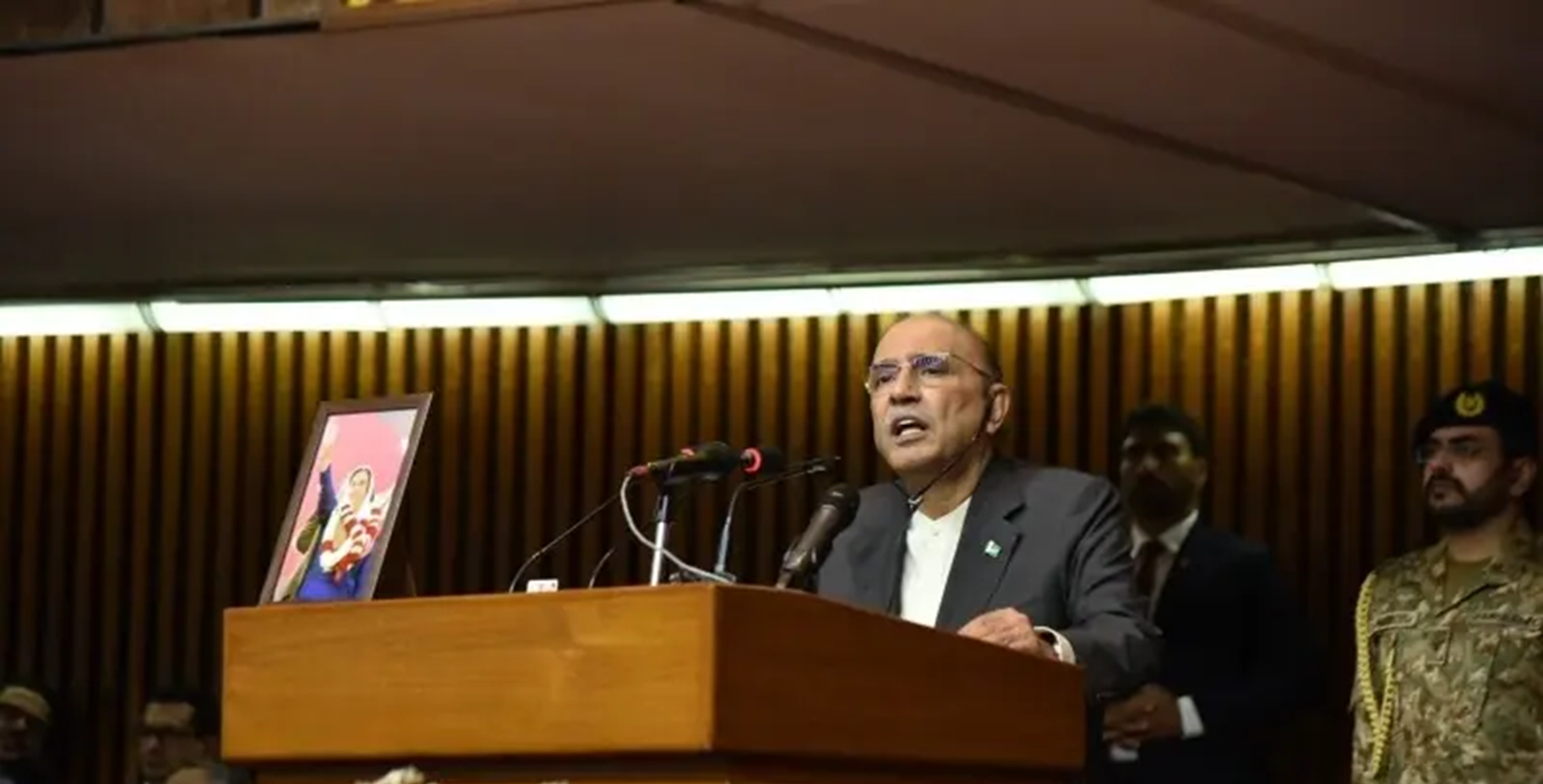
The Federal Minister for Parliamentary Affairs is scheduled to lay before the National Assembly today (March 4, 2026) an authenticated copy of President Asif Ali Zardari’s third address to Parliament, delivered on March 2.
Under Rule 60(1) of the National Assembly’s Rules of Procedure and Conduct of Business, 2007, a copy of the President’s Address must be laid before the House at its first sitting following the joint session. Subsequently, the Assembly will open discussion on the Address through a motion of thanks moved by the Minister for Parliamentary Affairs.
The President’s latest address lasted approximately 22 minutes, compared to 33 minutes for his address delivered last year. The House concluded discussion on the second address only four weeks ago by adopting the motion of thanks on February 11, 2026. The discussion on the motion had formally begun last year on March 12, 2025 — two days after the President addressed the joint sitting.
Following its introduction, the motion of thanks remained on the Assembly’s Orders of the Day for 51 sittings, representing 60 percent of the 84 sittings held during the second parliamentary year. However, debate took place only on March 12, 13 and 14, 2025, with 15 MNAs participating.
Not many people would know the reason behind keeping the discussion on presidential address alive round the year. Actually, the National Assembly rules prohibit taking up adjournment motions while the presidential address is being discussed. So, keeping the discussion pending effectively restricts the legislators’ ability to bring adjournment motions on public issues.
What do the rules say?
The President’s annual address to Parliament is a constitutional requirement, and so is the provision for discussion on it. Article 56(4) of the Constitution requires that parliamentary procedures provide for discussion on matters referred to in the President’s Address. Both the National Assembly and the Senate have operationalized this requirement through the mechanism of a motion of thanks.
In the National Assembly, Rules 59 to 66 of the Rules of Procedure and Conduct of Business, 2007 govern the procedure relating to the President’s Address and its discussion.
Under Rule 60(1), at the first sitting of the Assembly held after the President’s Address, a Minister is required to lay a copy of the Address on the Table of the House.
The Address is then discussed through a motion of thanks moved by the Minister for Parliamentary Affairs and seconded either by another Minister or by a member. Members may debate the contents of the Address before a vote is taken on the motion.
Rule 61 empowers the Speaker to allot one or more days for discussion. As the Rules do not prescribe a maximum duration for the debate, the motion may remain on the agenda until it is formally concluded.
Rule 66 allows the transaction of government and other formal business on a day allocated for discussion on the President’s Address. However, Rule 66(2) explicitly prohibits the taking up of adjournment motions during such discussion.
This procedural arrangement has been followed in recent years. In the past, lawmakers proposed amendments to define a time frame for concluding the debate on the President’s Address; however, those proposals were not adopted.