The legal mechanism for removing deceased voters from Pakistan’s electoral rolls depends on a quarterly data flow from local governments to Registration Officers. It is a statutory duty of the LGs under the Elections Act, 2017.
What does the law say?
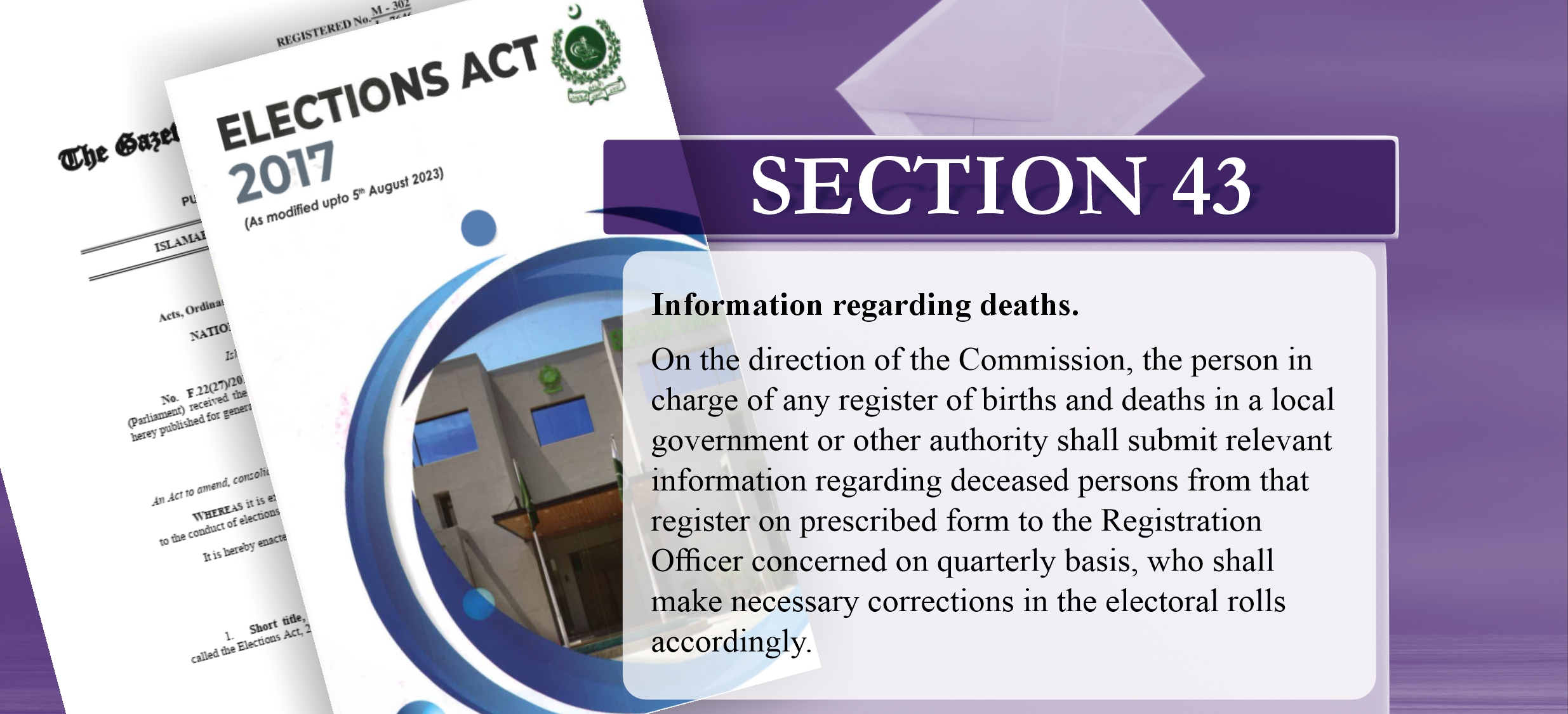
Section 43 of the Elections Act 2017 provides that on the direction of the Election Commission of Pakistan (ECP), the person in charge of any register of births and deaths in a local government or other authority must submit relevant information about deceased persons to the Registration Officer concerned, on a prescribed form, on a quarterly basis. The Registration Officer must then make necessary corrections in the electoral rolls accordingly.
The obligation falls on the local government official maintaining the deaths register, acting on ECP direction. The Registration Officer’s subsequent duty to correct the roll is immediate upon receiving the information.
Why does this matter?
If Section 43 works as designed, electoral rolls are updated four times a year with deaths registered through official channels. However, if local governments fail to submit quarterly reports, or when Registration Officers fail to act on data received, the mechanism breaks down and deceased voters remain enrolled.
Civil society organisations, local governance monitors, and election observers can use Section 43 as an accountability benchmark. Has the ECP issued the required direction to local governments? Have local governments submitted their quarterly reports? Have Registration Officers made the corresponding corrections? These are three distinct points of compliance, any one of which can cause the mechanism to fail.
Source: Elections Act 2017, Section 43.
This post is part of FAFEN’s series on electoral literacy. Read more of this series here.