Most people who claim the title of religious scholar do not know that the Elections Act defines aalim with legal precision.
Pakistan’s Senate includes seats reserved for ulema — religious scholars. These seats exist because the Constitution envisions religious learning as a distinct form of expertise deserving parliamentary representation. But the word aalim in everyday usage and its meaning under the Elections Act 2017 are not the same thing.
What does the law say?
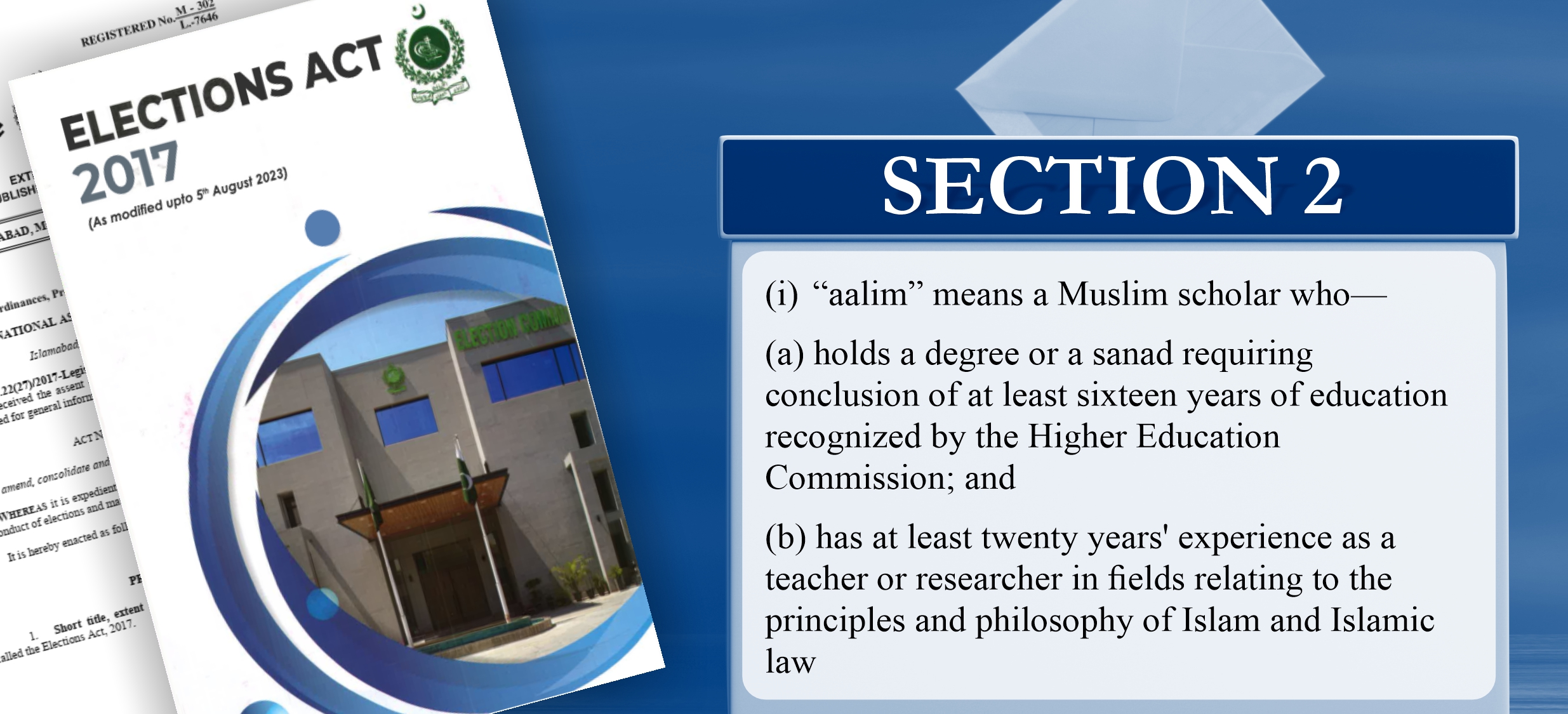
Section 2(i) of the Elections Act 2017 defines aalim as a Muslim scholar who holds a degree or sanad requiring at least 16 years of education recognized by the Higher Education Commission (HEC), and who has at least 20 years’ experience as a teacher or researcher in fields relating to the principles and philosophy of Islam and Islamic law.
The HEC recognition requirement is significant. A sanad from an institution not recognized by HEC — even if widely respected within a religious community — does not satisfy the first condition. Similarly, years spent in pastoral or preaching roles, rather than formal teaching or academic research, may not satisfy the second.
Why does this matter?
The legal definition of aalim exists to set a transparent, verifiable standard for who can contest reserved seats. Without it, the category would be susceptible to subjective or politically convenient interpretation. Any citizen can access nomination papers of election candidates — which are public documents under Section 60(7) — and check the credentials filed to see whether they meet the definition laid down in Section 2(i).
Source: Elections Act 2017, Section 2(i).
This post is part of FAFEN’s series on electoral literacy. Read more of this series here.