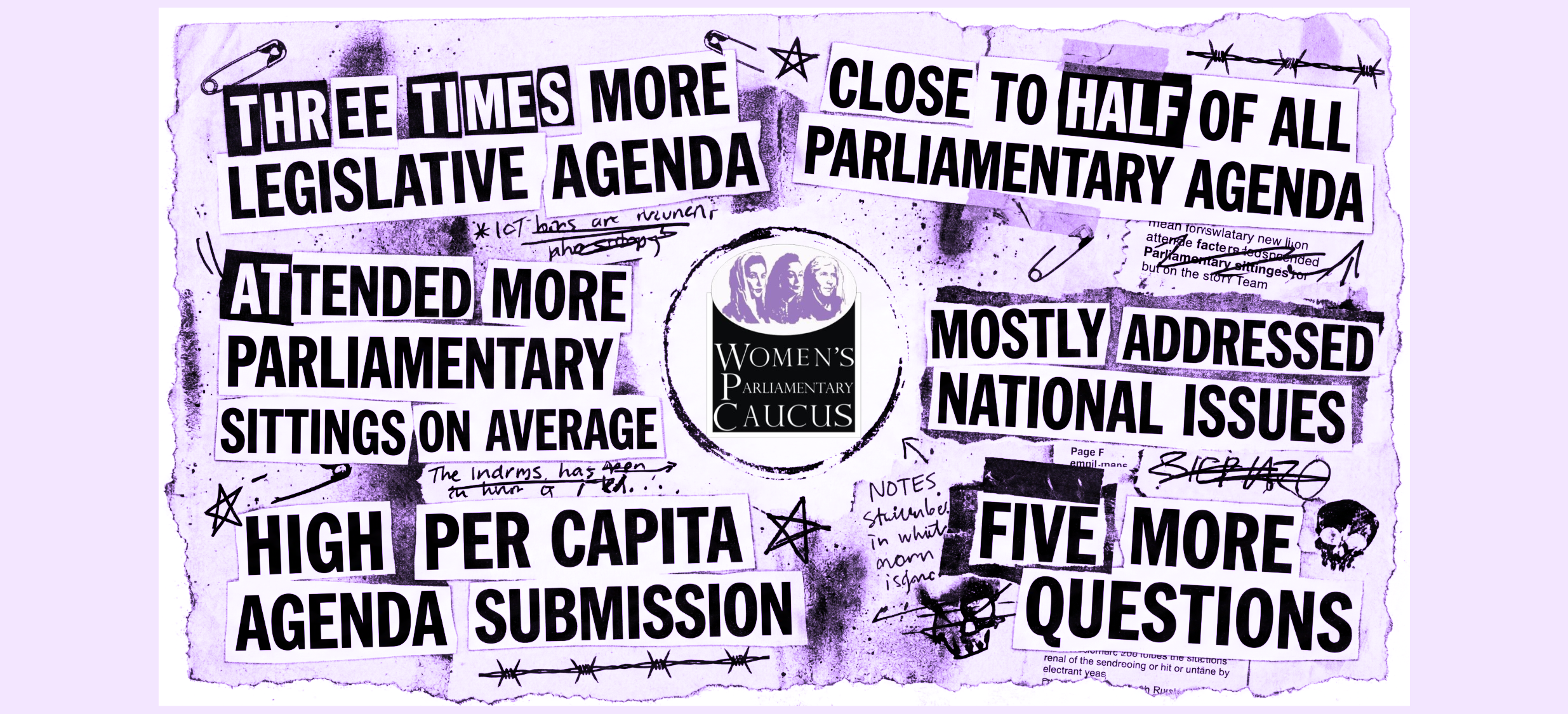
The five highest-ranking female MNAs by agenda submission — Sharmila Sahiba Faruqui Hashaam (127 items), Aliya Kamran (116), Shahida Rehmani (115), Tahira Aurangzeb (97), and Asia Naz Tanoli (93) — submitted a combined 548 items. Total female MNA agenda for the year was 1,206 items. These five members therefore accounted for approximately 45% of all female-sponsored agenda.
How this is measured:
FAFEN records every agenda item submitted by each individual MNA across the parliamentary year. Items are attributed to the primary sponsor and tracked cumulatively across all 84 sittings. Rankings are based on raw agenda volume per member for the full period 1 March 2025 to 28 February 2026. The concentration ratio — the share of total output accounted for by the top five members — is calculated directly from the dataset. All five top-ranked members held reserved seats.
Why this matters in parliamentary terms:
Concentration of output among a small cohort of members is a structural finding, not merely a ranking exercise. It indicates that the conditions enabling high legislative productivity — familiarity with parliamentary procedure, Â party encouragement, access to research resources, and freedom from other competing demands — are not evenly distributed across female membership. When 45% of all female-sponsored agenda comes from five of 74 members, the remaining 69 members are not contributing proportionally. This is not a comment on their capacity. It is a finding about the institutional conditions — including party allocation of resources and parliamentary secretariat support — that determine how productively members can engage. FAFEN notes that extending the enabling conditions available to high performers to a broader group of female MNAs is a policy-actionable recommendation arising from this data.
Source: FAFEN Women Parliamentarians Performance Report 2025–2026, Table 2. Data period: 1 March 2025 – 28 February 2026.*