
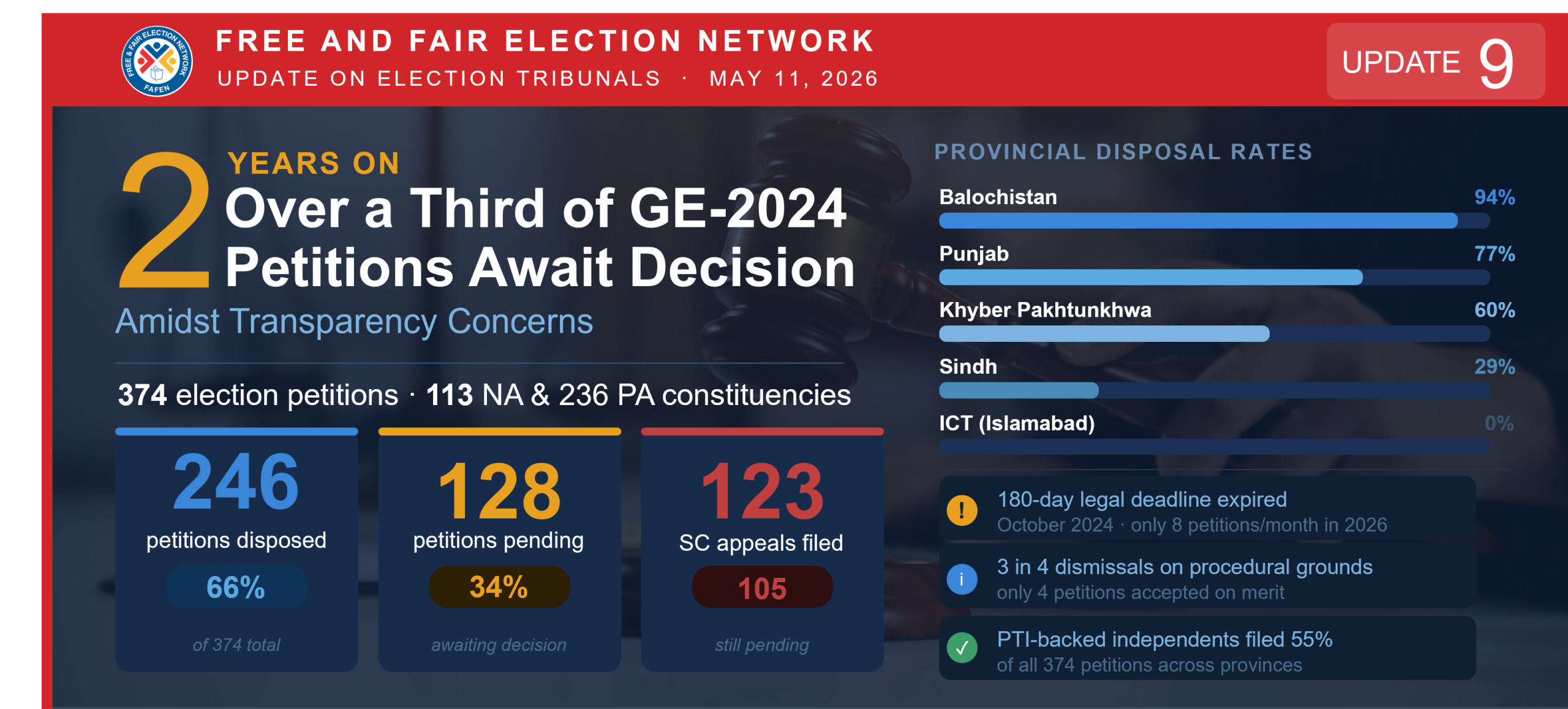
More than two years after the General Elections of February 2024 (GE-2024), election tribunals across Pakistan have disposed of nearly two-thirds of election petitions, with 128 petitions still awaiting adjudication, says latest (ninth) update on election tribunals by the Free and Fair Election Network (FAFEN).
By end of April 2026, election tribunals have decided 246 (66 percent) out of 374 petitions filed against GE-2024 outcomes in 113 National Assembly and 236 Provincial Assembly constituencies. Of 374, 73 out of 124 petitions pertaining to National Assembly constituencies and 173 out of 250 petitions pertaining to Provincial Assemblies constituencies have been disposed of.
Under Section 142 of the Elections Act, candidates may contest election results within 45 days of the gazette notification of a returned candidate, while Section 148(5) requires tribunals to decide each petition within 180 days of filing. The legally prescribed timeline for disposing of petitions expired in October 2024. Tribunal proceedings beyond this window are subject to special conditions, including mandatory cost payments for adjournments, recorded reasons where tribunals adjourn cases on their own motion, and the potential suspension of their assembly membership where delay is attributable to a returned candidate.
The pace of disposal has slowed in recent months. Compared with 171 petitions decided by 31 July 2025 – when FAFEN issued its eighth update – only 75 petitions have been decided over the subsequent nine months, averaging eight per month. This is below the monthly average of ten petitions decided between February 2024 and July 2025.
Disposal rates vary sharply by province. Balochistan leads with 49 out of 52 petitions decided (94 percent), followed by Punjab with 147 out of 192 (77 percent), Khyber Pakhtunkhwa with 26 out of 43 (60 percent), and Sindh with 24 out of 84 (29 percent). None of the petitions from Islamabad constituencies have been disposed of amidst pending litigation over the transfer of election petitions from one tribunal to another.
As many as 123 of the 246 decided tribunal decisions have been challenged before the Supreme Court, which has so far decided 18 appeals, fully or partially accepting three and rejecting 15. The remaining 105 appeals are pending.
FAFEN also noted uneven public access to tribunal proceedings and records. Petition memos, hearing details, and judgments remain largely accessible in tribunals comprising sitting judges of the Sindh, Balochistan, and Peshawar High Courts. By contrast, Punjab tribunals have provided access only to case-status information, withholding petition memos, judgments, and related documents. FAFEN tracks progress on election petitions through information acquired from tribunals, and official websites of the High Courts and Supreme Court of Pakistan.
Click here to download the complete report.