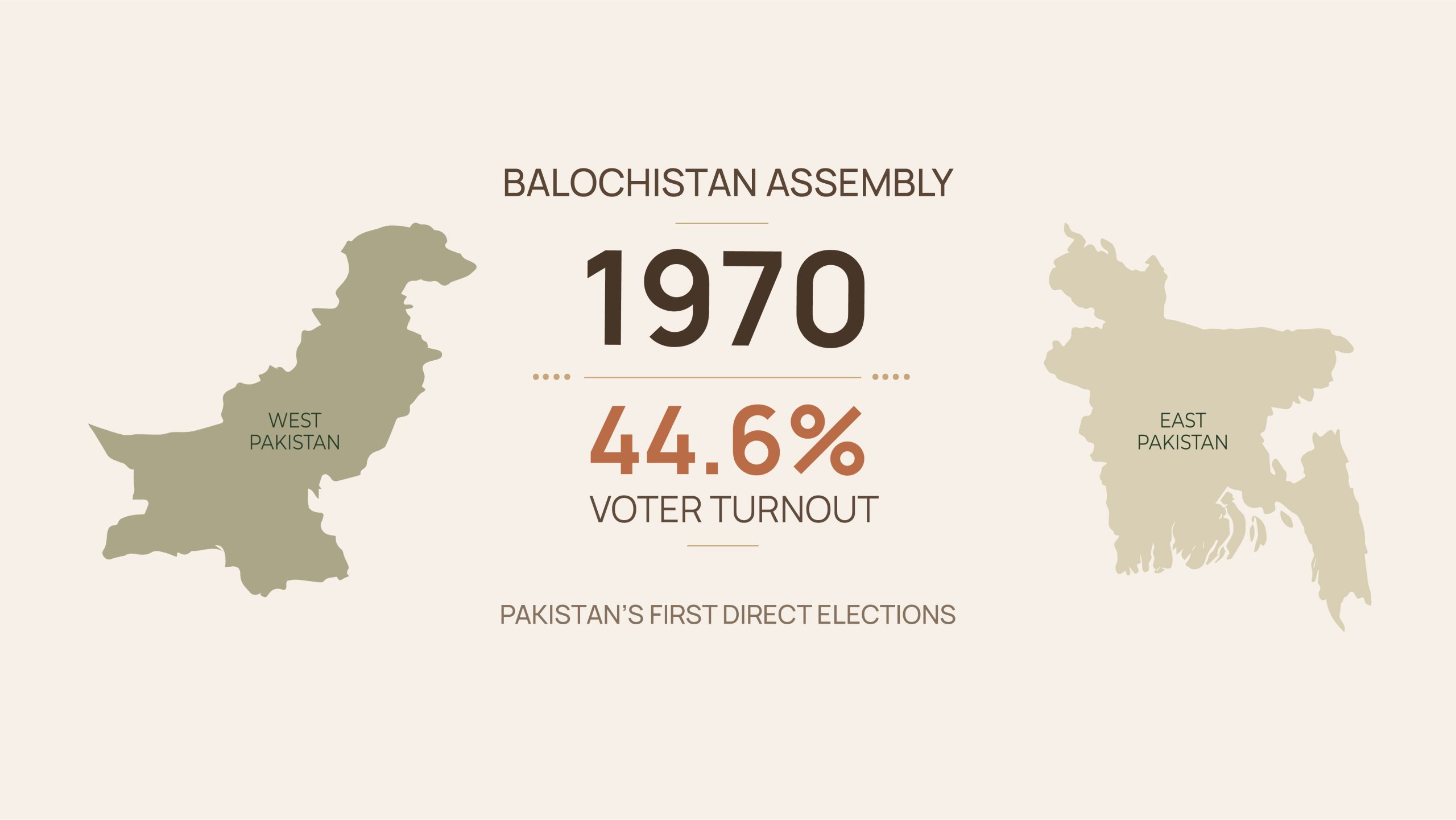
Balochistan recorded 0.43 million votes polled for the Provincial Assembly in the First General Elections, 1970, against 0.96 million registered voters, producing a turnout of 44.6%.
Balochistan is Pakistan’s largest province by land area — covering approximately 44% of the country’s total territory — but the least populous. Its registered electorate has remained the smallest of all four provinces across all twelve elections in this series. Balochistan’s political history has been marked by periods of armed insurgency, with multiple conflicts between Baloch nationalist groups and the Pakistani state documented since the 1940s. These security conditions, combined with the province’s vast distances and sparse population distribution, have been associated with lower voter turnout compared to other provinces across most election cycles.
Balochistan’s registered electorate comprised 0.56 million male voters (58.9%) and 0.39 million female voters (41.1%). The gender gap in voter registration in the province was 0.17 million — 17.8% of Balochistan’s registered electorate. Balochistan has consistently recorded the largest gender gap in voter registration as a percentage of total registered voters of any province in Pakistan.
Votes polled for the Balochistan Assembly totalled 0.43 million against a registered electorate of 0.96 million, producing a turnout of 44.6%. Balochistan has recorded the lowest provincial assembly turnout of all four provinces in most of the twelve elections in this series — including this election cycle. Turnout in the province has been below 33% in six of the twelve elections.
Gender-disaggregated votes-polled data are not available for the Balochistan Assembly in the 1970 elections. Such disaggregated data were not systematically recorded and published prior to the 2018 elections.
Rejected ballots in the Balochistan Assembly election numbered 9,973 — 2.3% of total votes polled. The rejection rate in Balochistan has consistently been the highest of all four provinces across most election cycles, ranging from 1.9% (1990) to 5.2% (2013 and 2018). The high rejection rates may reflect a combination of lower average literacy rates and the administrative complexities of managing elections across some of Pakistan’s most geographically remote constituencies.
Balochistan’s registered electorate grew from under one million in 1970 to 5.4 million in 2024 — the fastest proportional growth of any province — though its absolute registered voter count remains by far the smallest. Votes polled for the Balochistan Assembly increased from 426,147 in 1970 to 2.4 million in 2024. Across all twelve elections, Balochistan’s highest recorded Assembly turnout was 44.6% in 1970 and its lowest was 19.3% in 1977.