
The 2023 amendment to the Elections Act increased the number of election agents a candidate can appoint — but imposed a specific restriction at the most critical stage of the process. Election agents has the right to represent candidates during the polling and counting processes.
What does the law say?
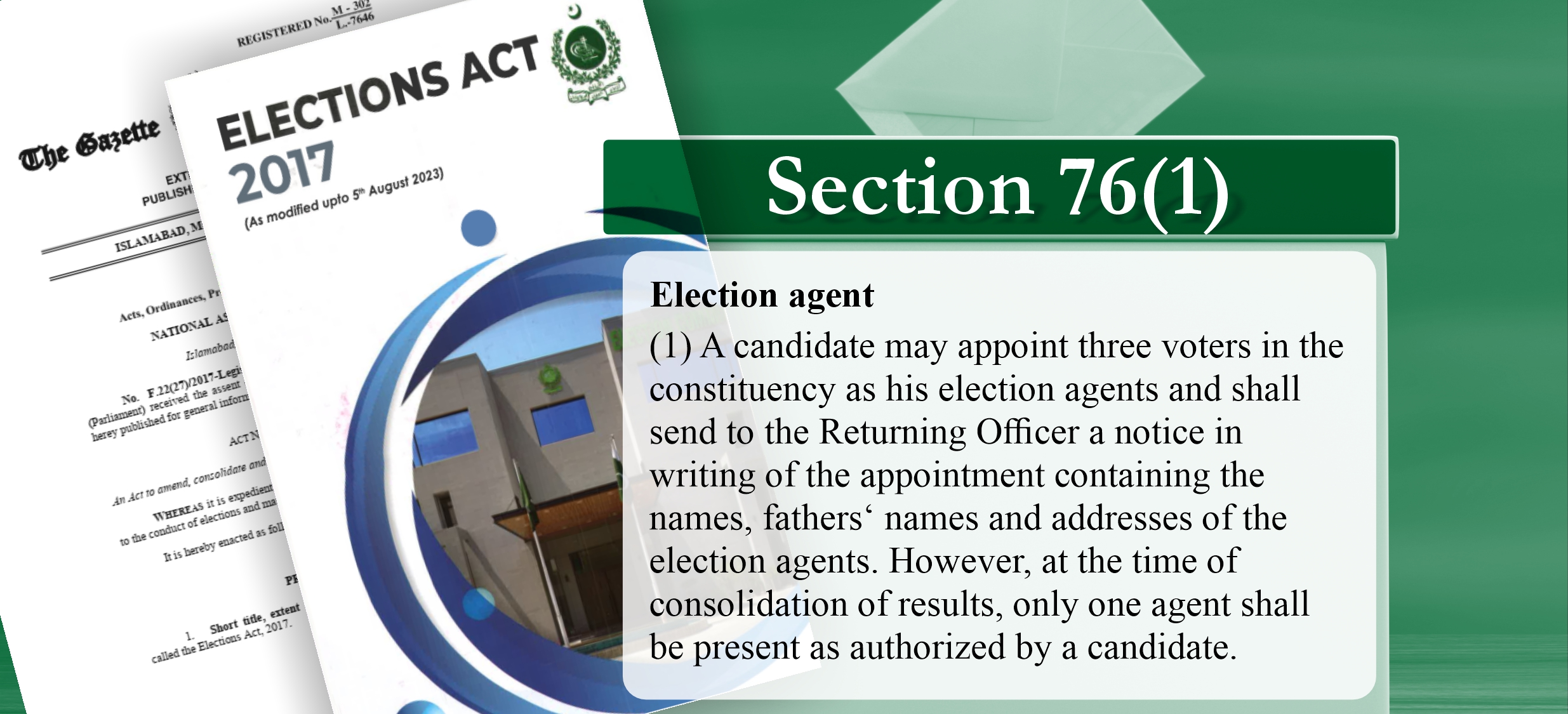
Section 76(1) of the Elections Act 2017, as amended in 2023, allows a candidate to appoint three voters in the constituency as election agents. The candidate must notify the Returning Officer of their names, fathers’ names, and addresses. However, Section 76(1) adds a specific restriction that at the time of consolidation of results, only one agent shall be present as authorised by the candidate.
Consolidation of results is the stage at which the Returning Officer aggregates polling station results from across the constituency to determine the overall winner. This is a distinct process from the polling station count as it occurs at the Returning Officer’s office, typically through the night following polling day.
Why does this matter?
The three-agent entitlement — up from one agent under the previous version of the Act — enhances candidate representation in the constituency before and during the voting day. In a large constituency with hundreds of polling stations, a candidate can deploy agents more effectively across the geography.
Simultaneously, the one-agent limit at consolidation is a crowd management provision. The consolidation process involves multiple candidates’ agents in a single location, and limiting each candidate to one authorised presence prevents the proceedings from becoming unmanageable. The authorised agent at consolidation has the right to observe, receive copies of the Consolidation Result, and sign the record.
 Source: Elections Act 2017, Section 76(1) as amended by the Elections (Second Amendment) Act 2023.
This post is part of FAFEN’s series on electoral literacy. Read more of this series here.