Pakistan’s election law requires the ECP to carry out a post-election review after every general election and to publish its findings. Most citizens have never read one.
Every general election in Pakistan is followed by public debate about what went wrong particularly regarding results delays, polling station problems, security failures, disenfranchisement of women voters. What is less commonly known is that the Elections Act 2017 requires the Election Commission of Pakistan (ECP) to conduct its own formal review of these issues, and to publish the findings.
What does the law say?
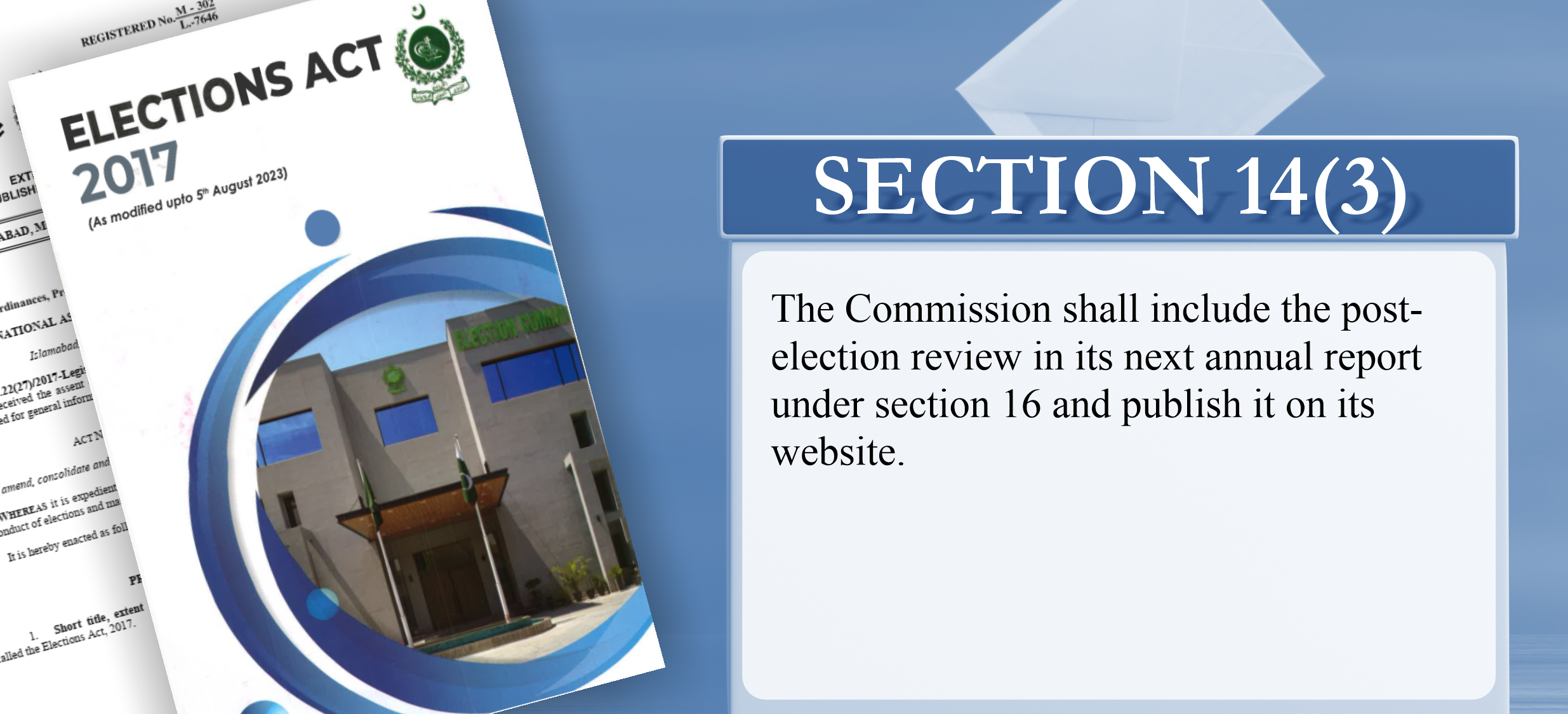
Section 14(2) of the Elections Act 2017 requires the Commission to carry out a post-election review of the implementation of its pre-election Action Plan. The review must identify shortcomings and include suggestions for further improvements to the electoral system. Under Section 14(3), the Commission must include this post-election review in its next annual report and publish it on its website.
The annual report itself carries its own statutory deadline. Under Section 16(1), it must be published within 90 days of the end of each calendar year. The report is sent to the federal and provincial governments, which are required to lay it before the Parliament and Provincial Assemblies. Section 16(3) requires the Commission to publish the report on its website immediately after it has been laid in the National Assembly or the Senate.
Why does this matter?
The ECP’s post-election review is a self-assessment tool created by law. It exists because Parliament recognized that election management improves only through systematic reflection on documented failures. When the ECP identifies a shortcoming in its Action Plan — whether in results management, voter enrolment, or polling station operations — that finding should drive procedural change before the next election.
Citizens and observers should also look for ECP’s post-election review and annual reports. It is the Commission’s own account of what the law required and where implementation fell short.
 Source: Elections Act 2017, Sections 14(2) & (3) and 16(1) & (3).
This post is part of FAFEN’s series on electoral literacy. Read more of this series here.