The ECP’s power to alter or reissue an Election Programme is provided in the Elections Act, but it comes with a transparency requirement that constrains arbitrary use.
A common perception in Pakistan is that the Election Commission of Pakistan (ECP) can postpone or restructure elections entirely at its discretion. Section 58 of the Elections Act 2017 contains this power, and its legal limits.
What does the law say?
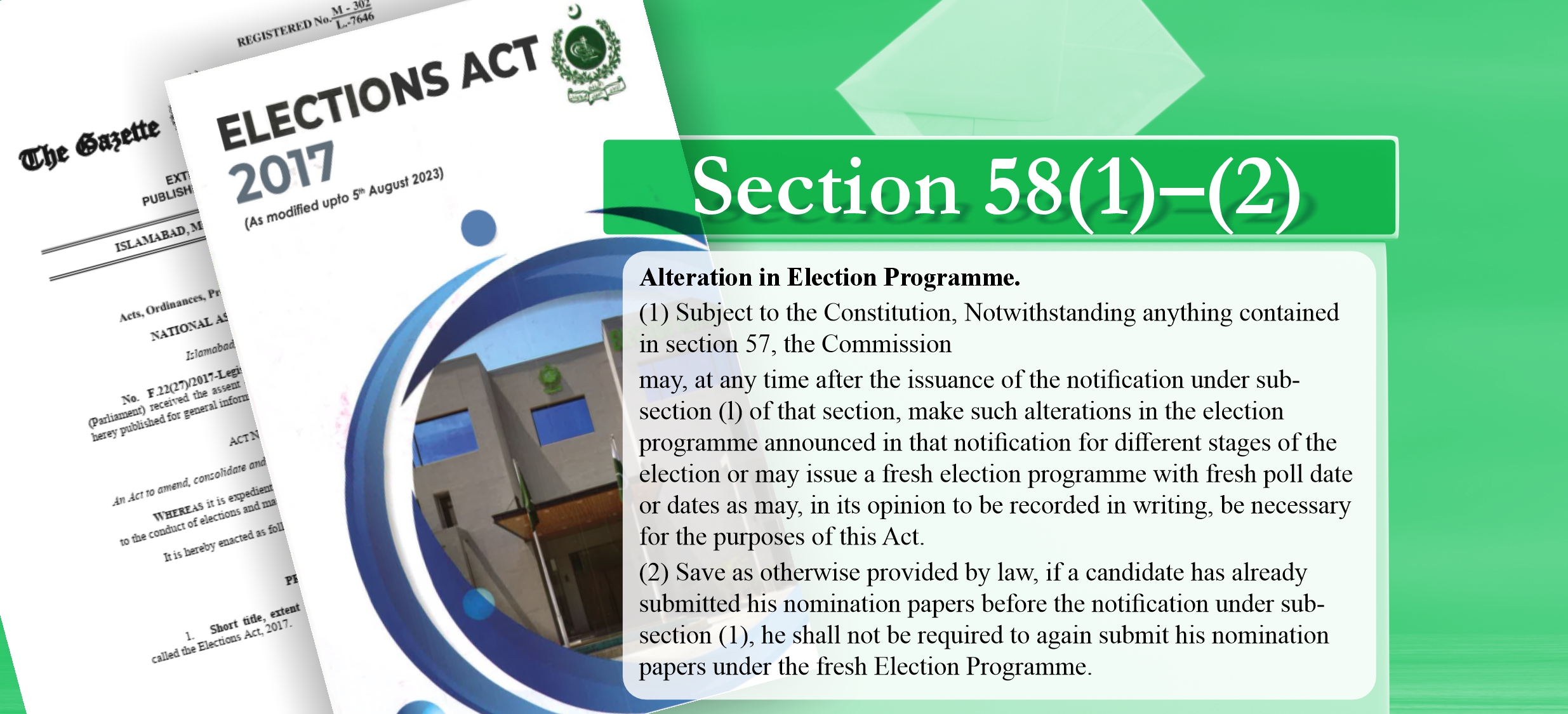
Section 58(1) of the Elections Act 2017 allows the Commission, at any time after issuing a notification under Section 57(1), to alter the Election Programme for different stages or to issue a fresh programme with a new polling date or dates. The operative constraint is that the Commission must record its opinion including the reasons for that opinion in writing. A programme cannot be altered by administrative convenience alone. The reasons must be documented.
Section 58(2) contains an important candidate protection as well. If a candidate has already submitted nomination papers before the alteration, they are not required to resubmit them under the fresh programme.
Why does this matter?
The written-reasons requirement in Section 58 is the check on arbitrary postponement. When the ECP alters an Election Programme, the recorded reasons become a public document subject to scrutiny by courts, civil society, and the media. This provision matters particularly in contexts where election postponement is alleged to serve political purposes. If reasons are recorded and published, they can be evaluated.
Source: Elections Act 2017, Section 58(1)–(2).
This post is part of FAFEN’s series on electoral literacy. Read more of this series here.