
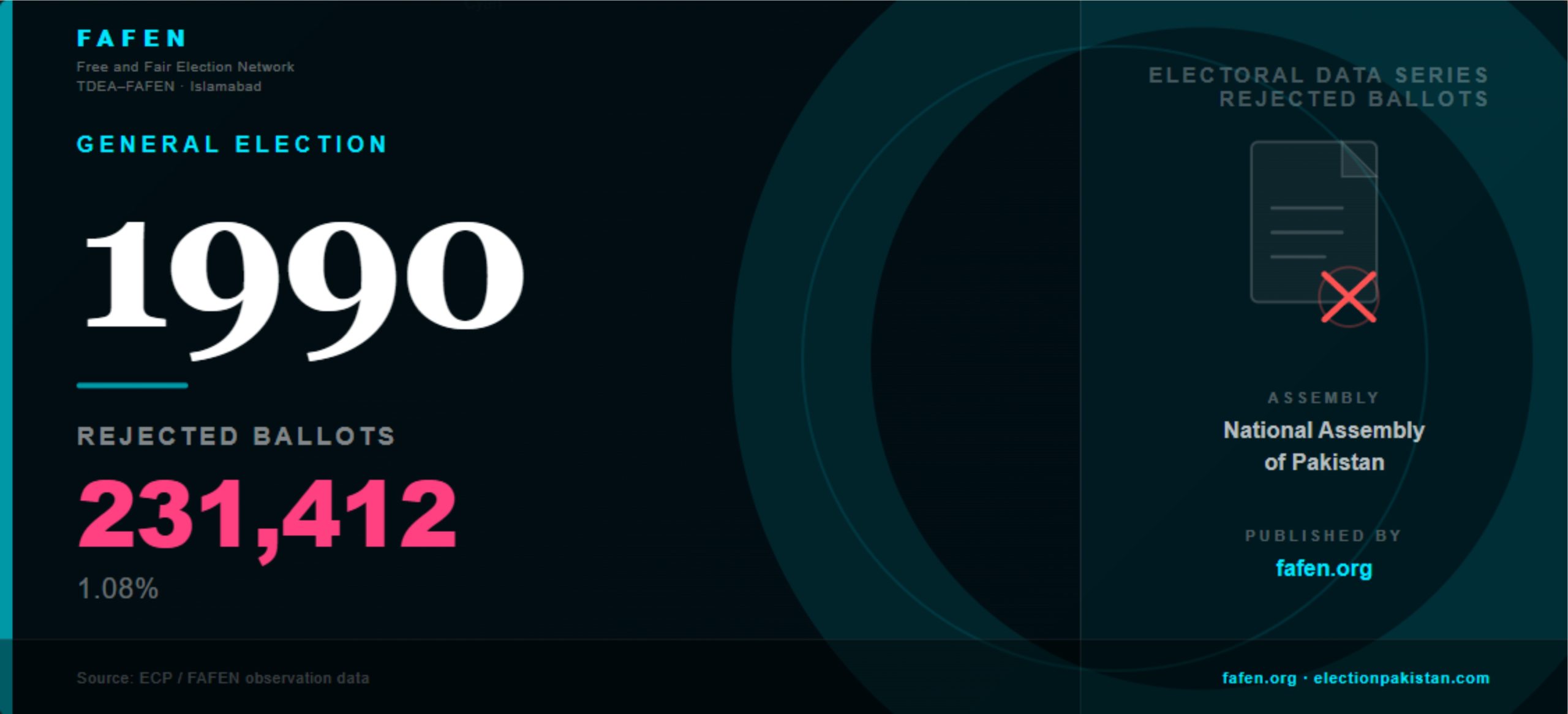
The 1990 National Assembly election recorded the lowest rejection rate in this dataset: 231,412 votes rejected out of 21,397,153 polled, a rate of 1.08%. The nationwide total across all assemblies — 414,986 rejected ballots — was also the lowest absolute figure in the dataset. Sindh had the lowest provincial rate at 0.71%, followed by Punjab at 0.76% and Khyber Pakhtunkhwa at 1.32%. Balochistan, at 1.85%, recorded the highest rate even in this historically low-rejection election.
Election Context: 1990
Pakistan’s 1990 general elections were held on 24 October 1990 following the dismissal of Prime Minister Benazir Bhutto’s government by President Ghulam Ishaq Khan. The elections saw the Islami Jamhoori Ittehad contest against the PPP-led alliance. The 1.08% National Assembly rejection rate — the lowest in this dataset — reflects a second consecutive party-based election cycle in which voters had become familiar with party-symbol ballot procedure. Balochistan’s consistently elevated rejection rate across election cycles warrants focused attention from election administrators and civic education programmes.
Breakdown — Rejected Ballots
| Assembly | Rejected Ballots | Rejection Rate |
| National Assembly Election | 231,412 | 1.08% |
| Khyber Pakhtunkhwa Assembly Election | 30,606 | 1.32% |
| Punjab Assembly Election | 104,760 | 0.76% |
| Sindh Assembly Election | 33,560 | 0.71% |
| Balochistan Assembly Election | 14,648 | 1.85% |
Source: TDEA–FAFEN compiled dataset from Election Commission of Pakistan records.
What Is a Rejected Ballot?
A rejected ballot is a ballot paper excluded from the vote count. Polling staff identify and set aside such ballots during the counting process at the polling station. The Returning Officer (RO) then reviews these determinations during the consolidation of results, and the ballot is formally rejected only after that scrutiny. Pakistani electoral procedure specifies four grounds for rejection: the ballot does not bear the presiding officer’s official stamp and signature; it carries any mark or writing beyond the Assistant Presiding Officer’s (APO) official seal and signature; an extraneous paper or material is attached to it; or the voting mark falls simultaneously in the boxes of two candidates in a way that makes it impossible to determine which candidate the voter intended to select.
Rejection does not automatically indicate fraud or deliberate misconduct. Voter error — including accidental double-marking or stamps placed outside the designated box — accounts for a documented share of rejections in every election.