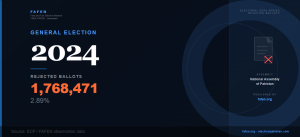
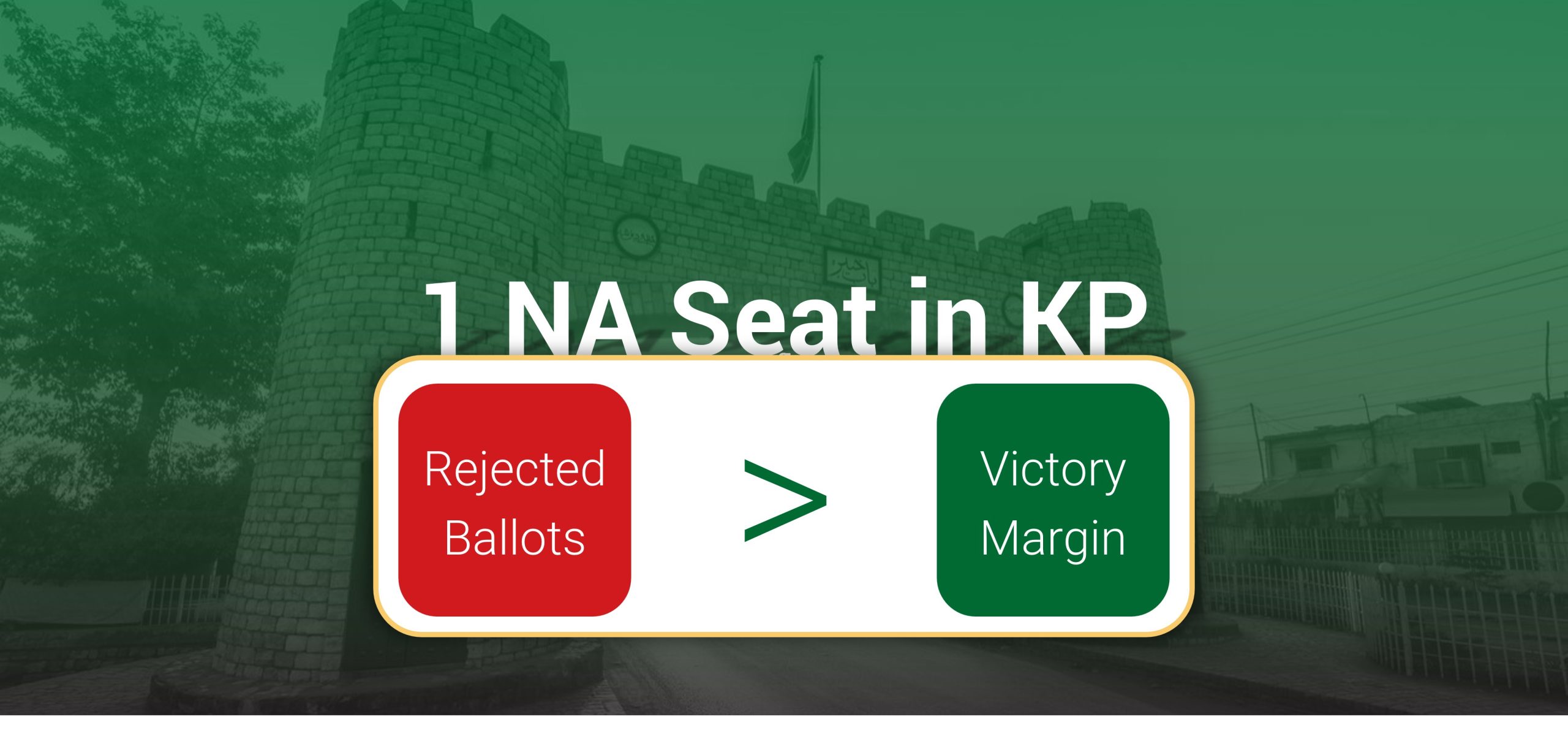
In the general elections of 8 February 2024 (GE-2024), one of 45 contested National Assembly (NA) constituencies in Khyber Pakhtunkhwa (KP) returned a result where the number of rejected ballots exceeded the margin of victory between the winning candidate and the runner-up. This represents 2.2 percent of all KP NA seats — the lowest proportion recorded in the province across five general elections since 2002 and well below the national average of 12.1 percent.
What the Numbers Show
The data for KP require a note on the administrative history of the Federally Administered Tribal Areas (FATA). Through GE-2018, FATA returned 12 separate NA constituencies and is reported here as a distinct region for those four elections. Following the Twenty-Fifth Constitutional Amendment of 2018, FATA was merged into KP. The merger took effect after GE-2018 was held, meaning FATA contested its 12 seats independently for the last time in that election. In GE-2024, the former FATA areas were represented through six newly allocated NA seats within KP’s expanded 45-seat NA bloc, and no separate FATA figure is recorded from that election onward.
Across five general elections since 2002, KP and FATA together recorded 28 NA constituencies where rejected ballots exceeded the winning margin — 22 in KP and six in the former FATA constituencies across GE-2002, GE-2008, and GE-2013. In GE-2002, one of 35 KP seats (2.9 percent) and one of 12 FATA seats (8.3 percent) recorded this condition — a combined figure of two of 47 seats (4.3 percent). This rose sharply in GE-2008 to nine KP seats (25.7 percent) and two FATA seats (16.7 percent) — a combined peak of 11 of 47 constituencies (23.4 percent), the highest figure recorded in the region across the five elections. In GE-2013, the combined figure declined to eight — five KP seats (14.3 percent) and three FATA seats (25 percent). In GE-2018, six KP seats (17.1 percent) recorded the condition while no FATA constituency did, for a combined figure of six of 47 seats (12.8 percent). In GE-2024, with FATA now part of KP, one of the expanded 45 KP seats (2.2 percent) recorded rejected ballots above the winning margin — the lowest figure in the series and a sharp reduction from every preceding election.
What the Numbers Do Not Establish
The figures do not, on their own, explain what drove the reduction — particularly the sharp decline from six constituencies in GE-2018 to one in GE-2024. Whether this reflects changes in voter education, electoral administration, polling station practice, or the structural effects of the FATA merger requires constituency-level analysis. The one constituency recorded in GE-2024 nonetheless warrants individual examination — of the grounds on which ballots were rejected, the consistency of invalidation across polling stations, and whether the rejection rate fell within the normal range. The ECP may use its powers under Section 8(b) of the Elections Act, 2017 to conduct such an exercise, which could inform its future voter education campaigns and highlight any unique patterns of rejection with a bearing on election outcomes. FAFEN’s constituency-level data series, drawing on Form 49 records, is intended to support precisely that analysis.
What Is the Margin of Victory?
The margin of victory is the numerical difference between the votes secured by the winning candidate and the votes secured by the candidate who finished second. It is the gap that separates a seat won from a seat lost. In closely contested constituencies, this margin may be a few hundred — or even a few dozen — votes.
What Are Rejected Ballots?
A rejected ballot is a ballot paper excluded from the vote count. Polling staff identify and set aside such ballots during the counting process at the polling station. The Returning Officer (RO) then reviews these determinations during the consolidation of results, and the ballot is formally rejected only after that scrutiny. Pakistani electoral procedure specifies four grounds for rejection: the ballot does not bear the presiding officer’s official stamp and signature; it carries any mark or writing beyond the Assistant Presiding Officer’s (APO) official seal and signature; an extraneous paper or material is attached to it; or the voting mark falls simultaneously in the boxes of two candidates in a way that makes it impossible to determine which candidate the voter intended to select.
Rejection does not automatically indicate fraud or deliberate misconduct. Voter error — including accidental double-marking or stamps placed outside the designated box — accounts for a documented share of rejections in every election.