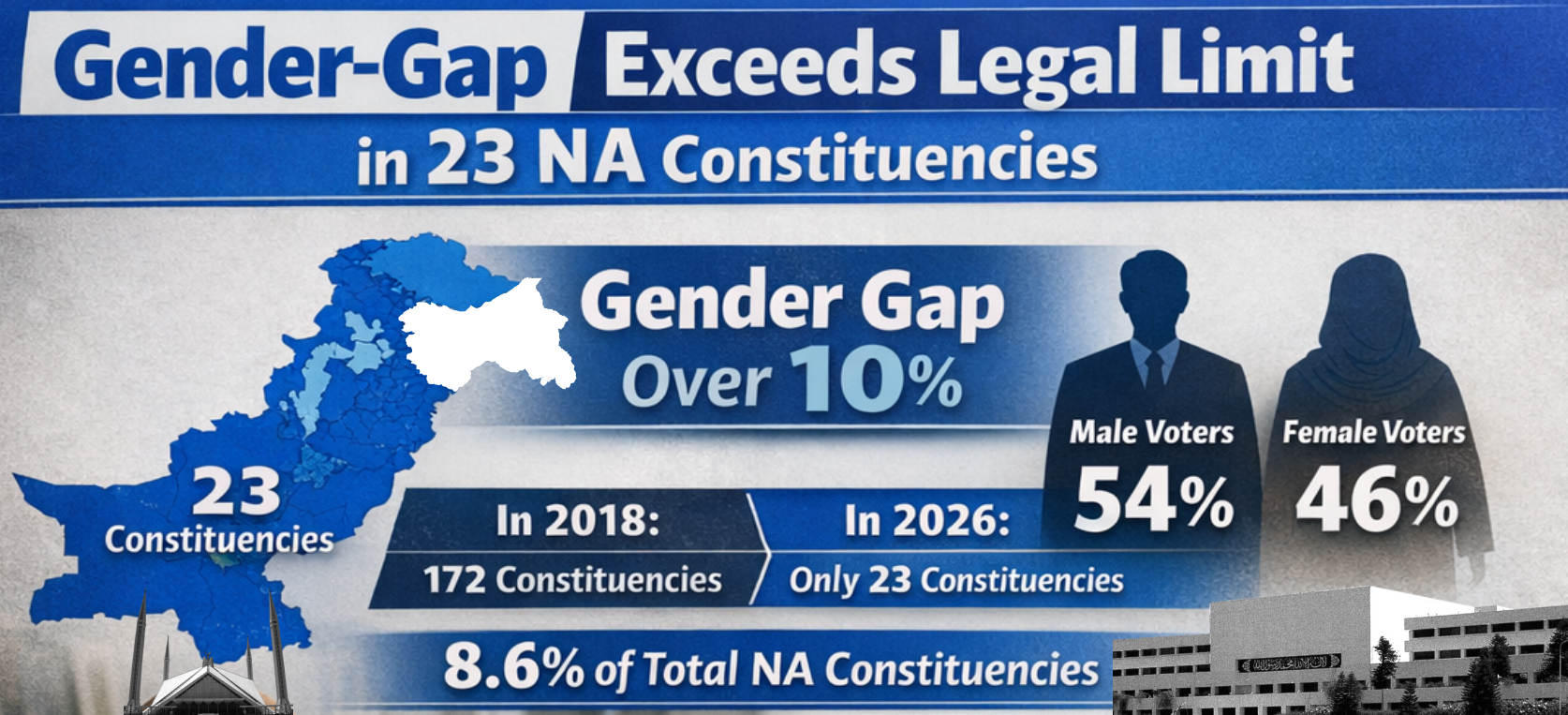
 Twenty-three of 266 National Assembly (NA) constituencies recorded a gender gap in voter registration above the legally permissible threshold of ten percent, according to constituency-wise electoral rolls published by the Election Commission of Pakistan (ECP) on 3 February 2026.
During the General Elections 2018 (GE-2018), 172 NA constituencies recorded a gender-gap in voter registration exceeding ten percent. This represented approximately 63.2 percent of the total NA constituencies in the country at the time. In 2018, the National Assembly comprised 272 constituencies, however, the number of NA constituencies was subsequently reduced to 266 following the merger of the Federally Administered Tribal Areas (Ex-FATA) with Khyber Pakhtunkhwa (KP) province under the 25th Constitutional Amendment in May 2018. Since the 25th Amendment in the Constitution, now the number of NA constituencies is 266.
[Read FAFEN’s story: History of Constitutional Amendments in Pakistan]
By the time of the General Elections 2024 (GE-2024), the number of such constituencies with a gender-gap exceeding ten percent had declined significantly from 172 to 37 accounting for 13.9 percent of all NA constituencies.
More recent voter statistics released in February 2026 indicate further improvement. According to the updated electoral rolls issued by the ECP, only 23 such constituencies approximately 8.6 percent of the total now have a gender-gap of more-than ten percent between registered male and female voters. These figures suggest a continuing, though uneven, trend toward greater gender balance in the electoral rolls. reflecting a gradual but steady narrowing of the gender gap in voter registration across the country. While the overall trend is encouraging, 23 constituencies remaining above the legal threshold indicate that structural and sociocultural barriers to female voter registration persist in parts of the country.
[Read FAFEN’s story: Constituency-wise electoral rolls as on 3 February 2026]
What the Elections Act requires
The continued presence of a gap of this magnitude nonetheless underscores the need for sustained institutional actions. Section 47(1) of the Elections Act, 2017 requires the ECP to annually publish disaggregated data of registered male and female voters in each constituency and to highlight the difference in their numbers. Under Section 47(2), the Commission must take special measures in any constituency where this difference exceeds ten percent including measures reduce this variation. Section 47(3) further specifies that these measures shall include action by the National Database and Registration Authority (NADRA) to expedite National Identity Card (NIC) issuance for women in affected constituencies, and by the ECP to enroll them as voters in the relevant electoral area. This provision places a clear, joint institutional responsibility on both NADRA and the ECP to address the gender-gap where it crosses the legal threshold.
These measures include targeted voter registration campaigns, NIC facilitation drives, and community-level outreach to address the barriers that continue to limit women’s registration. Consistent implementation of these provisions is critical to ensuring that the downward trend in the gender gap is sustained and accelerated in the electoral rolls ahead of the next general elections.
[Read FAFEN’s Story: 54% of Pakistan’s Population Is Registered as Voter]
Suggested Readings
- National gender gap in electoral rolls narrows to 6.98%
- Punjab’s gender gap in voter registration narrows to 8%
- Sindh’s gender gap in voter registration declines to 7.7%
- Khyber Pakhtunkhwa records marginal decline in gender gap among voters
- Gender gap among voters increases in Balochistan
- ICT Gender Gap: Number Up, Percentage Down