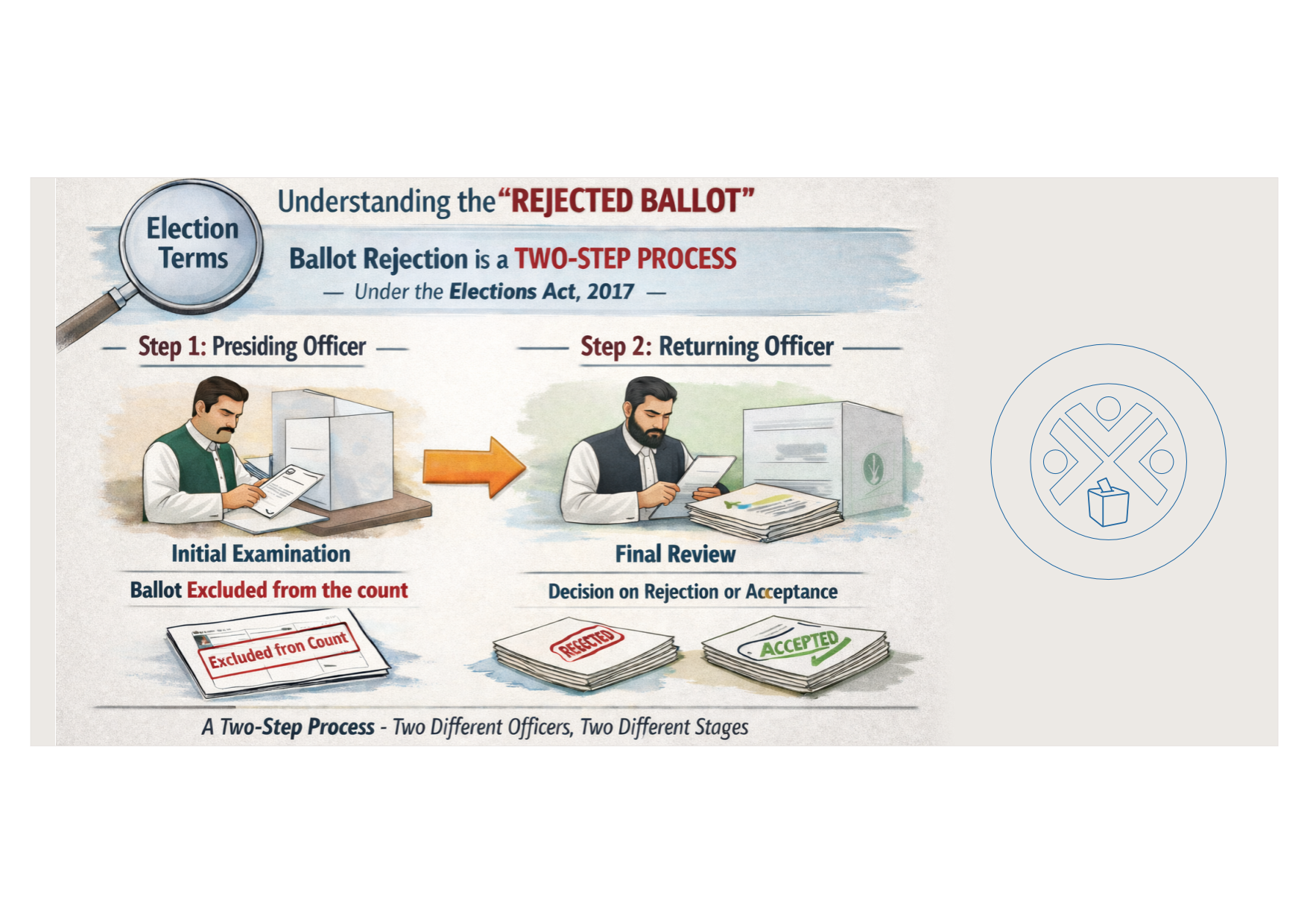
During elections, certain technical terms surface repeatedly in results coverage but receive little public explanation. “Rejected ballot” is one of them. Under the Elections Act, 2017, ballot rejection is not a single action it is a two-step process involving two different officials at two different stages of the count.
Step one: Exclusion at the polling station
At the close of polling, the Presiding Officer (PrO) opens the ballot box and counts all ballot papers. Under Section 90(4)(c) of the Elections Act, 2017, the PrO excludes from the count any ballot that meets one or more of the following conditions:
- It carries no official mark and no signature of the PrO.
- It bears any writing, mark, or attached object beyond the official mark, the PrOs signature, and the prescribed voting mark.
- It carries no prescribed mark indicating the voter’s choice of candidate.
- It carries a mark from which the voter’s choice cannot be clearly determined.
Section 90(5) further specifies when a mark is valid: a ballot is counted in favour of a candidate only if the whole, or more than half, of the prescribed mark falls clearly within the space bearing that candidate’s name and symbol. Where the mark is divided equally between two candidates’ spaces, the ballot is deemed invalid.
Tendered and challenged ballots are cast and counted separately by the PrO as distinct lots. Some ballots within each lot may be excluded on the same Section 90(4)(c) grounds that apply to all other ballots. At the conclusion of counting, the PrO seals and packs ballots excluded from the count, excluded tendered ballots, and excluded challenged ballots in three separate, labelled packets. Tendered and challenged ballot counts are recorded separately on Form-45 (Result of the Count), along with the overall count. All sealed packets are then dispatched to the Returning Officer (RO).
Step two: Review and rejection during consolidation
On receiving Form 45s from all polling stations, the RO prepares Form 47 (Provisional Consolidated Statement of Results of the Count) a candidate-wise aggregation of votes received at each polling station. Form 47 records the total number of ballots excluded from the count, but does not contain rejected ballot figures. Exclusion and rejection are distinct: ballots excluded by a PrO have not yet been formally reviewed, and no determination of rejection has been made at this stage.
That determination is made during the consolidation of results proceedings under Section 95 of the Elections Act, 2017. The RO is required to give all contesting candidates and their election agents advance written notice of the day, time, and place fixed for consolidation. At this stage, the RO opens and reviews all three packets separately – ballots excluded from the count, excluded tendered ballots, and excluded challenged ballots applying the same Section 90(4)(c) criteria in each case.
Critically, Section 95(2) requires the RO to examine every excluded ballot before consolidating the results. If the RO finds that any excluded ballot should not have been excluded, it must be counted in favour of the candidate for whom it was cast.
Postal ballots received before the time fixed for consolidation are counted under Section 95(3) and included in the Consolidated Statement except those the RO rejects on the grounds specified in Section 90(4)(c). Ballots rejected by the RO at this stage are recorded by polling station in Form-48 (Consolidated Statement of the Results of the Count Furnished by the Presiding Officers), finalised at the conclusion of consolidation proceedings.
Why rejected ballots matter
Rejected ballots carry no votes. They do not contribute to any candidate’s total. However, they represent real voters who attended a polling station, received a ballot, and cast it – votes that were ultimately not counted.
Their significance is greatest in closely contested constituencies. Where the total number of rejected ballots exceeds the margin of victory, the outcome of the contest may have been different had those ballots been marked correctly.
The leading documented cause of ballot rejection is insufficient voter education. Voters who are unfamiliar with the correct method of marking a ballot particularly the requirement that the prescribed mark fall clearly within a single candidate’s space are more likely to cast ballots that are subsequently excluded or rejected. Investment in voter education by the Election Commission of Pakistan (ECP) and by political parties, particularly before polling-day, reduces the proportion of rejected ballots and contributes to a more accurate translation of voter intent into results.
Stay tuned to FAFEN website for our upcoming series of stories on National and Provincial Assembly constituencies where total number of rejected ballots were greater than the margin of victory in General Elections-2024.