
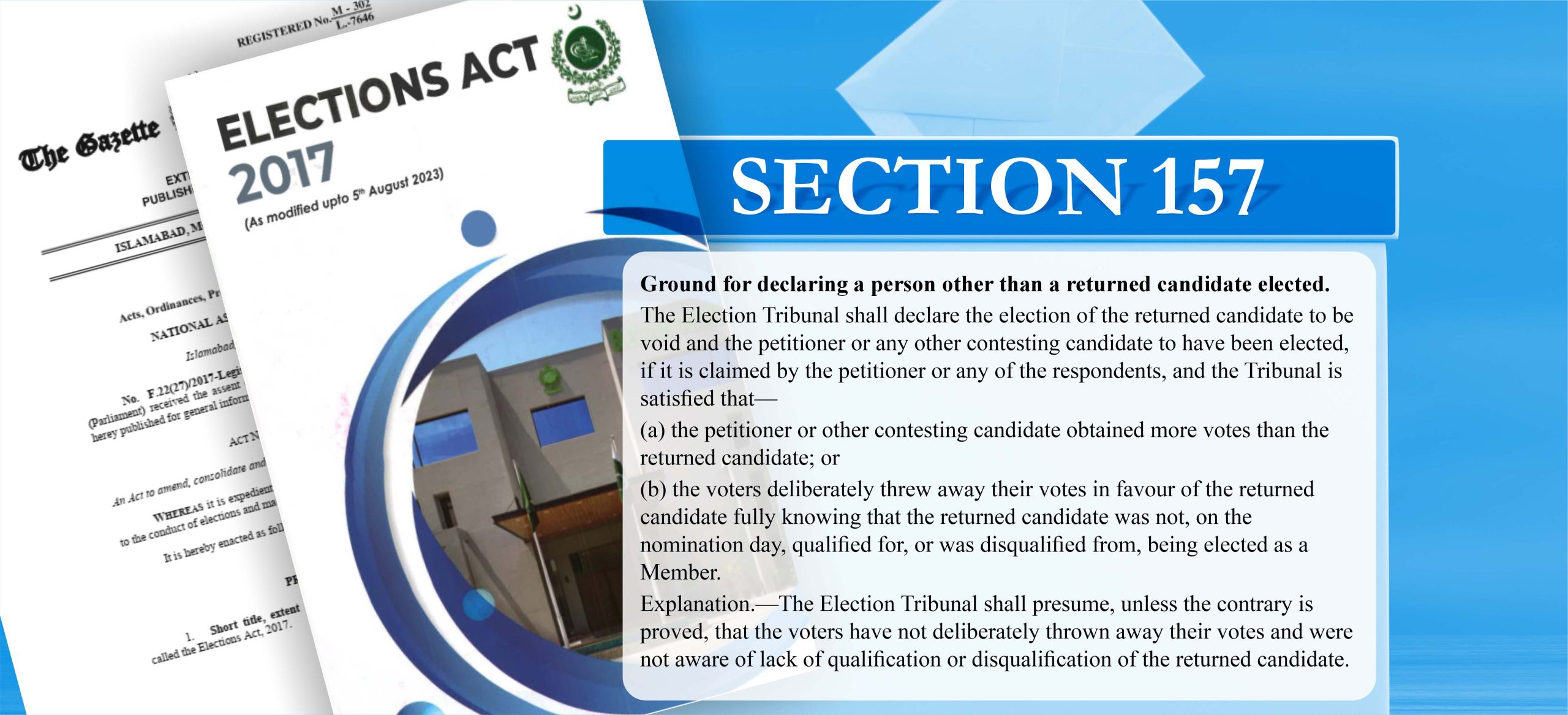
Election tribunal decisions in Pakistan most commonly result in either dismissal of the petition (the returned candidate keeps their seat) or the voiding of the election (triggering fresh polling at some or all polling stations). But the Elections Act 2017 contains a third possible outcome that is often overlooked. The tribunals have the power to substitute a different winner in place of the returned candidate without ordering fresh polling.
What does the law say?
Section 157 of the Elections Act 2017 requires the Election Tribunal to declare the returned candidate’s election void and to declare the petitioner or another contesting candidate elected in their place if it is satisfied of one of two things.
- First, that the petitioner or another contesting candidate obtained more votes than the returned candidate.
- Second, that the voters deliberately threw away their votes in favour of the returned candidate in full knowledge that the returned candidate was, on nomination day, either not qualified or disqualified from being elected as a Member of an Assembly, Senate or local government, as the case may be.
Nevertheless, the section includes an important presumption. The tribunal must presume — unless the contrary is proved — that voters did not deliberately throw away their votes and were not aware of the returned candidate’s lack of qualification or disqualification. This places the burden on the party claiming deliberate wasted votes to prove it.
Why does this matter?
The substitution remedy in Section 157 matters because it can deliver a faster final result than a fresh election. Petitioners who have strong vote-count evidence should consider framing their petition specifically for the Section 157 remedy.
Source: Elections Act 2017, Section 157.
This post is part of FAFEN’s series on electoral literacy. Read more of this series here.