Ever wondered why political parties often prefer to flex their muscles on the streets rather than in the assemblies? One reason may be that much of their vote bank never makes it to the assemblies in the first place.
Major contestants of the General Elections 2024 (GE-2024) lost between one-third and all of their votes in the electoral process, meaning that these votes did not win them any assembly seat. It is somewhat like the line losses in the power sector, where inefficiencies and outdated power systems make electricity more expensive than its actual production cost.
This analysis is part of FAFEN’s series on representation issues in Pakistan’s electoral system, where we are examining how the First-Past-The-Post system is causing a representation crisis in Pakistan.
Of the 112 political parties that fielded candidates for the National Assembly seats in the GE-2024, only 14 succeeded in winning seats in the Assembly. Even among these, most could not convert their full vote strength into representation.
Who suffered the biggest losses?
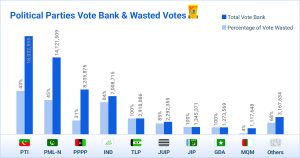
Three political parties together secured more than five million votes in the GE-2024, yet none managed to win a single seat in the National Assembly. These include Tehreek-e-Labbaik Pakistan (TLP) with 2.9 million votes, Jamaat-e-Islami (JI) with 1.3 million votes, and the Grand Democratic Alliance (GDA) with 1.2 million votes. While JI’s support base was relatively spread across all four provinces, GDA’s votes were concentrated entirely in Sindh, and nearly 84 percent of TLP’s votes came from Punjab.
Similarly, Jamiat Ulema-e-Islam (JUI) received over 2.2 million votes, but only about 15 percent contributed to winning seats. The rest were effectively wasted. The independent candidates together received more than seven million votes. Yet only about one million votes (16 percent) helped elect winning candidates, leaving 84 percent without representation.
How did the major parties do?
This system inefficiency also affected the major parties. The country’s largest political players also saw a significant proportion of their votes failing to yield seats. Around 45 percent of the ruling Pakistan Muslim League-Nawaz (PML-N) votes, 43 percent of Pakistan Tehreek-e-Insaf (PTI) backed independents’ votes, and 31 percent of Pakistan Peoples Party Parliamentarians (PPPP) votes did not translate into any representation.
The cumulative vote bank of the remaining political parties stood at about 3.1 million, of which 68 percent did not contribute to any seat in the National Assembly. The following graph shows the total vote bank of the parties and the proportion that went to waste:
Next in this series, FAFEN will publish the constituency-wise vote shares of both winning and losing candidates. Stay tuned to our website to explore how your constituency voted.