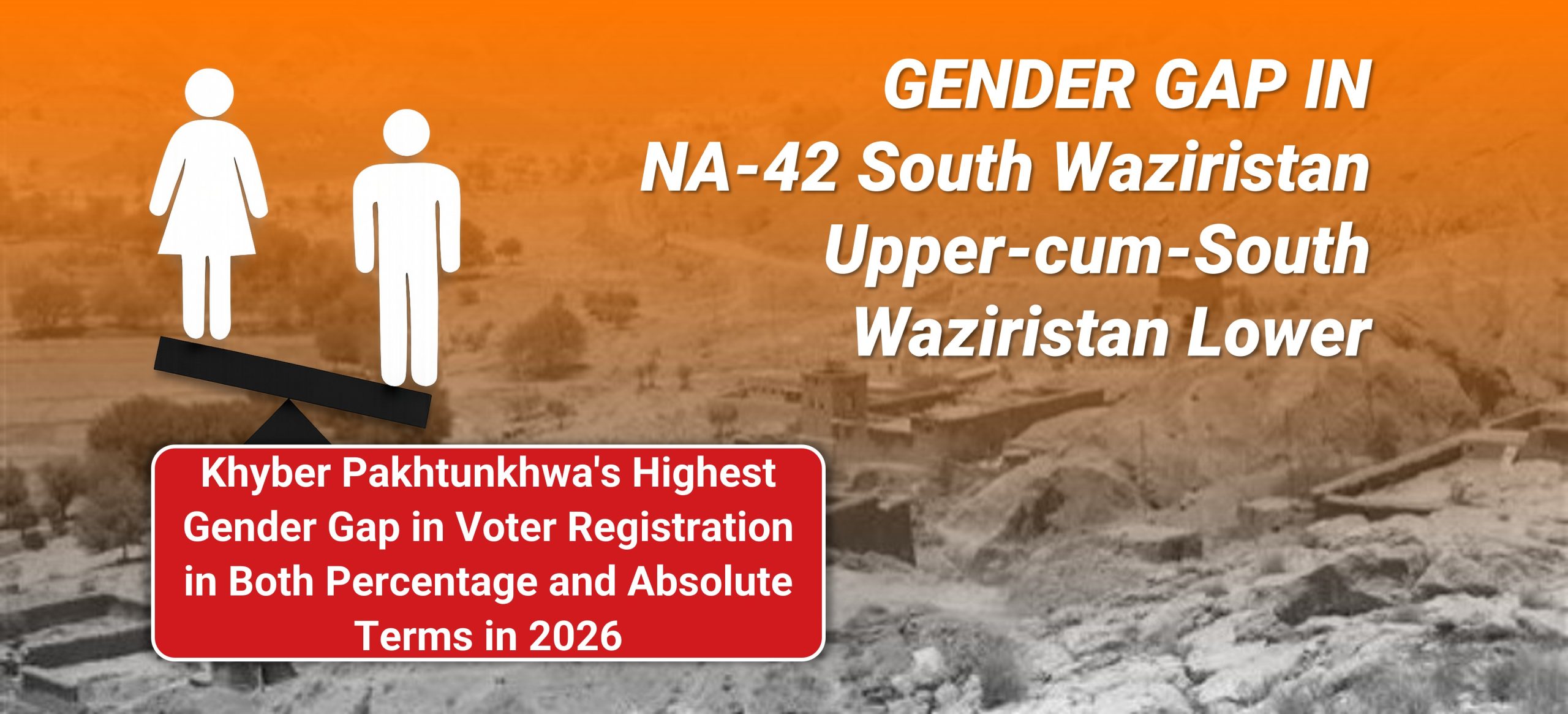
NA-42 South Waziristan Upper-cum-South Waziristan Lower recorded Khyber Pakhtunkhwa’s highest gender gap in voter registration in 2026 by both measures — as a percentage of its total electorate at 16.96%, and in absolute terms with 85,705 fewer women registered than men. Unlike Punjab and Sindh, where the two measures pointed to different constituencies, in Khyber Pakhtunkhwa both converge on the same constituency, making the case for urgent remedial action under the Elections Act, 2017 unambiguous.
According to data released by the Election Commission of Pakistan (ECP), NA-42 South Waziristan Upper-cum-South Waziristan Lower had 295,488 registered male voters against 209,783 registered female voters as of 2026, for a total registered electorate of 505,271. Male voters constituted 58% of the registered electorate and female voters 42%.
Negligible change from 2024 — and a gap that widened in absolute terms
In 2024, the constituency recorded a gender gap of 85,560 — equivalent to 18.31% of its then-total electorate of 467,292. By 2026, the percentage gap had narrowed by 1.35 percentage points to 16.96%. In absolute terms, however, the gap moved in the opposite direction: it increased by 145 voters, from 85,560 in 2024 to 85,705 in 2026.
This divergence between the two measures reflects the arithmetic of a growing electorate. The constituency’s total registered electorate grew by 37,979 voters between 2024 and 2026 — from 467,292 to 505,271. Male voters increased by 19,062 and female voters by 18,917. Female registrations grew at a marginally slower pace than male registrations, which accounts for the slight increase in the absolute gap even as the percentage gap fell. The percentage gap declined because the overall electorate expanded; the absolute gap grew because women’s registrations did not keep pace with men’s.
The distinction matters. A falling percentage gap can create an impression of progress where the ground reality is one of stagnation. In NA-42 South Waziristan Upper-cum-South Waziristan Lower, 145 more women were absent from the electoral rolls in 2026 than in 2024 — even as the headline percentage improved. At 16.96%, the constituency’s gender gap remains among the highest recorded across all National Assembly constituencies in Pakistan, and sits well above the 10% threshold that triggers statutory obligations under the Elections Act, 2017.
What the Elections Act requires
The continued presence of a gap of this nature underscores the need for sustained institutional action. Section 47(1) of the Elections Act, 2017 requires the ECP to annually publish disaggregated data of registered male and female voters in each constituency and to highlight the difference in their numbers. Under Section 47(2), the Commission must take special measures in any constituency where this difference exceeds 10 percent, including measures to reduce this variation. Section 47(3) further specifies that these measures shall include action by the National Database and Registration Authority (NADRA) to expedite National Identity Card (NIC) issuance for women in affected constituencies, and by the ECP to enrol them as voters in the relevant electoral area. This provision places a clear, joint institutional responsibility on both NADRA and the ECP to address the gender gap where it crosses the legal threshold.
These measures include targeted voter registration campaigns, NIC facilitation drives, and community-level outreach to address the barriers that continue to limit women’s registration. Consistent implementation of these provisions is critical to ensuring that the downward trend in the gender gap is sustained and accelerated in the electoral rolls ahead of the next general elections.