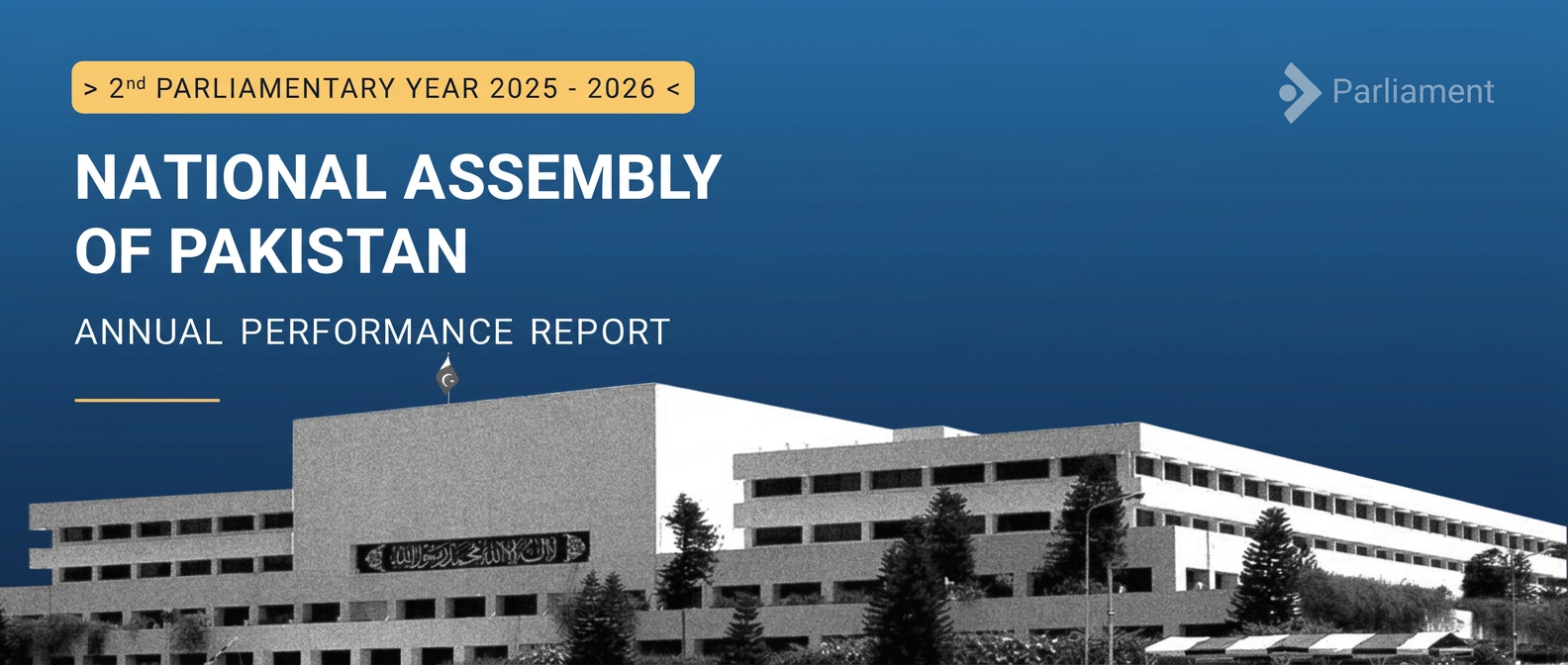
The National Assembly of Pakistan addressed 87 percent of its scheduled agenda during its second parliamentary year (March 2025 to February 2026), showing productivity and punctuality. However, key gaps remain in legislative deliberation, executive oversight, and effective use of parliamentary time, according to Annual Performance Report of the Lower House released by Free and Fair Election Network (FAFEN).
The Assembly held 11 sessions comprising 84 sittings, meeting for a total of 263 hours and 22 minutes including 87 percent of productively utilized floor time. The average delay in the start of sittings reduced to 17 minutes compared to 44 minutes in the previous year.
Despite these gains, parliamentary time continued to be dominated by points of order, which consumed 40 hours and 23 minutes (17 percent of proceedings), exceeding the time allocated for legislative debates. Rule 288, which allows suspension of procedural requirements, was invoked 30 times to expedite agenda items.
Legislative Business: The Assembly passed 66 bills, including 45 government bills, eight ordinances, and 13 private members’ bills. Of the government legislation, 42 percent related to public-impact issues, while 58 percent concerned administrative or procedural matters. Notably, six bills were passed after suspending the minimum deliberation period, including four that were introduced and passed on the same day.
Oversight Performance Improves, but Gaps Remain: The Assembly listed 1,961 questions for answers — a 44 percent increase from the previous year — with an overall response rate of 91 percent. However, Question Hour was held in only 35 out of 51 sittings where it was scheduled. For the remaining sittings, the requirement of Question Hour was waived off or suspended for taking up other agenda in accordance with the rules. Additionally, only 66 percent of Calling Attention Notices received ministerial responses, while 34 percent were not taken up.
Gender Responsiveness and Participation: Female members outperformed male members in both attendance and participation. They submitted more questions and maintained higher engagement across sessions. The Assembly recorded a Gender Responsiveness Score (GRS) of 1.0, indicating equal responsiveness to agenda items submitted by female and male members. However, disparities persisted in specific agenda categories, particularly motions on public importance, amendments to House rules, and private members’ bills.
Attendance and Participation Trends: Average attendance stood at 200 members per sitting (60 percent of total membership). However, cabinet members attended, on average, 51 percent of sittings, compared to 60 percent average attendance by private members. The Prime Minister attended six sittings (7 percent), while the former and incumbent Leaders of the Opposition attended 53 percent and 100 percent of sittings in their respective period in office.
While 90 percent of members participated in parliamentary business, 12 percent or 41 remained completely inactive. Furthermore, a gap between attendance and participation was observed, with 10 members having over 70 percent attendance but not contributing to proceedings.
FAFEN emphasizes the need to strengthen legislative scrutiny, ensure consistent observance of oversight mechanisms, and promote more effective use of parliamentary time to enhance democratic governance.
Click here to download the complete report