
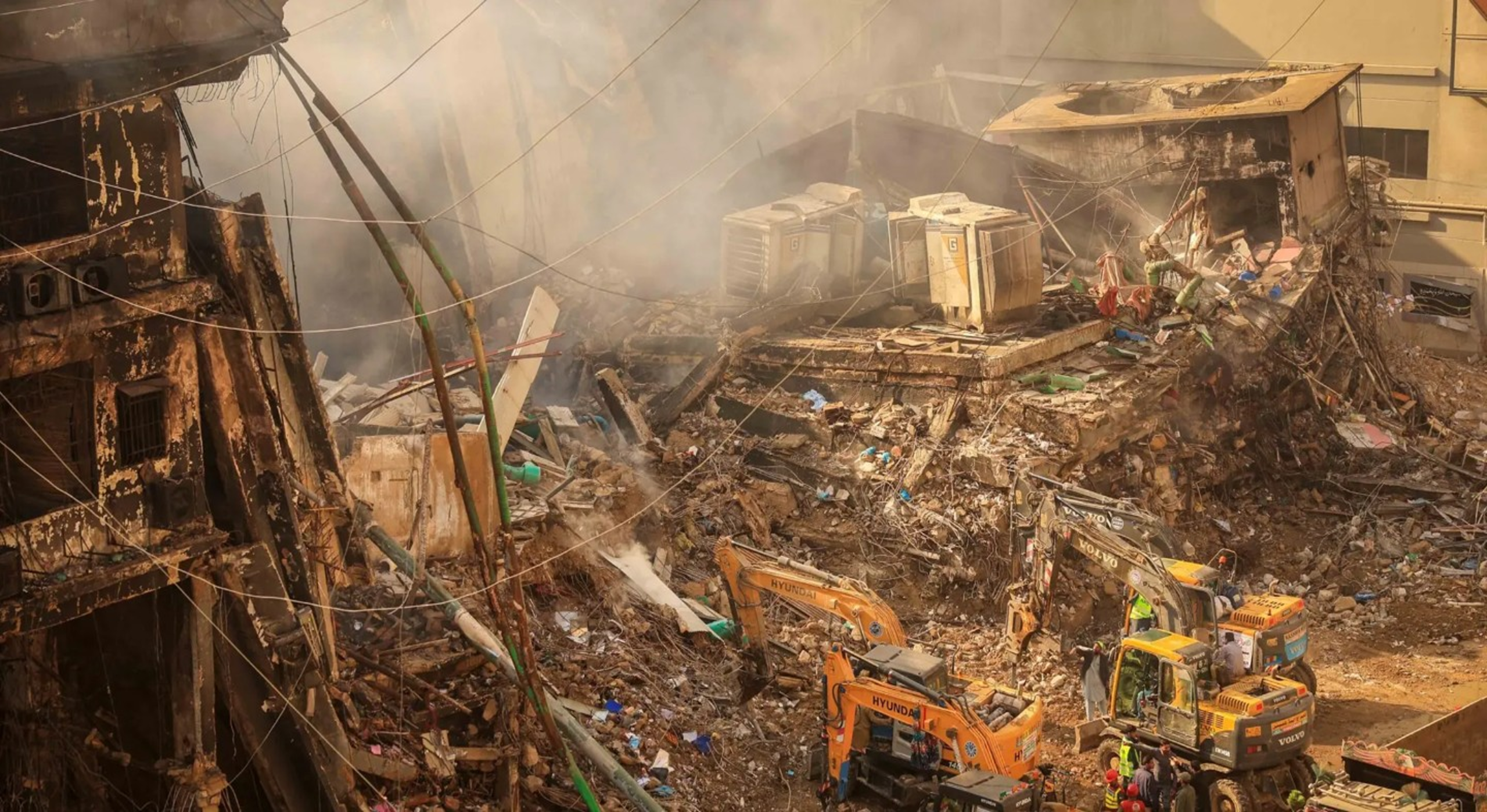
As population in Pakistan increasingly shifts toward large urban centers, the expansion of settlements in these cities has become largely unplanned and haphazard. Commercial activity has intensified, and large commercial plazas and markets are expanding rapidly. The situation has reached a point where, in the outskirts of major cities, it is rare to find any vacant space along main roads. Commercial centers, markets, and shops stretch as far as the eye can see. Almost all properties located on these roads have been converted into commercial buildings. In many areas, high-rise plazas have become a common sight. Even ordinary residential neighborhoods have turned into commercial hubs. In Lahore, areas such as Ichhra, Township, Multan Road, Yateem Khana Chowk, Sanda, Baghbanpura, and many others have completely commercialized. This trend is not limited to large cities. Smaller cities are also going through similar commercialization. Yet, the critical questions remain. Whether building safety and other precautionary measures are matching the pace of rapid construction and development. Are regulatory standards being enforced at the government level? Are building control and design standards being followed? And, most importantly, how active, vigilant, and effective are the responsible institutions and authorities in oversight and monitoring?
Numerous incidents of fires in commercial buildings have occurred across various cities in the country. These incidents are not confined to large plazas alone. They have also taken place in smaller localities. In several cities, such incidents have resulted in the loss of many precious lives. Each time such an incident happens, condolences pour in, the government announces compensation, and inquiries are conducted. Then everything returns to where it was, and silence prevails until the next tragedy occurs.
Recently, a plaza in Karachi’s Saddar area was burnt claiming dozens of lives of customers, shopkeepers, and firefighters, and causing financial losses amounting to millions. With the fire also started a series of accusations and political statements. There is a clear need for impartial and transparent investigations and not the usual paperwork as it becomes a country-wide issue with manifolds increase in the risks of such tragedies happening anywhere at any time, not just in Karachi or Lahore.
This situation persists because of the absence of adequate preventive and safety measures, and due to a casual and careless attitude toward such measures. This attitude is not limited to plazas and large buildings alone. One only has to observe the tangled clusters of electric wires in streets and neighborhoods to understand the scale of neglect. Open manholes on major roads, damaged streets and alleys, billboards and signage (both decorative and promotional), and haphazardly planted trees along roads all reflect the same neglectful mindset.
This situation begs answers to questions like who is responsible for this? The public itself also bears some responsibility. In pursuit of higher income, property owners make unapproved design changes and unauthorized additions to their buildings. Where four shops are approved under an official plan, alterations are made to increase the number to eight. In doing so, people create their own problems. The denser the area becomes, the more congested the residential population grows. Alongside this, there is negligence and criminal silence on the part of regulatory and supervisory institutions, which often ignore risks in exchange for bribes. This practice has spread from lower to higher levels, rendering effective control impossible. A fundamental issue is that these institutions lack the capacity and competence required to meet present-day needs. Their systems are outdated and require modernization.
Until 1990s, firefighting was a mandatory function of local governments. While it remains a formal responsibility even today, in Punjab, it has largely been transferred to the provincial government’s domain. Fire prevention and response are now primarily associated with Rescue 1122. Metropolitan corporations, which had this responsibility once, no longer possess the required capacity or resources aligned with modern needs. In urban areas across the country, there is no adequate arrangement for water supply specifically for firefighting. Even on major roads and intersections, there is no proper or reliable heavy water supply system.
While current regulatory regime has mandated obtaining environmental certification from the provincial environment department prior to starting construction of large buildings and explicitly securing fire protection approval. However, ensuring water availability at the time of need has not received adequate attention. There may be formal approvals on paper, but enforcement has fallen victim to negligence by institutions and responsible authorities. Consider the recent case in Karachi. Had sufficient water been readily available inside or near the affected plaza, control efforts might have been more effective. Furthermore, if approval was granted for fewer shops or fewer floors, how were additional structures allowed? How many alternative evacuation routes existed? And if building plans or rules were violated, who will be held accountable? These are critical questions which beg answers, with no one offering them.
Local governments, particularly in urban areas, must be equipped with the capacity and capability to respond effectively to unforeseen disasters, in line with modern resources and practices. Globally, rapid and effective disaster response is largely carried out through local governments. Pakistan must also learn from these incidents and focus on modernization, not only of the equipment, but also of the institutional structures dealing with such challenges.
—Â Written by Zahid Islam, Member FAFEN National Council and Executive Director Sangat Development Foundation