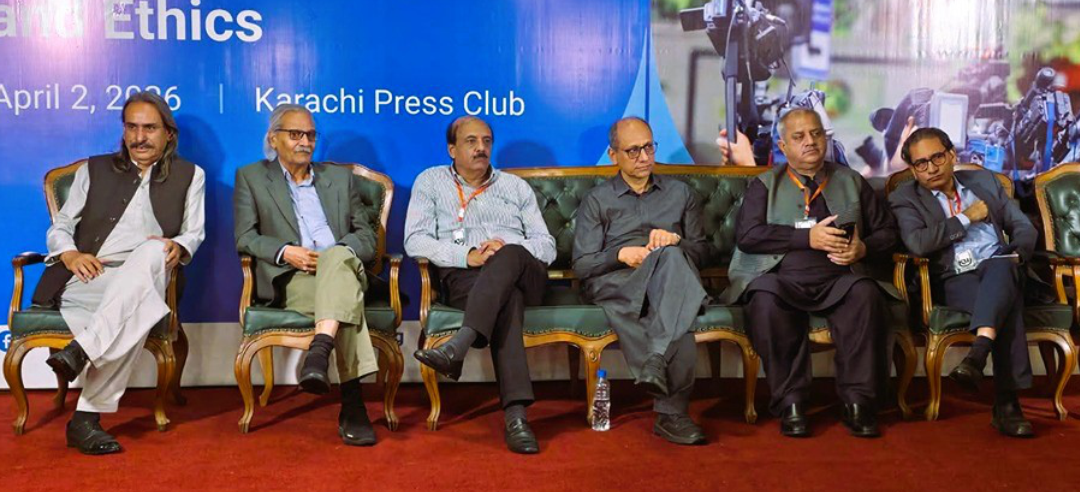
The Pakistan Federal Union of Journalists (PFUJ) held its second provincial convention on media laws, regulations, and ethics at the Karachi Press Club on April 2, 2026. The event brought together a wide range of participants, including journalists, trade and labour union representatives, civil society members, government officials, opposition leaders, and political party representatives. The convention was part of PFUJ’s broader effort to engage diverse segments of society and raise awareness about controversial media laws that affect not only journalists but also ordinary citizens due to their misuse. Participants reaffirmed their commitment to protecting freedom of the press and expression.
Prominent attendees included Provincial Labour Minister Saeed Ghani, who was the chief guest, former Senate Chairman Raza Rabbani, opposition leader in the Sindh Assembly Ali Khurshidi, Deputy Mayor Salman Murad, and representatives from multiple political parties and organizations. Speakers highlighted the importance of democratic freedoms and the role of independent institutions in sustaining a democratic system.
Saeed Ghani emphasized that a true democracy requires the freedom of the judiciary, media, political parties, civil society, and student unions. He warned that restricting any of these pillars undermines democratic progress. He also stressed the responsibility of the state to protect the economic rights of journalists and media workers, noting that financial insecurity weakens media independence. He pointed out that while media organizations may receive support during difficult times, workers often suffer, and he advocated extending government support to both traditional and digital media employees.
Raza Rabbani called for amendments to existing laws, expressing concern over what he described as the increasing criminalization of legislation and the weakening implementation of the Constitution. He criticized the lack of funding and infrastructure for the Sindh Commission for the Protection of Journalists and urged the government to make it fully functional. He also highlighted issues such as unpaid salaries for journalists and delays in forming the 9th Wage Board, pledging continued support for journalists’ rights.
Ali Khurshidi questioned the differing interpretations of press freedom and democracy among the government, opposition, and media, stressing the need for a national consensus. He advocated dialogue over conflict and criticized the government for failing to address basic public needs, arguing that the benefits of democracy are not reaching ordinary citizens.
A key outcome of the convention was the adoption of a resolution presented by senior journalist Mazhar Abbas. The resolution strongly rejected the PECA 2025 amendments, describing them as a repressive law designed to suppress media freedom and intimidate journalists. It accused the state of reneging on its commitment not to use such laws against the press and highlighted actions such as judicial harassment, travel restrictions, and other forms of pressure that contribute to a climate of fear.
The resolution demanded the immediate withdrawal of all cases against journalists under PECA and called for a transparent review of the law to prevent its misuse for political victimization. It also urged the government to clear outstanding salaries and dues of media workers, stating that economic pressure undermines media independence.
Reaffirming that journalism is not a crime, the resolution warned that suppressing free expression damages the country’s democratic fabric. It concluded with a strong declaration of solidarity with the media community and emphasized that safeguarding freedom of expression is essential for a functioning democracy.