Pakistan’s Elections Act contains a pre-poll transparency protocol that directly counters the possibility of an electoral fraud: that ballot boxes arrive at polling stations already filled. The Elections Act 2017 mandates a procedure specifically designed to make pre-stuffing detectable by everyone present.
What does the law say?
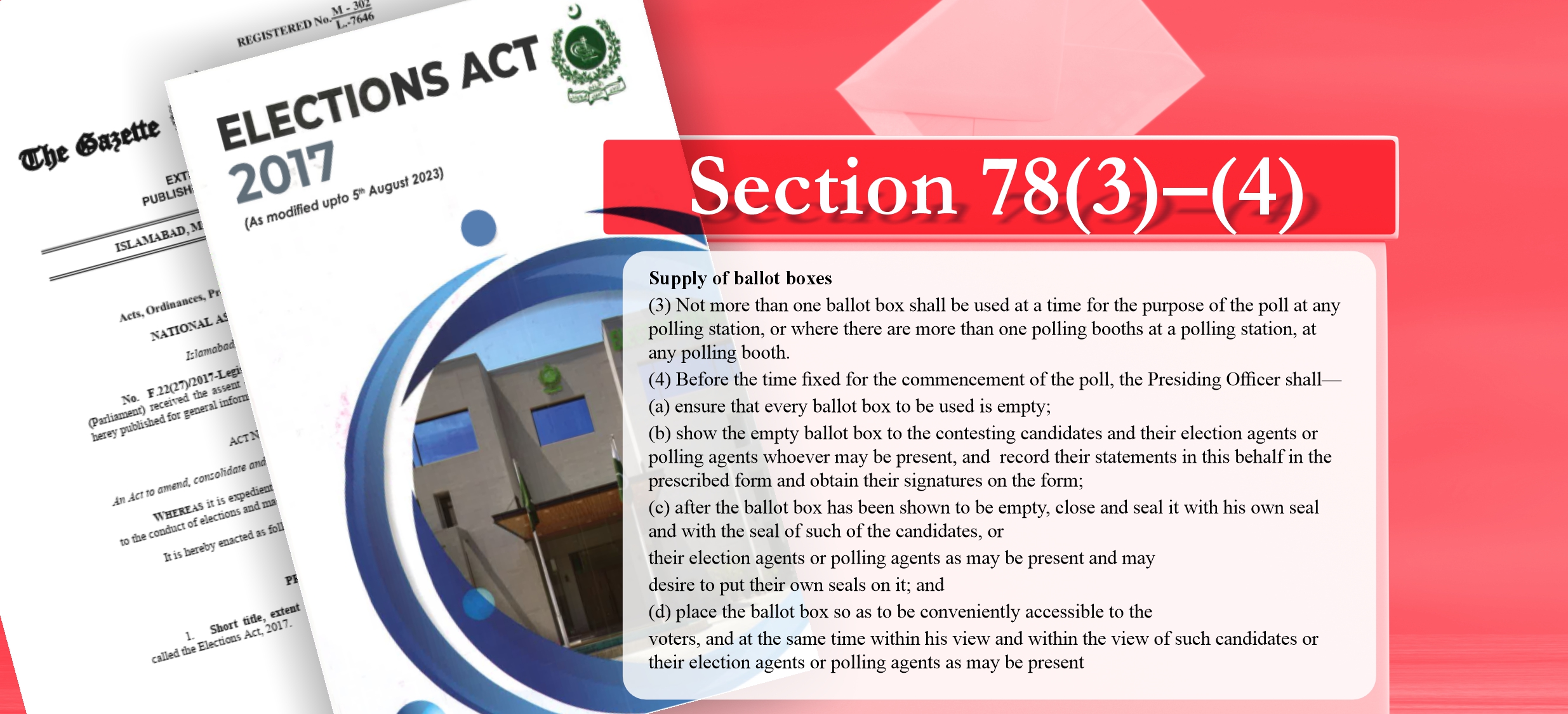
Section 78(3) and 78(4) of the Elections Act 2017 require the Presiding Officer, before the time fixed for the poll to begin, to complete a specific sequence of steps. First, the Presiding Officer must ensure every ballot box is empty. Second, the officer must show the empty box to all contesting candidates, election agents, and polling agents who are present. Third, the Presiding Officer must record each person’s statement about the empty box, obtain their signatures on a prescribed form, and only then seal the box. Sealing uses both the Presiding Officer’s own seal and the seals of any agents present who wish to apply them. The sealed box is then placed in a visible position, within the Presiding Officer’s view and that of all agents present.
Why does this matter?
The processes in Section 78 creates a documented, witnessed record of the ballot box’s status before a single vote is cast. If a candidate or agent was present and signed the form confirming the box was empty, that signature is evidence that pre-stuffing did not occur.
For candidates and their agents, the practical instruction is to be present when ballot boxes are opened and sealed before polling begins. Absence from this process weakens any later claim about box integrity.
 Source: Elections Act 2017, Sections 78(3)–(4).
This post is part of FAFEN’s series on electoral literacy. Read more of this series here.