
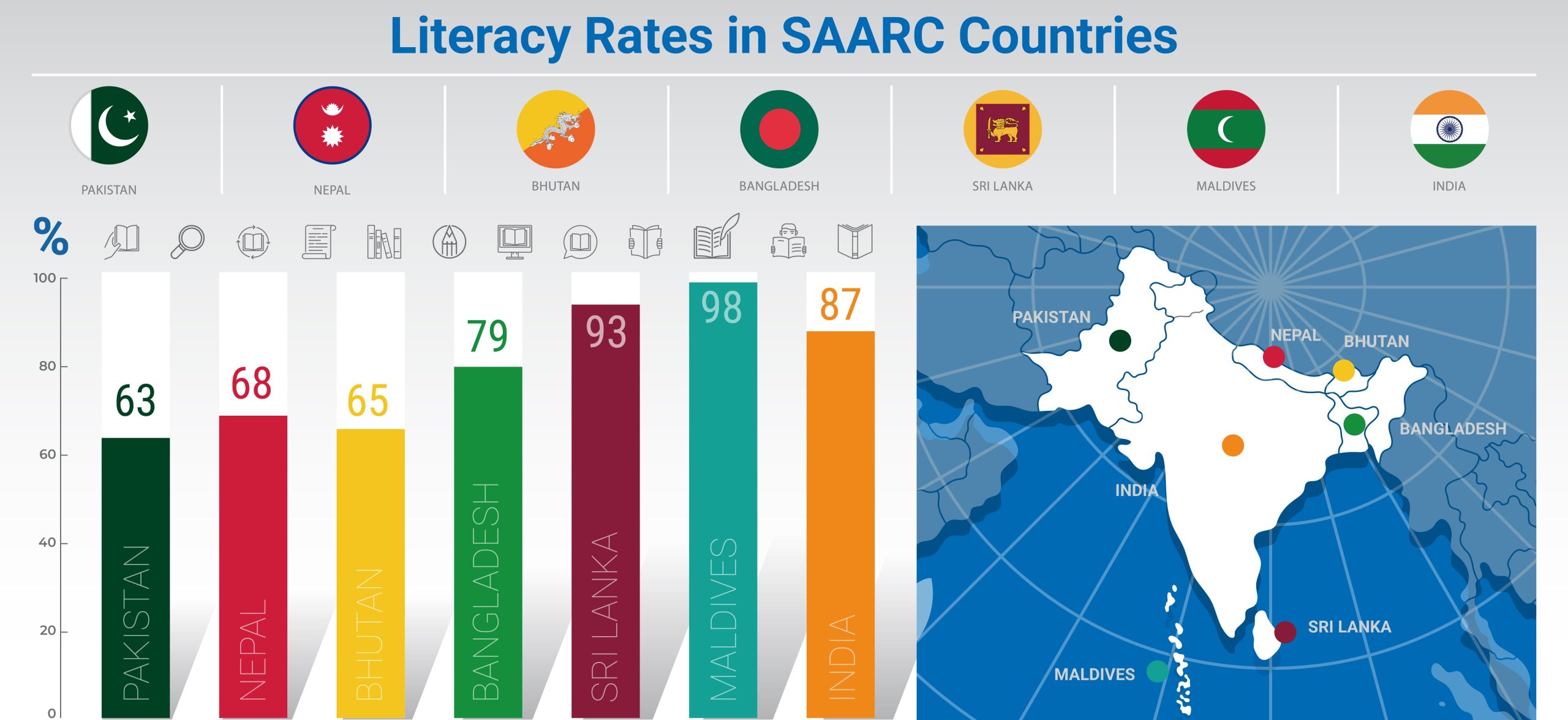
Pakistan’s overall literacy rate stands at 63 percent, which is the lowest among South Asian countries, according to data from the Pakistan Bureau of Statistics read alongside World Bank figures.
According to Pakistan Social and Living Standards Measurement–Household Integrated Economic Survey (PSLM–HEIS) 2024–2025, literacy among the population aged 10 years and above increased from 60 percent in 2018–2019 to 63 percent in 2024–2025.
How does Pakistan’s literacy rate compare with other South Asian countries?
According to the World Bank, adult literacy in Maldives is the highest in South Asia at over 98 percent, followed by Sri Lanka at 93 percent, India at 87 percent, and Bangladesh at 79 percent.
Nepal records an adult literacy rate of 68 percent, while Bhutan stands at 65 percent. The regional average literacy rate across South Asia is 78 percent.
Read more: Provinces Vary Widely in Educational Indicators & Spending
Who is counted as literate in Pakistan?
According to the PSLM–HEIS Social Report, a literate person is defined as someone aged 10 years or above who can read and comprehend a simple statement and write a simple sentence.
The report also distinguishes between youth literacy and adult literacy. Youth literacy refers to individuals aged 15 to 24 years who can read and write with understanding, while adult literacy refers to individuals aged 15 years and above who meet the same criteria. Youth literacy is a subset of adult literacy.
How do literacy rates differ across gender, provinces & age groups?
Literacy among men continues to exceed that of women. According to the survey, 73 percent of men are literate compared to 54 percent of women.
At the provincial level, Punjab records the highest literacy rate at 68 percent. Sindh and Khyber Pakhtunkhwa each record literacy rates of 58 percent, while Balochistan remains the lowest at 49 percent.
Among the age groups, youth (15-24 years old) literacy stood at 77 percent in 2024–2025, increasing from 72 percent in 2018–2019. Adult (all 15+ people) literacy reached 60 percent, up from 56 percent.
Why does literacy matter for governance and development?
Article 25A of the Constitution guarantees free and compulsory education for children aged five to 16 years. Following the Eighteenth Constitutional Amendment, education became a provincial subject.
Pakistan is also a signatory to the United Nations Sustainable Development Goals, including Goal 4, which aims to ensure inclusive and equitable quality education and promote lifelong learning opportunities for all.