
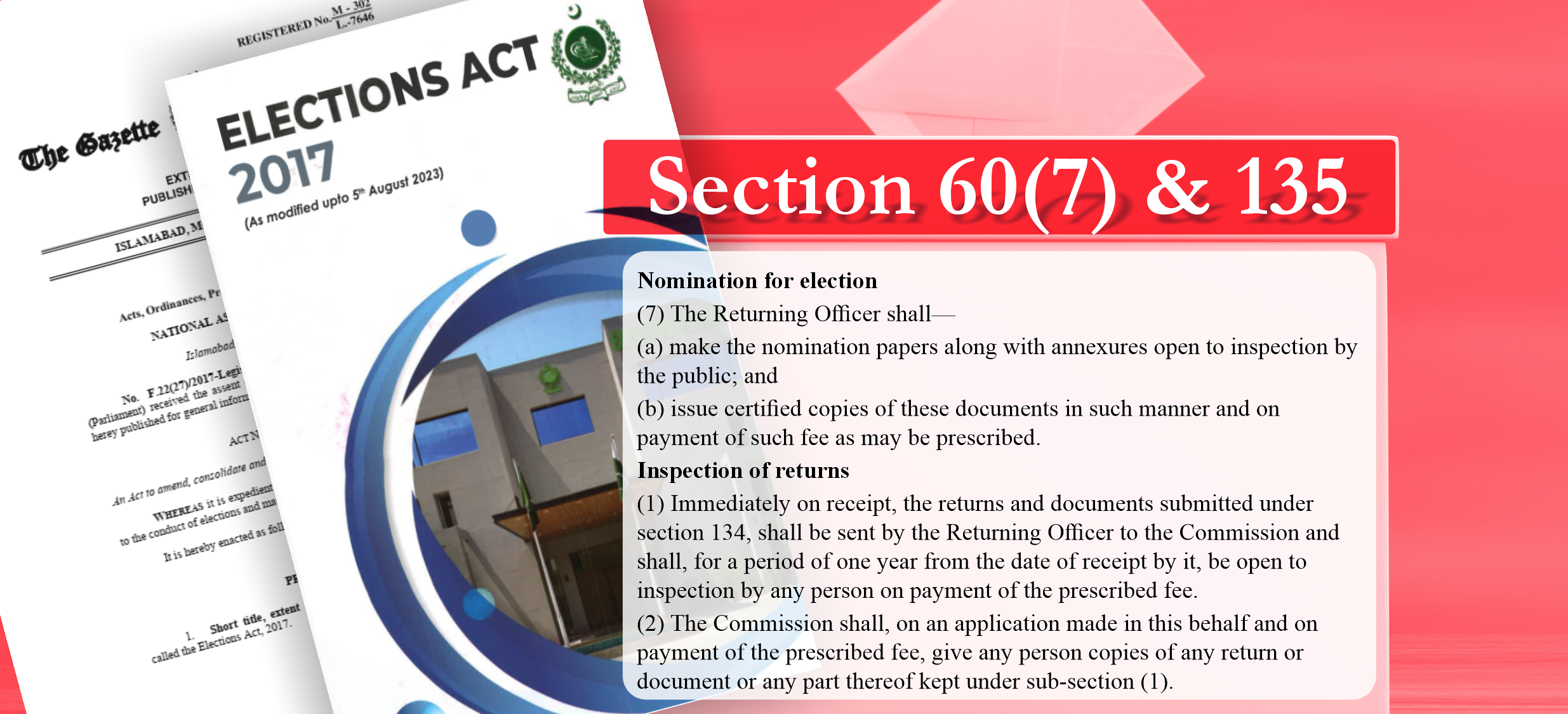
Pakistan’s election finance transparency framework creates two public-access points. The first is the nomination paper and bank statement, accessible during the nomination period under Section 60(7). The second is the election expense return, accessible after the election under Section 135.
Every candidate who contests an election must submit a detailed expense return after polling. The return is a public document that any voter can inspect — a transparency right that most voters do not know they have.
What does the law say?
Section 135 of the Elections Act 2017 requires the Returning Officer to send all election expense returns submitted by the candidates to the Election Commission, who shall keep them open to public inspection for a period of one year from the date of receipt by the Commission.
Any person may inspect these documents by paying a prescribed fee, which currently is 10 rupees per page.
Why does this matter?
The right to inspect expense returns is an accountability tool that functions only when citizens use it. Journalists, civil society organisations, and voter groups can request inspection of expense returns for any constituency and compare the declared figures against the visible scale of a candidate’s campaign — billboard expenditure, media advertising, voter mobilisation events, and distribution of campaign materials.
Where declared expenses appear significantly lower than the observable scale of campaign activity, the discrepancy is a legitimate basis for complaint to the ECP. Section 136 gives the ECP the power to act on expense return irregularities, to direct filing a complaint of corrupt practices against candidate concerned.
 Source: Elections Act 2017, Sections 60(7) and 135.
This post is part of FAFEN’s series on electoral literacy. Read more of this series here.