
In any polls, not every voter marks their paper with perfect precision. Some marks fall squarely on a candidate’s name, others land on the border between two candidates’ spaces. How should these borderline ballots be treated? The Elections Act 2017 provides a precise answer to such situations.
What does the law say?
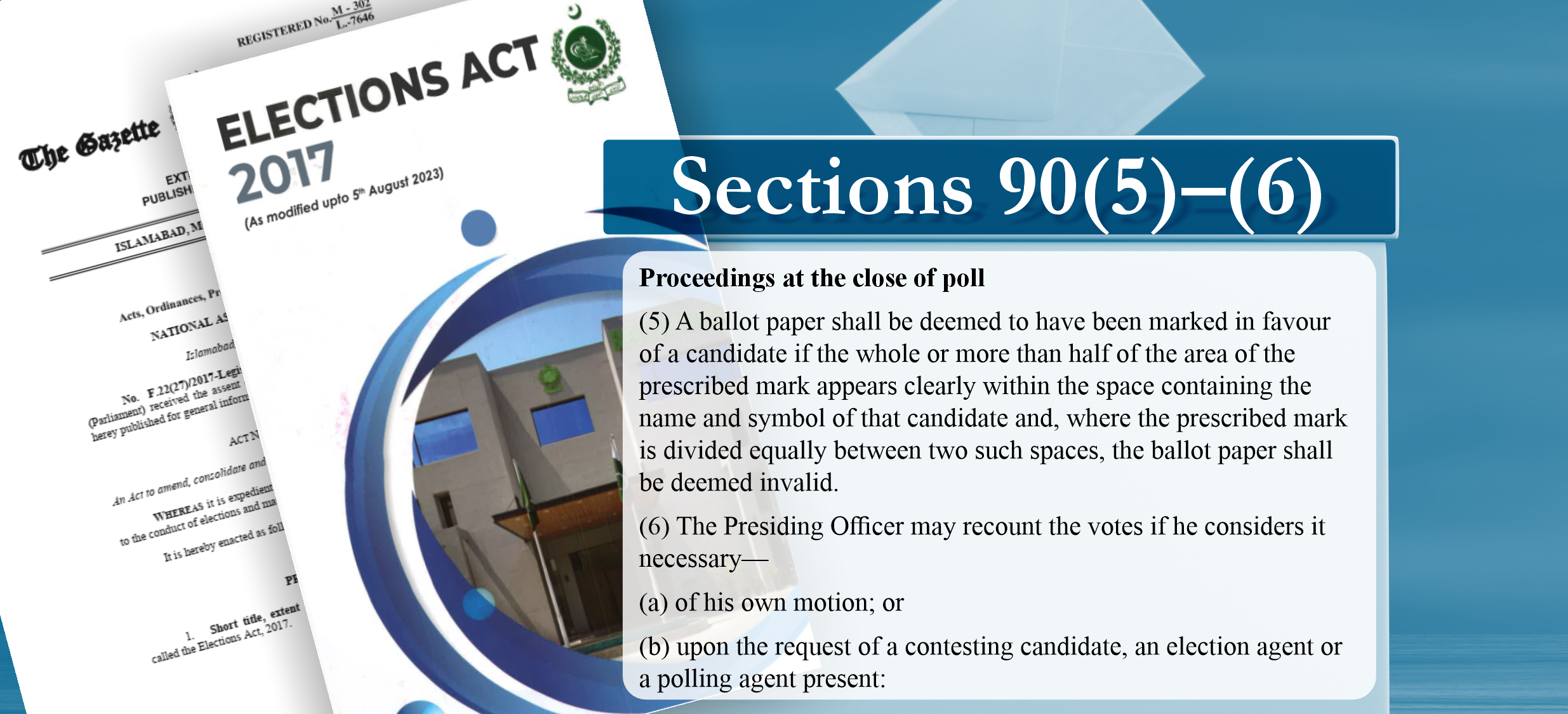
Section 90(5) of the Elections Act 2017 specifies the validity standard for ballot papers. A ballot paper is deemed to have been marked in favour of a candidate if the whole or more than half of the area of the prescribed mark appears clearly within the space containing the name and symbol of that candidate. Where the mark is divided equally between two spaces, the ballot paper is deemed invalid.
The standard for counting a ballot in favour of a candidate is “more than half” of the stamp being placed in that candidate’s area.” A mark that is 51% inside a candidate’s space and 49% outside is valid. A mark divided exactly 50-50 between two candidates’ spaces will invalidate the vote.
Section 90(6) allows the Presiding Officer to recount votes — once only, on their own motion or on request by a candidate or agent.
Why does this matter?
Agents who understand Section 90(5) can challenge Presiding Officer decisions about borderline papers on the basis of the statutory standard, not on subjective grounds.
When an agent requests a recount under Section 90(6), they should be specific about which ballots they believe were incorrectly decided, citing the Section 90(5) standard. A general request for a recount, without identifying specific errors, gives the Presiding Officer less to work with.
 Source: Elections Act 2017, Sections 90(5)–(6).
This post is part of FAFEN’s series on electoral literacy. Read more of this series here.