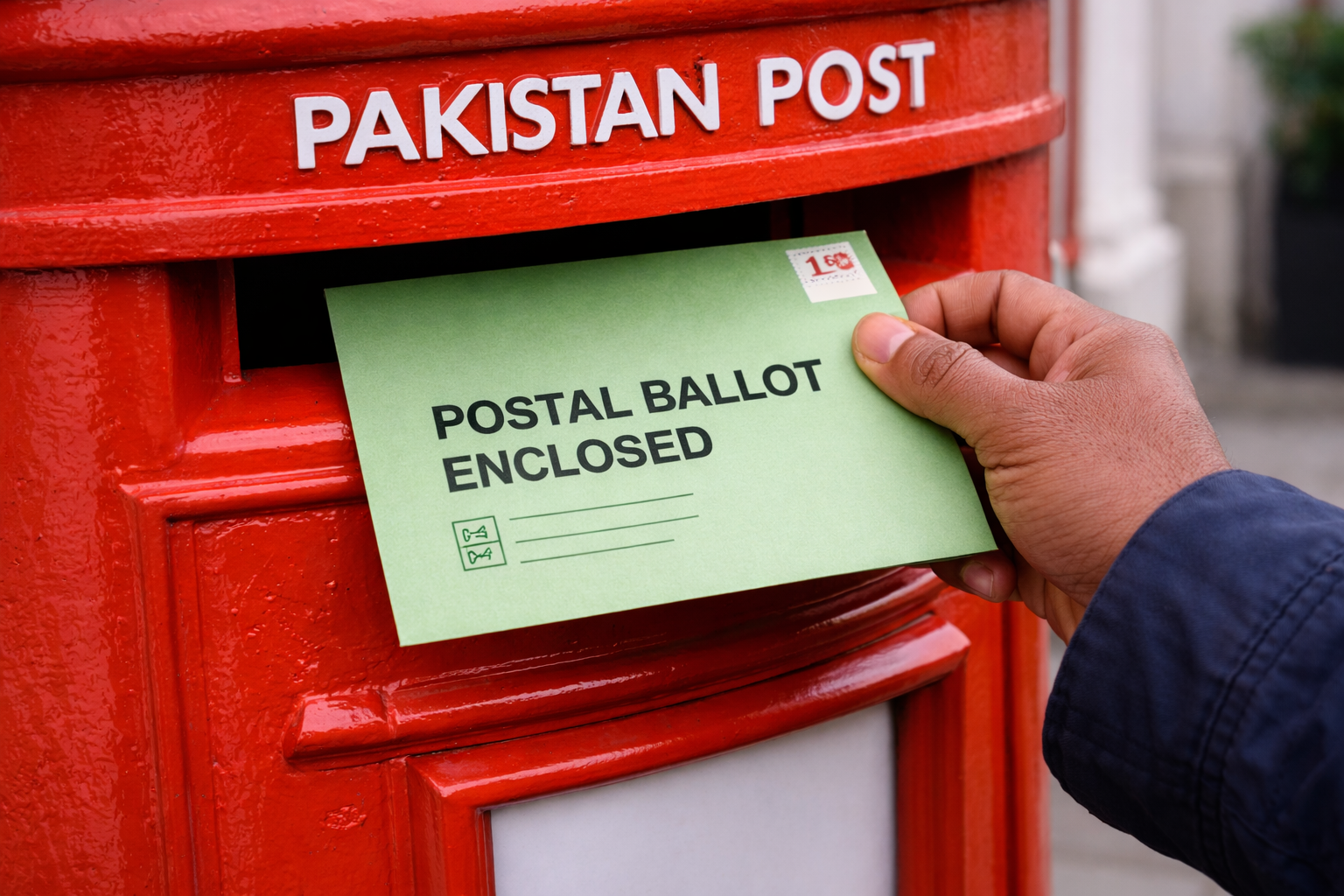
In General Elections 2024, a total of 216,204 postal ballots were cast across Pakistan. Though small compared to overall turnout, these ballots offer provides a deeper analysis of party organization, institutional presence, and provincial political strength.
Postal ballots are typically cast by public servants, security personnel, and voters who cannot be physically present in their constituencies i.e. persons with disabilities and prisoners. For that reason, they often reflect structured support networks and party penetration within state-linked segments of the electorate. The Election Commission of Pakistan (ECP), however, does not provide a category-wise breakdown of postal ballots issued.
A National Tie with Provincial Dominance
At the national level, the contest between Pakistan People Party Parliamentarian (PPPP) and Pakistan Muslim League Nawaz (PML-N) is almost identical. PPPP secured 44,701 postal ballots, while PML-N received 44,668, leaving a difference of just 33 ballots out of the 216,204 cast nationwide.
This near tie does not mean both parties performed evenly across the country. Instead, it reflects strong provincial anchors that offset each other.
PPPP’s total of 44,701 is driven largely by Sindh, where it secured 26,818 out of 31,974 postal ballots. PML-N’s 44,668 relies heavily on Punjab, where it received 24,746 out of 59,646 ballots. Pakistan Tehreek-e-Insaf (PTI) affiliated independents (IND-PTI) secured 35,021 ballots nationwide, with most of their strength concentrated in Khyber Pakhtunkhwa (KP) (15,510) and Punjab (18,024). Jamaiat Ulema-e-Islam Pakistan (JUI-P) obtained 22,142 ballots nationally, primarily from KP (14,482) and Balochistan (7,496).
The national balance, therefore, is a product of provincial concentration rather than uniform national performance.
Closey Competitive Khyber Pakhtunkhwa
Khyber Pakhtunkhwa recorded the largest number of postal ballots in the country, with 80,715, representing 37% of the national total.
Within this total, IND-PTI led with 15,510 ballots, closely followed by JUI-P with 14,482, leaving a narrow gap of 1,028 ballots. Independent candidates secured 12,625, while PML-N received 9,428 and Awami National Party (ANP) obtained 8,437.
The relatively small margins between multiple parties show that no single actor dominates institutional voting in KP. Instead, the province reflects competitive fragmentation, with several parties clustered within a limited range of support.
Two-Way Punjab Split
Punjab contributed 59,646 postal ballots, accounting for 28% of the national total. PML-N secured 24,746 ballots, establishing a lead over IND-PTI, which received 18,024, a difference of 6,722 ballots. Independent candidates also maintained a presence with 11,135 postal ballots.
Taken together, PML-N and IND-PTI account for 42,770 ballots, which is approximately 72% of Punjab’s postal ballots. This concentration reflects a clearly polarized structure in which two dominant blocs shape the institutional vote.
Single Party Dominant Sindh
Sindh recorded 31,974 postal ballots, the lowest provincial share at 15% of the national total. Out of these, PPPP secured 26,818 ballots, amounting to approximately 84% of the province’s total postal ballots. GDA received 3,606 ballots, while IND-PTI secured 1,108.
The margin between PPPP and GDA stands at 23,212 ballots, indicating overwhelming dominance. In fact, 26,818 of PPPP’s 44,701 nationwide postal ballots roughly 60% come from Sindh alone, underscoring the province’s central importance to the party’s national standing.
The Bigger Picture
When the national totals are viewed collectively, PPPP with 44,701 ballots, PML-N with 44,668, and IND-PTI with 35,021 together account for 124,390 postal ballots, which represents 58% of all postal ballots cast nationwide.
However, each of these blocs depends heavily on specific provinces. PPPP’s national figure is anchored primarily in Sindh, where it secured 26,818 ballots. PML-N’s institutional strength rests mainly in Punjab, where it received 24,746 ballots, and is further supported by 10,298 ballots in Balochistan. IND-PTI draws almost all of its support from KP and Punjab, where it secured 15,510 and 18,024 ballots, respectively. JUI-P’s 22,142 ballots are concentrated in KP and Balochistan, where it received 14,482 and 7,496 ballots.
The extremely narrow national margin of 33 ballots between PPPP and PML-N is the cumulative effect of distinct provincial strongholds balancing each other across the federation.