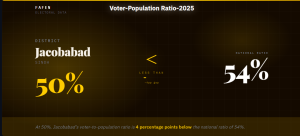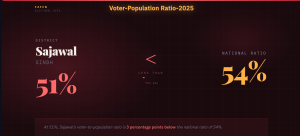
Approximately 54% of Pakistan’s estimated 2025 population of 254.2 million is registered as a voter, according to district-wise voter registration statistics issued by the Election Commission of Pakistan (ECP) on 30 December 2025 and population projections derived from the 2023 Digital Census.
Pakistan’s population in 2023 and 2025
The 2023 Digital Census recorded a total population of 241.5 million, comprising 124.3 million males (51.5%), 117.2 million females (48.5%), and 20,331 transgender persons. The sex ratio stood at 106.1 males per 100 females.
Applying the inter-census annual growth rate of 2.55%, the estimated total population for 2025 stands at 254.2 million — an increase of approximately 12.7 million persons over two years. This projected population includes 130.9 million males, 123.3 million females, and 21,454 transgender persons.
How many people are registered as voters?
As of 30 December 2025, there are 136.0 million registered voters — 72.8 million males (54%) and 63.2 million females (46%). Against the 2025 estimated population, these figures indicate that:
- 54% of the total estimated population is registered as voters;
- 56% of the estimated male population is registered as voters; and
- 51% of the estimated female population is registered as voters.
Provincial and ICT distribution
Registration rates vary across provinces and the Islamabad Capital Territory (ICT). Punjab records the highest proportion of its population registered as voters at 58%, followed by Khyber Pakhtunkhwa (KP) at 54%, Sindh at 49%, Balochistan at 36%, and ICT at 49%.
Punjab, being the most populous province, accounts for the largest share of registered voters at 77.4 million, followed by Sindh at 28.5 million, KP at 23.2 million, Balochistan at 5.7 million, and ICT at 1.2 million.
District-level analysis
Provincial figures show measurable differences in registration proportions, and further variation may exist at the district level that provincial aggregates do not capture. FAFEN will conduct a district-wise analysis in a forthcoming series of stories, examining how registration proportions compare across districts within each province and ICT.
Source: 7th Population and Housing Census of Pakistan, 2023; population projections at 2.55% annual growth rate (FAFEN Electoral Data Analysis, 2025).
This post is part of FAFEN’s series on voter vs population ratio. Read more of this series here.