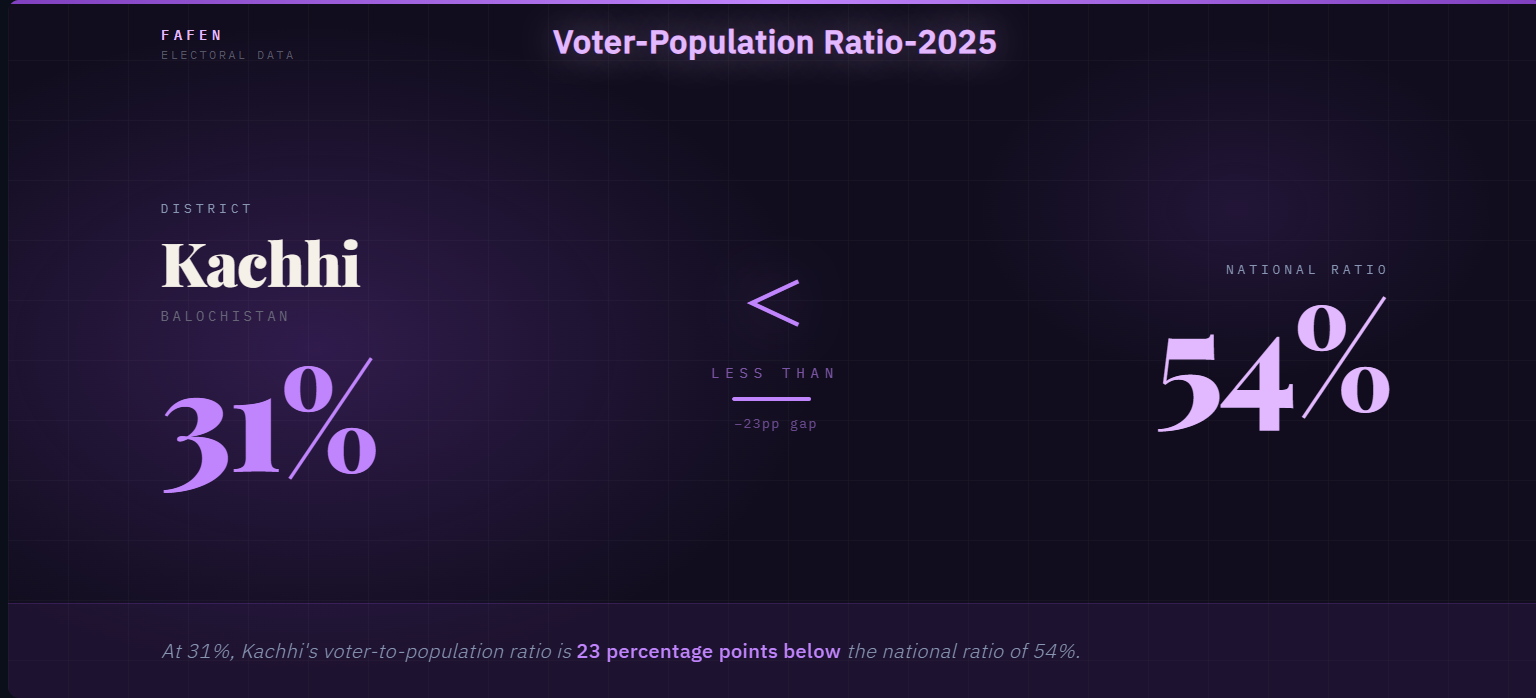
Kachhi’s voter registration rate stands at 31% of its estimated 2025 population — 23 percentage points below the national ratio of 54%.
Methodology
These figures are drawn from district-wise electoral roll statistics released by the Election Commission of Pakistan (ECP) on 30 December 2025. They are cross-referenced against population estimates derived from the 2023 Digital Census. The 2025 population estimate applies the 6.14% inter-censal annual growth rate to Kachhi’s census base population of 442,674, yielding an estimated 2025 population of 498,703. Registration rates are calculated by dividing the number of registered voters by this estimated population.
Voter registration in Kachhi
The district has 153,974 registered voters — 87,262 males (56.7%) and 66,712 females (43.3%). Among males, 33% of the estimated population is registered; among females, 28%. Kachhi ranks 103rd out of 136 districts nationally by population size and is constituting approximately one-third of a National Assembly constituency shared with adjoining districts.
By voter registration rate, Kachhi ranks 124th nationally and 25th of 34 within Balochistan.
Why registration trails the national ratio
An significant gender gap is the primary driver of Kachhi’s below-average registration rate. Female voters account for 43.3% of the registered electorate — 20,550 fewer than male voters. Women’s registration stands at 28% of the estimated female population, against a male rate of 33%.
Unlike the census enumeration effect that explains the below-average ratio in major cities, Kachhi’s gap reflects genuine non-registration. Women counted in the 2023 census as residents of Kachhi are not correspondingly represented on the electoral roll.
Restricted mobility, lower female CNIC penetration, and social constraints on civic participation are the principal structural barriers. Mobile NADRA units and sustained ECP outreach through community networks in Kachhi are essential to reduce this gap before the next general elections.
This post is part of FAFEN’s series on voter vs population ratio. Read more of this series here.