Pakistan’s election law gives the ECP a 60-day window after results are published to void a poll — and any aggrieved person can appeal against that decision to the Supreme Court.
Most people assume that once an election result is officially published in the Gazette, it is final. Under the Elections Act 2017, it is not — not immediately, and not without recourse.
What does the law say?
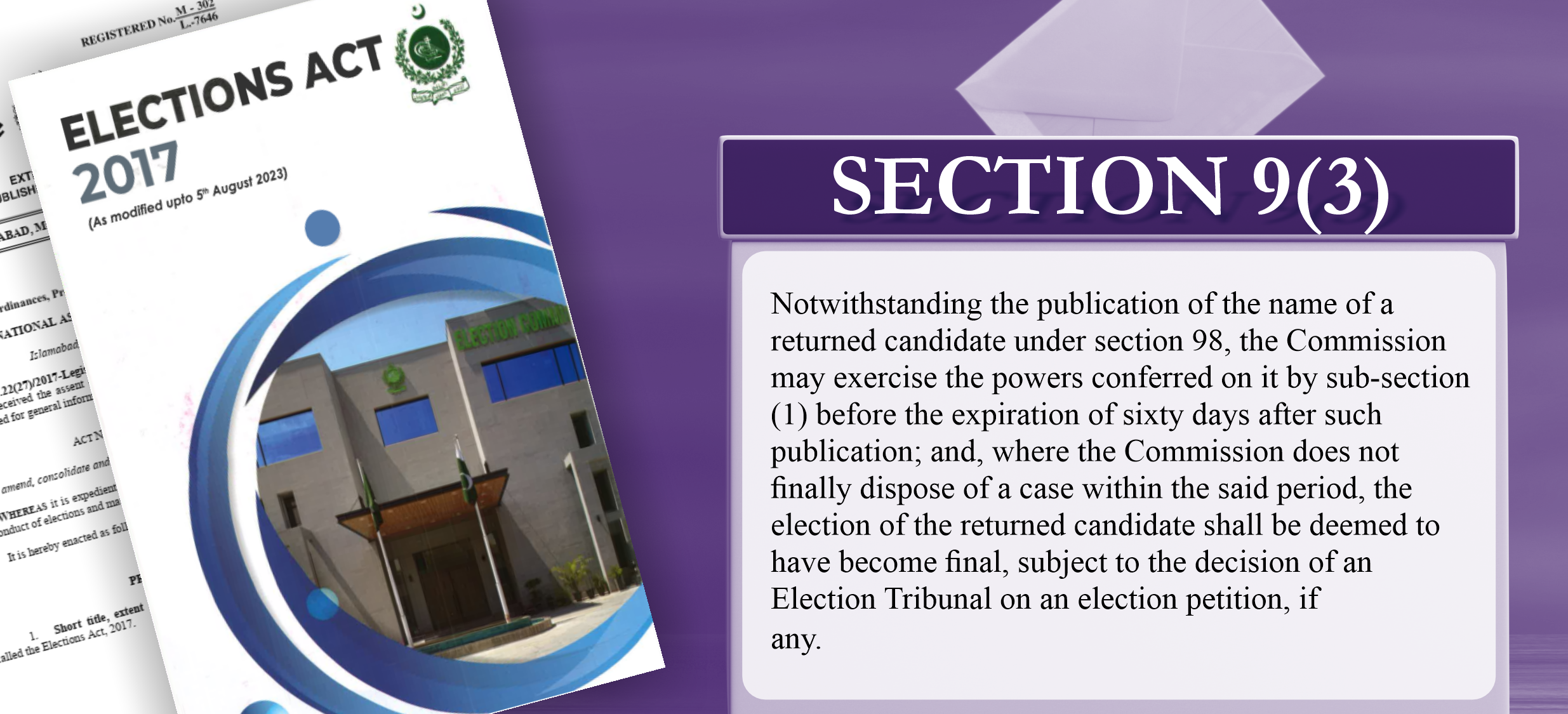
Section 9(3) of the Elections Act 2017 states that the Commission may exercise its power to declare a poll void up to 60 days after the name of a returned candidate is published in the official gazette under Section 98. This power applies where the Commission is satisfied — based on facts apparent from the record and after an inquiry — that grave illegalities or violations of the Act or Rules materially affected the result at one or more polling stations or in the entire constituency.
Among other grounds, the ECP is also authorized to declare a poll void in a constituency if women voters appear to have been restrained from voting through an agreement. Where women’s turnout remains below 10 percent of total votes polled in a constituency, the law prescribes the Commission to presume that such an agreement existed and void the poll accordingly.
Where the Commission exercises this power, Section 9(5) gives any aggrieved person 30 days to appeal the declaration to the Supreme Court.
Why does this matter?
This provision gives the ECP a meaningful post-election accountability mechanism that operates independently of the Election Tribunal process. It matters particularly in constituencies where irregularities are widespread but may not fit neatly into an election petition framework, and in constituencies where women have been systematically prevented from voting.
For citizens and election observers, the 60-day window is the period during which documented evidence of grave violations should be compiled and presented to the Commission. The law provides a mechanism. Whether it is used depends on whether evidence reaches the ECP within the statutory timeframe.
 Source: Elections Act 2017, Sections 9(1), 9(3), & 9(5).
This post is part of FAFEN’s series on electoral literacy. Read more of this series here