
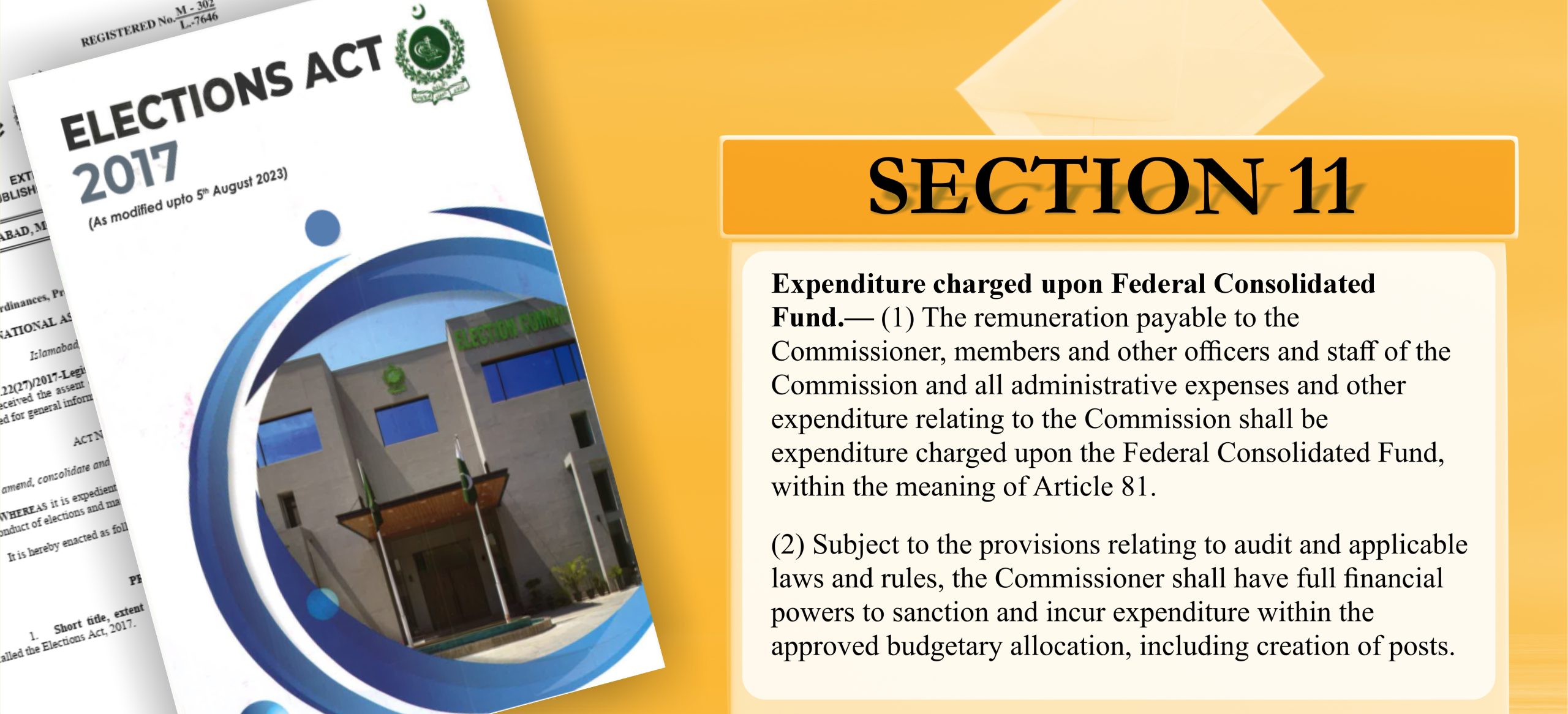
The ECP’s budget including salaries, administrative expenses and others is drawn directly from the national treasury and does not require annual approval by the National Assembly.
Government ministries operate on budgets that the National Assembly approves each year. The Election Commission of Pakistan (ECP) does not. Its financial independence is written into the Constitution and the Elections Act 2017 as a protection against political pressure.
What does the law say?
Section 11(1) of the Elections Act 2017 states that the remuneration payable to the Chief Election Commissioner, members of the Commission, and all its officers and staff, along with all administrative expenses and other expenditure relating to the Commission, shall be expenditure charged upon the Federal Consolidated Fund. This statutory provision originates from Article 81 of the Constitution, which provides the details of charged expenditure.
Expenditure charged on the Federal Consolidated Fund is disbursed without requiring a vote by the National Assembly each year. Article 81 of the Constitution lists categories of expenditure that are automatically available — they cannot be withheld, reduced, or made conditional by annual budget process. The ECP’s expenditure is in this protected category.
Section 11(2) adds that the Commissioner has full financial powers to sanction and incur expenditure within the approved budgetary allocation, including creating posts, subject to applicable audit and financial rules.
Why does this matter?
An election commission that depends on annual parliamentary approval for its funding can be pressured, starved of resources, or destabilized by the very political actors whose elections it is meant to oversee. The charged-fund arrangement severs that link. The ECP’s financial independence is a structural safeguard for the integrity of the electoral process itself.
It is also worth understanding what this provision does not do. It does not exempt the ECP from audit. It does not give the Commission unlimited funds. The Commissioner operates within an approved budgetary allocation, and ECP accounts are subject to audit in the same way as other public bodies. What the charged-fund status removes is political leverage over the Commission’s day-to-day resourcing.
 Source: Elections Act 2017, Section 11(1)–(2); Constitution of Pakistan, Article 81.
This post is part of FAFEN’s series on electoral literacy. Read more of this series here