Imposition of restrictions on political parties has been a recurring topic in Pakistan’s political discourse. You may have come across terms such as banning, proscribing, and dissolving a political party, especially during the Federal Government’s recent measures against Tehreek-e-Labbaik Pakistan (TLP).
While these terms are often used interchangeably in the media, they have distinct legal meanings. Banning is a general expression, whereas proscription and dissolution are specific legal processes governed by separate laws and carrying different consequences.
Before unpacking these processes, let’s first understand how political parties are formed and what restrictions may be imposed on them under the Constitution.
What does the Constitution say about political parties?
Under Article 17(2) of the Constitution, all citizens, except for those in the service of Pakistan, are free to form and join political parties. However, this freedom to form and join political parties is not absolute. Article 17(2) also provisions reasonable restrictions by the Federal Government “in the interest of the sovereignty or integrity of Pakistan.” It authorizes the Federal Government to declare officially if a political party is found to have posed such a threat. Such a declaration shall be referred to the Supreme Court for a final decision.
This constitutional provision has evolved over a period of time:
- The original Constitution, as enforced in 1973, made no mention of any restrictions on political parties, except accounting for their sources of funds.
- The First Constitutional Amendment in 1974 introduced the restriction related to sovereignty and integrity.
- The Legal Framework Order 2002 added further grounds for restrictions, including public order, promoting sectarian or ethnic hatred, or branding as a militant group or section.
- The Eighteenth Constitutional Amendment in 2010 reversed these additional LFO restrictions and restored the language as amended in 1974, although the government at the time claimed that they had restored the constitution in its original form in 1973.
Which law deals with the political parties?
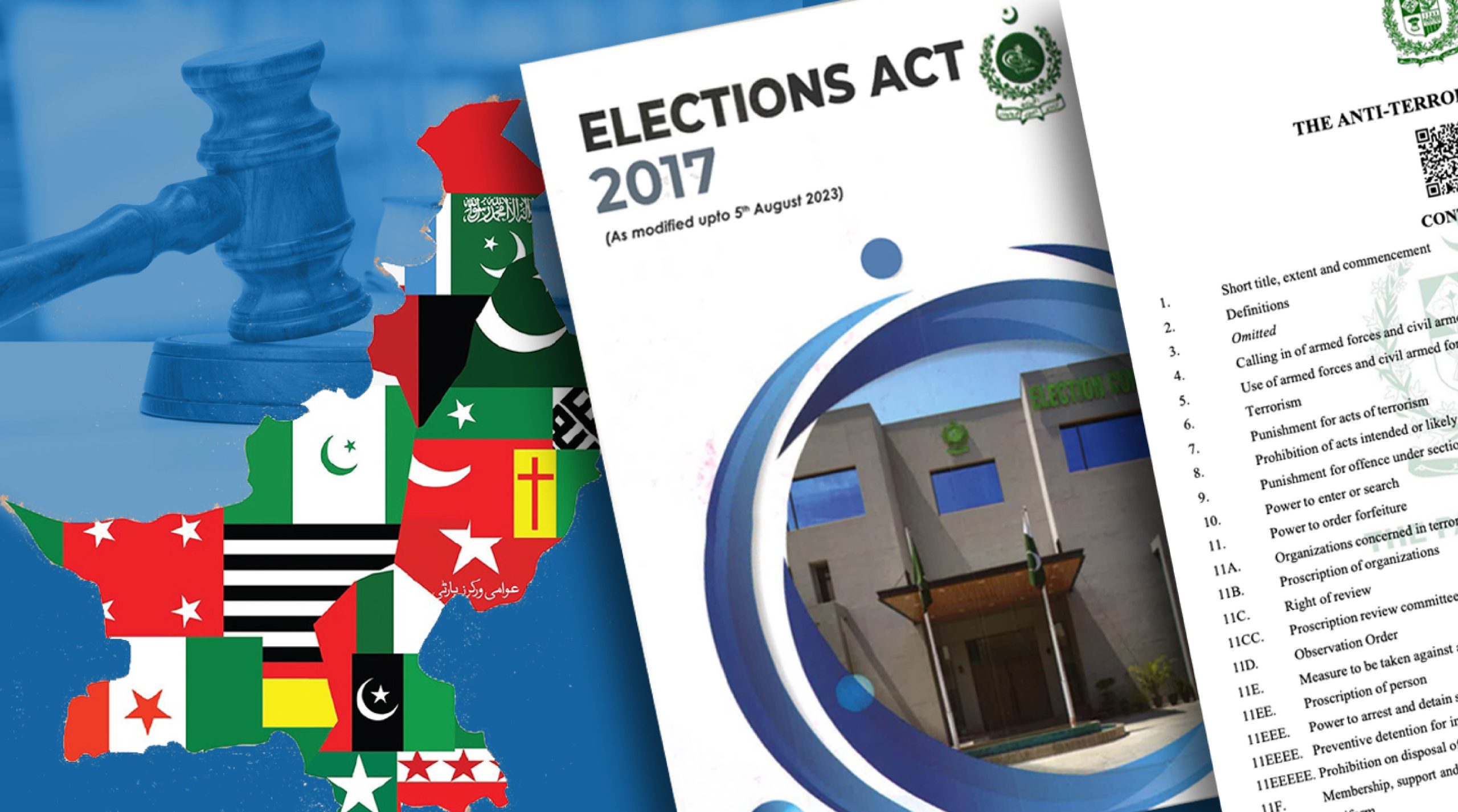
The primary law dealing with political parties today is the Elections Act, 2017, which covers their formation, enlistment with the Election Commission of Pakistan (ECP), internal elections, funding, and potential dissolution. The restrictions on political parties, as mentioned in the Constitution, have been operationalized through this act. Its predecessor laws were the Political Parties Order 2002 and the Political Parties Act 1962.
It is important to note that a political party does not need to register itself with any authority to exist. However, to contest elections, a political party must be enlisted with the ECP for the issuance of an election symbol to be used by its candidates for campaigning.
What is the process for the dissolution of a party?
Section 212 of the Elections Act, 2017 operationalizes the constitutional provision of Article 17(2) and specifies three grounds for initiating the process of dissolution of a political as below:
- The party is foreign-aided;
- The party has been formed or is operating in a manner prejudicial to the sovereignty or integrity of Pakistan; or
- The party is indulging in terrorism.
The Federal Government shall make a declaration in this regard about the political party through a notification in the official gazette. Such declaration shall be referred to the Supreme Court within 15 days. If the Supreme Court upholds the declaration, the party stands dissolved, and all its sitting MNAs, MPAs, Senators, and local government members are disqualified for the remainder of their terms. The ECP must then officially notify their disqualifications in the Gazette.
What is the process for proscribing an organization?
Since the Elections Act came into effect, no political party has been dissolved. Instead, various Federal Governments have relied on the Anti-Terrorism Act, 1997 (ATA) to restrict organizations, including political parties.
When an organization is proscribed under Section 11B of the ATA, its name is added to the First Schedule. Proscription can initially occur ex-parte, i.e., without giving the organization an opportunity to be heard. However
- The proscribed organization may seek a review within 30 days;
- The Federal Government must decide the review within 90 days; and
- If refused, the organization may appeal to the High Court.
Upon proscription, the government may seal offices, seize materials, and prohibit media coverage. It may also restrict the travel, passports, loans, and arms licenses of those associated with the proscribed entity.
The ATA also allows for de-proscription, empowering the Federal Government to remove an organization’s name from the list if the reasons for restriction no longer exist.
Why proscription shouldn’t lead to dissolution?
The Elections Act and the ATA operate in distinct but overlapping domains.
The ATA restricts an organization’s activities but does not dissolve its legal existence as a political entity. Its restrictions are reversible through administrative or judicial appeal.
In contrast, the Elections Act governs the existence and electoral rights of political parties. The proscription does not automatically trigger the dissolution of a party. But, it can serve as a ground for initiating the dissolution proceedings, since indulgence in terrorism is a basis for dissolution under the Elections Act, 2017.
However, invocation of Section 11B of the ATA to proscribe political parties clearly conflicts with Article 17(2) of the Constitution and 212 of the Elections Act 2017. The constitutional and Elections Act provisions require a mandatory judicial confirmation of any declaration made by the Federal Government through a notification in the official gazette that it has reasonable grounds to believe a political party is linked with terrorism. However, using provisions of ATA, the Federal Government evades reference of its declaration to the Supreme Court within 15 days for final adjudication, and therefore, the mandatory judicial confirmation for dissolution or otherwise.
This legal grey needs to be addressed by the Parliament as crucial to providing a fair trial to political parties, which has the potential of being misused by the Federal Government to curtail dissent.