Security in Pakistan’s ballot paper supply chain is a matter of statutory law. The Elections Act restricts printing to government-controlled facilities and mandates the use of watermarked stock.
Claims that ballot papers are forged, duplicated, or produced by private printers are among the most common forms of election disinformation in Pakistan. The Elections Act 2017 describes a security chain that, if followed, makes these claims technically difficult to sustain.
 What does the law say?
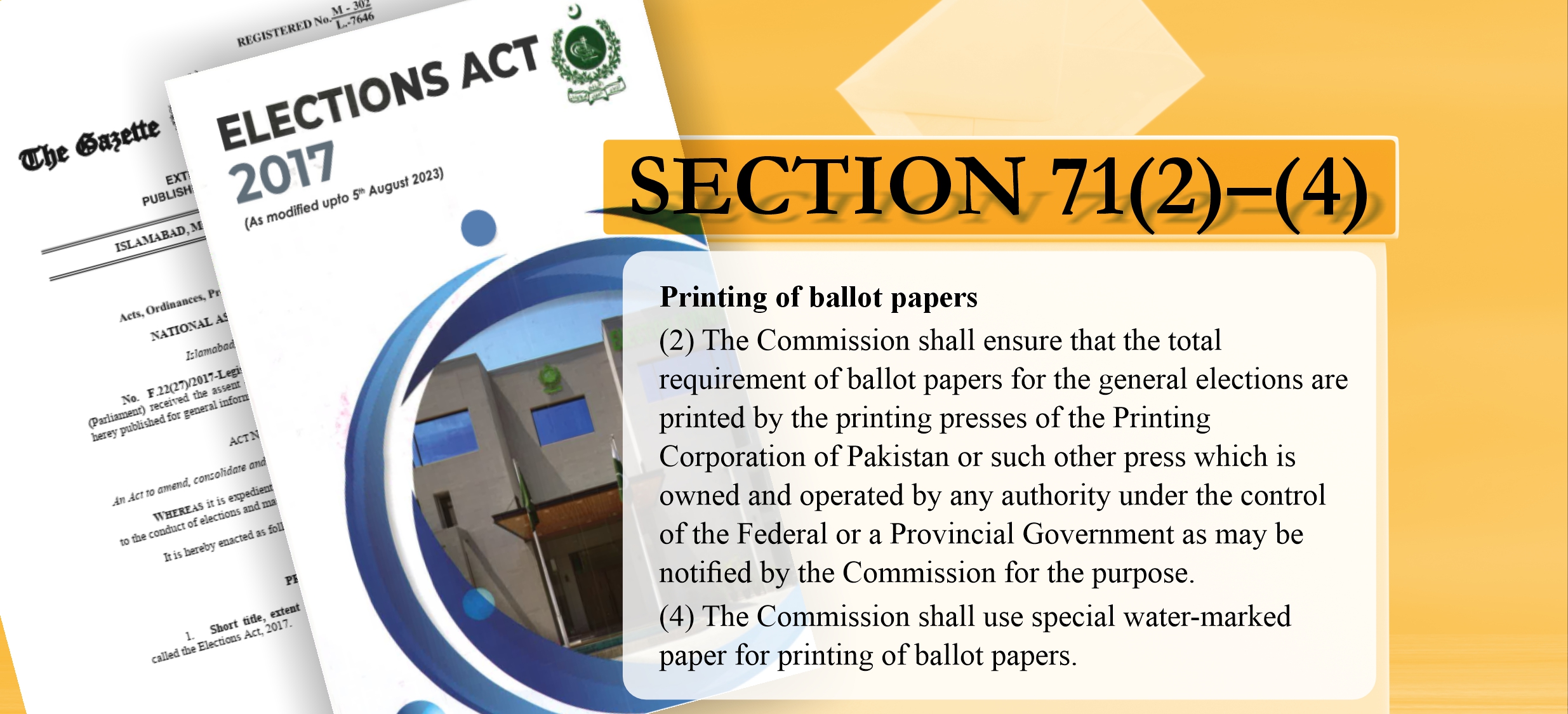
Section 71(2) of the Elections Act 2017 restricts ballot paper printing to the Printing Corporation of Pakistan or other printing presses owned and operated by a Federal or Provincial Government authority, as notified by the Election Commission of Pakistan (ECP). Private printing presses are categorically excluded. Section 71(3) requires the Commission to ensure that adequate security arrangements are in place during printing and for safe custody of printed papers until delivery to the Returning Officer. Section 71(4) mandates that special watermarked paper be used for all ballot papers.
Watermarking is a physical security feature that is difficult to replicate without access to the government’s specialised paper stock. It provides a baseline authentication mechanism that can detect forgeries produced on ordinary paper.
Why does this matter?
The three-tier security structure, i.e. restricted printing locations, custody arrangements, and watermarked paper, creates a documented chain of custody. Any ballot paper at a polling station should be traceable to a government press, printed on government watermarked stock, and delivered through the official Returning Officer supply chain.
When allegations of forged ballot papers arise, the first accountability questions are which press printed them, what happened to the watermarked stock, and what does the Ballot Paper Account show? If these questions cannot be answered, the failure is in accountability. If they can be answered, the evidence either supports or refutes the allegation.
 Source: Elections Act 2017, Sections 71(2)–(4).
This post is part of FAFEN’s series on electoral literacy. Read more of this series here.