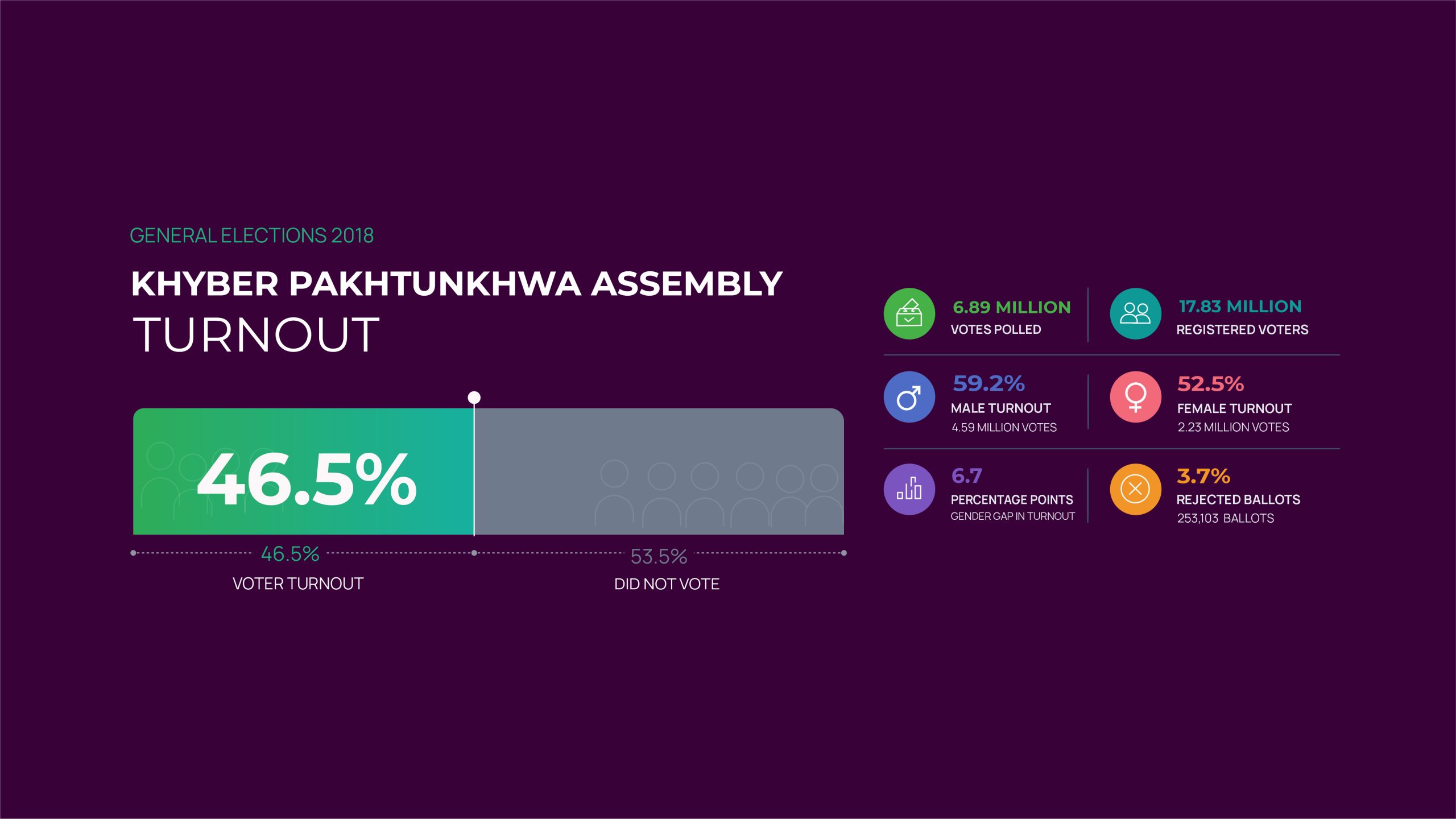
Khyber Pakhtunkhwa (KP) recorded 6.89 million votes polled for the Provincial Assembly in the General Elections, 2018, against 17.83 million registered voters, producing a turnout of 46.5%.
Khyber Pakhtunkhwa — known until 2010 as the North-West Frontier Province (NWFP) — is Pakistan’s third-most populous province and the province most directly affected by conflict and instability in the Afghanistan-Pakistan border region over several decades. Its electorate is predominantly Pashtun, though it encompasses Hindko-speaking communities in the Hazara division and other linguistic minorities. Following the Twenty-Fifth Constitutional Amendment of 2018, the Federally Administered Tribal Areas (FATA) were merged into KP, substantially expanding the province’s registered electorate. Registered voter and votes-polled figures from 2018 onwards therefore include former FATA constituencies.
KP’s registered electorate comprised 10.22 million male voters (57.3%) and 7.61 million female voters (42.7%). The gender gap in KP’s voter registration was 2.60 million — 14.6% of the province’s registered electorate. KP has historically had among the largest gender gaps in voter registration of any province in Pakistan, reflecting structural barriers to women’s civic participation in parts of the province.
Votes polled for the KP Assembly totalled 6.89 million against a registered electorate of 17.83 million, producing a turnout of 46.5%. KP’s turnout has consistently been lower than the national average, and lower than Punjab’s, across most election cycles. The province’s challenging geography — including mountainous terrain, limited transport infrastructure, and periods of security threat — has contributed to lower polling rates in some constituencies.
In the 2018 elections — for which gender-disaggregated polling data are available — male voters in KP cast 4.59 million votes at the KP Assembly level, recording a male turnout of 59.2%. Female voters cast 2.23 million votes, recording a female turnout of 52.5%. The gender turnout gap in KP was 6.7 percentage points.
Rejected ballots in the KP Assembly election numbered 253,103 — 3.7% of total votes polled. The rejection rate in KP has ranged between 1.4% (1970) and 3.7% (2018) across the twelve elections. KP’s rejection rates have generally been higher than Punjab’s and Sindh’s, which may reflect factors including lower average literacy in some constituencies and administrative complexities in polling management.
KP’s registered electorate grew from 3.1 million in 1970 to 21.9 million in 2024 — a sevenfold increase — with a significant portion of the growth after 2018 reflecting the merger of former FATA constituencies. Votes polled for the KP Assembly increased from 1.5 million in 1970 to 8.5 million in 2024. Across all twelve elections, KP’s highest recorded Assembly turnout was 47.8% in 1970 and its lowest was 24% in 1997.